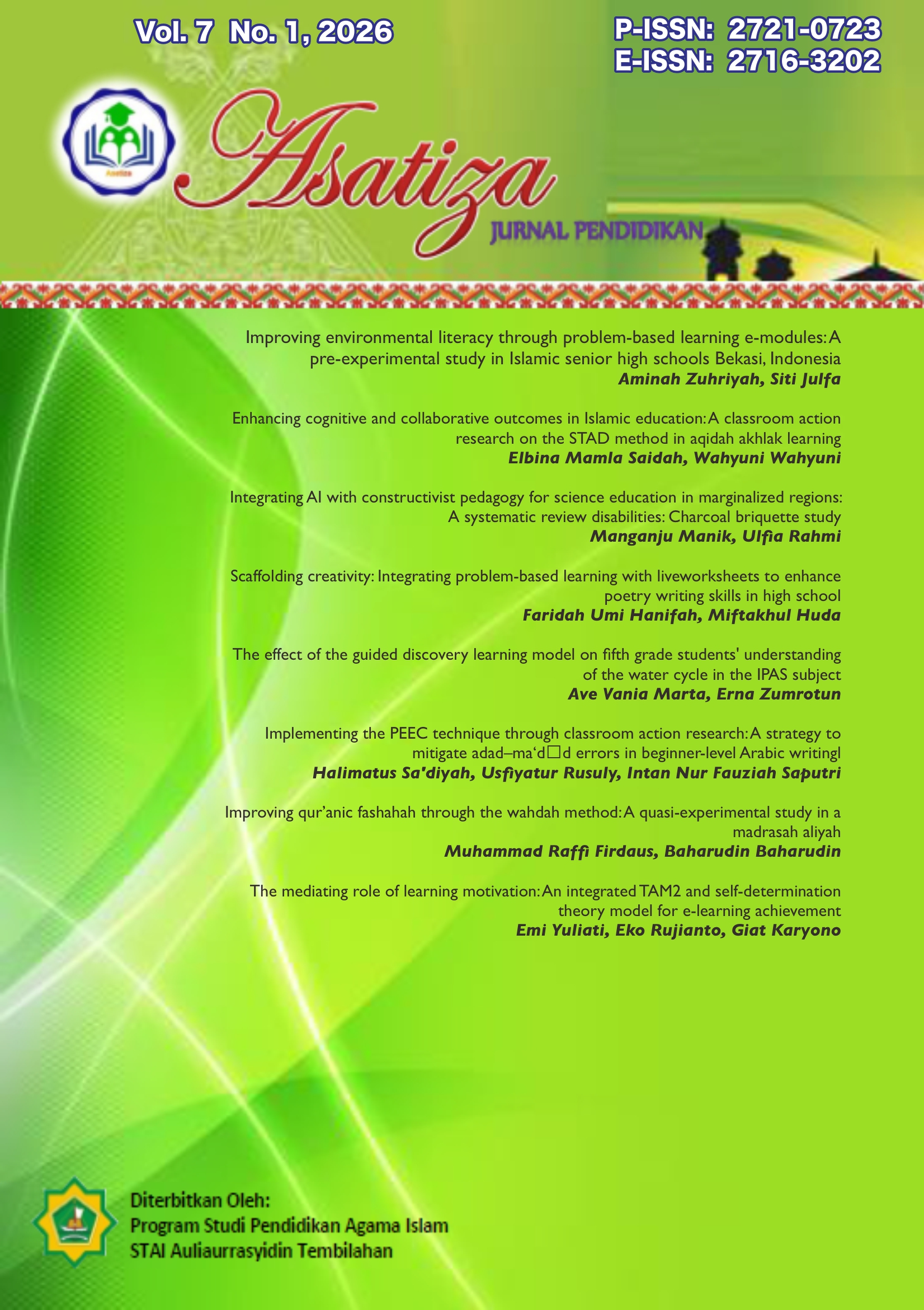
Integrating AI with constructivist pedagogy for science education in marginalized regions: A systematic review
DOI:
https://doi.org/10.46963/asatiza.v7i1.3287Keywords:
Science Education, Constructivism, Educational Technology, Artificial Intelligence, 21st-Century Competencies, 3T RegionsAbstract
Enhancing 21st-century competencies in frontier, remote, and disadvantaged (3T) regions remains challenging due to limited infrastructure, restricted digital access, and the need for culturally relevant science learning. This study employs a systematic literature review of selected peer-reviewed studies published between 2011 and 2025 to examine how constructivist-based science learning integrated with digital technology and artificial intelligence (AI) can support equitable education in low-resource contexts. The findings indicate that effective technology-enhanced learning in 3T regions is pedagogy-driven rather than technology-driven, grounded in the integration of constructivism, progressivism, and social reconstructionism. AI, learning management systems, and interactive digital media can support personalized learning, formative assessment, and the development of scientific literacy, numeracy, and digital literacy when embedded within adaptive instructional frameworks. However, the literature also reveals significant feasibility constraints related to digital access, teacher readiness, and ethical considerations. Therefore, context-aware, low-bandwidth, and teacher-mediated digital solutions are essential to ensure equitable and sustainable science learning in 3T regions.
Downloads
References
Amsal Alhayat, M., Dewi, M. R., & Putri, S. I. (2023). Values of constructivism in science learning: A case study. Paedagogia: Jurnal Pendidikan, 22(3), 45–55. https://jurnal.uns.ac.id/paedagogia/article/view/75712
Badan Pusat Statistik. (2023a). Indeks Pembangunan Manusia 2023. https://www.bps.go.id/id/statistics-table/1/NTAxIzE=/indeks-pembangunan-manusia--ipm-.html
Badan Pusat Statistik. (2023b). Proporsi sekolah dengan akses komputer. https://www.bps.go.id/id/statistics-table/2/MTc5NiMy/proporsi-sekolah-dengan-akses-komputer.html
Bandura, A. (1986). Social foundations of thought and action: A social cognitive theory. Prentice-Hall.
Branch, R. M. (2009). Instructional design: The ADDIE approach. Springer.
Counts, G. S. (1934). Dare the school build a new social order? John Day Company.
Dewantara, K. H. (1936). Pendidikan. Taman Siswa.
Dewey, J. (1916). Democracy and education. Macmillan.
Dewey, J. (1938). Experience and education. Macmillan.
Falah, A. I., & Hadna, A. H. (2022). Problematika Pendidikan Masa Pandemi di Indonesia pada Daerah 3 T. Jurnal Pendidikan dan Kebudayaan, 7(2), 164–185. https://doi.org/10.24832/jpnk.v7i2.2997
Farhatin, F. (2025). Kesenjangan akses pendidikan digital di daerah 3T (tertinggal, terdepan, dan terluar). Maliki Interdisciplinary Journal, 3(6), 1494–1502. https://urj.uin-malang.ac.id/index.php/mij/article/view/16179
Fismariza, W., & Ofianto, O. (2025). Teknologi sebagai solusi untuk meningkatkan akses pendidikan di daerah terpencil. TSAQOFAH, 5(4), 3604–3617. https://doi.org/10.58578/tsaqofah.v5i4.6408
Freire, P. (1970). Pedagogy of the oppressed. Continuum.
Gagné, R. M. (1985). The conditions of learning and theory of instruction (4th ed.). Holt, Rinehart & Winston.
Kemendikbud. (2020a). Merdeka Belajar: Transformasi pendidikan di Indonesia. Kementerian Pendidikan dan Kebudayaan Republik Indonesia.
Kemendikbud. (2020b). Panduan Merdeka Belajar: Memperkuat Profil Pelajar Pancasila dan Literasi Digital. Jakarta: Kementerian Pendidikan dan Kebudayaan.
Kemendikbudristek. (2022). Peraturan Menteri Pendidikan, Kebudayaan, Riset, dan Teknologi Republik Indonesia Nomor 5 Tahun 2022 tentang Standar Nasional Pendidikan. https://jdih.kemdikbud.go.id/detail_peraturan?box=1&id=2092
OECD. (2021a). Education at a glance 2021: OECD indicators. OECD Publishing. https://doi.org/10.1787/eag-2021-en
OECD. (2021b). PISA 2018 results (volume I): What students know and can do. OECD Publishing. https://www.oecd.org/pisa/publications/pisa-2018-results-volume-i.htm
Piaget, J. (1985). The equilibration of cognitive structures. Harvard University Press.
Raharjo, R. S. (2025). Artificial intelligence in Indonesian education: A critical review of ethics and practical challenges. At-Tarbawi: Jurnal Pendidikan Islam, 10(1), 50–62. https://ejournal.uinsaid.ac.id/at-tarbawi/article/view/12141
Redecker, C. (2017). European framework for the digital competence of educators: DigCompEdu. Publications Office of the European Union. https://doi.org/10.2760/159770
Thamrin, P. A. (2024). Digital transformation in education: Efforts to achieve equitable digitization in Indonesia. Jurnal Iman dan Manajemen (JIEMAN), 4(2), 87–99. https://jieman.uinkhas.ac.id/index.php/jieman/article/download/259/141/1441
VanLehn, K. (2011). The relative effectiveness of human tutoring, intelligent tutoring systems, and other tutoring systems. Educational Psychologist, 46(4), 197–221. https://doi.org/10.1080/00461520.2011.611369
Vygotsky, L. S. (1978). Mind in society: The development of higher psychological processes. Harvard University Press.
Zawacki-Richter, O., Marín, V. I., Bond, M., & Gouverneur, F. (2019). Systematic review of research on artificial intelligence applications in higher education: Where are the educators? International Journal of Educational Technology in Higher Education, 16, Article 39. https://doi.org/10.1186/s41239-019-0171-0
Downloads
Published
Issue
Section
License
Copyright (c) 2026 Manganju Manik, Ulfia Rahmi

This work is licensed under a Creative Commons Attribution-ShareAlike 4.0 International License.
Authors who publish with this journal agree to the following terms:
1. Copyright on any article is retained by the author(s).
2. The author grants the journal, right of first publication with the work simultaneously licensed under a Creative Commons Attribution shareAlike 4.0 International License that allows others to share the work with an acknowledgment of the work’s authorship and initial publication in this journal.
3. Authors are able to enter into separate, additional contractual arrangements for the non-exclusive distribution of the journal’s published version of the work (e.g., post it to an institutional repository or publish it in a book), with an acknowledgment of its initial publication in this journal.
4. Authors are permitted and encouraged to post their work online (e.g., in institutional repositories or on their website) prior to and during the submission process, as it can lead to productive exchanges, as well as earlier and greater citation of published work.
5. The article and any associated published material is distributed under the Creative Commons Attribution-ShareAlike 4.0 International License




2.png)