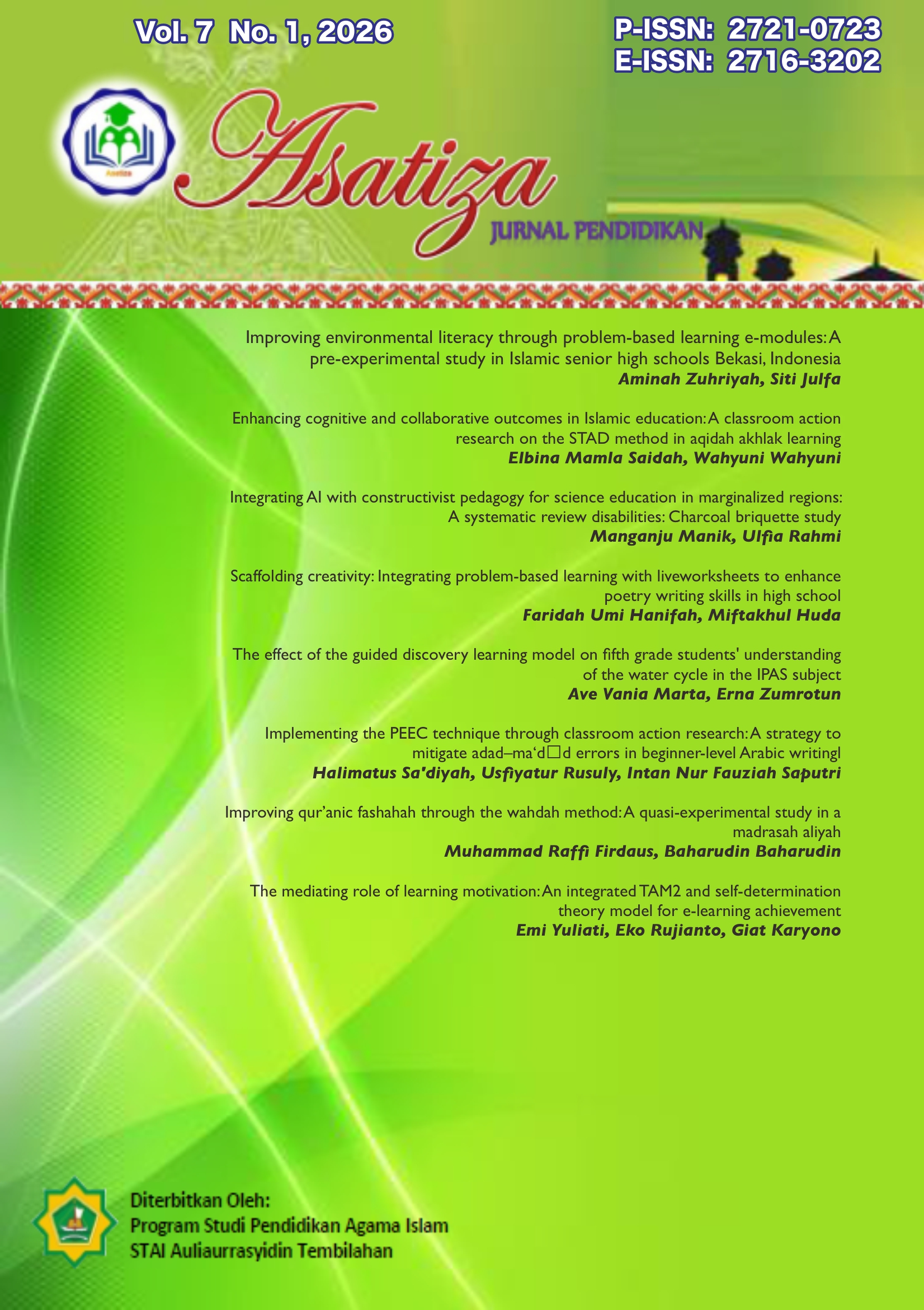
Implementing the PEEC technique through classroom action research: A strategy to mitigate adad–ma‘dud errors in beginner-level Arabic writing
DOI:
https://doi.org/10.46963/asatiza.v7i1.3390Keywords:
Arabic language, Error correction, Peer editing, Writing skills , Adad-Ma'dudAbstract
Mastering writing skills is a fundamental yet challenging aspect of beginner-level Arabic language acquisition, particularly in applying complex grammatical constructs such as adad–ma‘dūd (numeral-noun agreement). Conventional teacher-centered correction methods often fail to facilitate the deep processing required for rule internalization. This classroom action research (CAR) proposes the PEEC (Peer Editing and Error Correction) technique, a novel collaborative strategy integrating peer discussion with immediate corrective feedback to address this pedagogical gap. Conducted over two cycles with 36 first-year students in an intensive Arabic program at a state Islamic university in Malang, the study employed observation, writing tests, and document analysis of student drafts. Results demonstrated significant improvement in writing accuracy. The number of students achieving the mastery criterion rose from 12 (33.33%; average score: 61) in the pre-cycle, to 23 (63.89%; average: 73) in cycle I, and to 32 (88.89%; average: 84) in cycle II. This represents a 55.56% increase in completion rate and a 23-point average score gain, with marked enhancement in adad–ma‘dūd application. The findings confirm PEEC as an effective intervention for developing beginner Arabic writing proficiency, warranting further exploration in diverse instructional contexts.
Downloads
References
Aben, J. E. J., Timmermans, A. C., Dingyloudi, F., Lara, M. M., & Strijbos, J. W. (2022). What influences students’ peer-feedback uptake? Relations between error tolerance, feedback tolerance, writing self-efficacy, perceived language skills and peer-feedback processing. Learning and Individual Differences, 97, 102175. https://doi.org/10.1016/j.lindif.2022.102175
Al Khateeb, A., & Hassan, M. (2022). Peer feedback among learners of English and Arabic as a foreign language in a telecollaborative language learning program. JALT CALL Journal, 18(2), 164–184. https://doi.org/10.29140/jaltcall.v18n2.479
Al-Hamzi, A. M. S., Nababan, M., Santosa, R., & Yustanto, H. (2023). Frequent linguistic errors in the writing of Yemeni EFL Arabic-speaking learners. Studies in English Language and Education, 10(1), 350–368. https://doi.org/10.24815/siele.v10i1.26022
Albaqami, S. E. (2024). The impact of technology-based and non-technology-based vocabulary learning activities on the pushed output vocabulary learning of Saudi EFL learners. Frontiers in Education, 9. https://doi.org/10.3389/feduc.2024.1392383
Almelhes, S. (2024). Enhancing Arabic language acquisition: Effective strategies for addressing non-native learners’ challenges. Education Sciences, 14(10), 1116. https://doi.org/10.3390/educsci14101116
Azaza, M. (2020). Peer feedback in writing: Opportunities for collaboration and potential pitfalls. International Journal of Assessment and Evaluation, 27(2), 1–13. https://doi.org/10.18848/2327-7920/CGP/v27i02/1-13
Bourahouat, G., Abourezq, M., & Najima, D. (2024). Word embedding as a semantic feature extraction technique in Arabic natural language processing: An overview. The International Arab Journal of Information Technology, 21. https://doi.org/10.34028/iajit/21/2/13
Campbell, C. W., & Brandon, M. W. (2024). Peer editing and writing proficiency: An experimental study in South Korean higher education. Innovation in Language Learning and Teaching. https://doi.org/10.1080/17501229.2024.2399701
Cao, Z. (2021). Improving young learners’ L2 writing accuracy with written corrective feedback: A case study. English Teaching and Learning, 45(4), 375–396. https://doi.org/10.1007/s42321-020-00071-1
Chen, W., Hu, H., Lyu, Q., & Zheng, L. (2024). Using peer feedback to improve critical thinking in computer-supported collaborative argumentation: An exploratory study. Journal of Computer Assisted Learning, 40(6), 3390–3405. https://doi.org/10.1111/jcal.13078
Demir, C. (2021). Determining efficient post-writing activity for error correction: Self-editing, peer review, or teacher feedback? Porta Linguarum, 2021(36), 101–117. https://doi.org/10.30827/PORTALIN.V0I36.15824
Guellil, I., Saâdane, H., Azouaou, F., Gueni, B., & Nouvel, D. (2021). Arabic natural language processing: An overview. Journal of King Saud University - Computer and Information Sciences, 33(5), 497–507. https://doi.org/10.1016/j.jksuci.2019.02.006
Harthy, S. R. A., Darwish, A. S., Yacoub, M. A., & Alnwairan, M. A. (2024). Written corrective feedback and EFL students’ use of prepositions, articles, punctuation and capitalization. International Journal of Arabic-English Studies, 24(2), 415–436. https://doi.org/10.33806/ijaes.v24i2.526
Ilyas, I., Rasmi, M., & Rusydi, M. (2024). Improving modern pondok students' Arabic language skills in Indonesia: Language institutions as language improvement central. Al-Ishlah: Jurnal Pendidikan, 16(2), 1303-1313. https://doi.org/10.35445/alishlah.v16i2.5095
Irgin, P., & Bilki, Z. (2024). Students’ perceptions of online peer feedback in process-oriented L2 writing: A qualitative inquiry. Studies in Educational Evaluation, 83. https://doi.org/10.1016/j.stueduc.2024.101403
Ismail, A. N., Jabar, M. A. A., Mohamad, A. H. B., & Hassan, A. R. B. (2020). Common grammatical mistakes in the noun in electronic text “a statistic grammatical study.” Journal of Advanced Research in Dynamical and Control Systems, 12(7 Special Issue), 29–34. https://doi.org/10.5373/JARDCS/V12SP7/20202079
Kunlasomboon, N., Wongwanich, S., & Suwanmonkha, S. (2015). Research and development of classroom action research process to enhance school learning. Procedia - Social and Behavioral Sciences, 171, 1315–1324. https://doi.org/10.1016/j.sbspro.2015.01.248
Mertler, C. A. (2024). Action Research: Improving Schools and Empowering Educators. SAGE Publications.
Oğuz, İ., & Atik, A. D. (2024). Investigation of the effect of lesson study on developing the teaching skills of science teacher. Milli Egitim, 53(243), 1387–1414. https://doi.org/10.37669/milliegitim.1243903
Rasool, U., Mahmood, R., Aslam, M. Z., Barzani, S. H. H., & Qian, J. (2023). Perceptions and preferences of senior high school students about written corrective feedback in Pakistan. SAGE Open, 13(3). https://doi.org/10.1177/21582440231187612
Rudnicka, K., & Klégr, A. (2024). Non-verbal plural number agreement in the cross-linguistic context: Combining corpus findings with two kinds of acceptability rating results for English, German, Polish, and Czech. NJES Nordic Journal of English Studies, 23(2), 92–119. https://doi.org/10.35360/njes.v23i2.39166
Ruegg, R., Sudo, T., Takeuchi, H., & Sato, Y. (2017). Peer tutoring: Active and collaborative learning in practice. Studies in Self-Access Learning Journal, 255–267. https://doi.org/10.37237/080306
Sa`diyah, H., & Wiranegara, D. A. (2023). Pancasila values in the book of Al-`Arabiyah Lil Hayah as Arabic learning materials. Jurnal Pendidikan (Teori Dan Praktik), 8(2), 86–94. https://doi.org/10.26740/jp.v8n2.p86-94
Salmas, A. N. H., Bahruddin, U., & Syuhadak, S. (2024). Exploring language proficiency: dynamics of acquiring arabic speaking skills from Stephen Krashen's perspective at Islamic universities. Al-Ishlah: Jurnal Pendidikan, 16(3), 4012-4023. https://doi.org/10.35445/alishlah.v16i3.5100
Sheerah, H. A. H., & Yadav, M. S. (2022). Autonomous learning as a pedagogical tool: exploring the perceptions of teaching and learning practices at writing hub. Rupkatha Journal on Interdisciplinary Studies in Humanities, 14(4). https://doi.org/10.21659/rupkatha.v14n4.21
Shulgina, G., Costley, J., Shcheglova, I., Zhang, H., & Sedova, N. (2024). Online peer editing: The influence of comments, tracked changes and perception of participation on students’ writing performance. Smart Learning Environments, 11(1). https://doi.org/10.1186/s40561-024-00315-8
Silawati, L., Arsyad, S., & Yulistio, D. (2020). The correlation between knowledge of sentence structure, reading habits, and reasoning ability with essay writing skills. International Journal of Innovation, Creativity and Change, 13(5), 483–497. https://doi.org/10.25134/ieflj.v8i1.5588
Soh, S. B. (2024). A critical participatory (Action Research) adaptation in the teaching English as a second language practicum: Developing individual and collective reflective practices towards equitable practices. Educational Action Research. https://doi.org/10.1080/09650792.2024.2439980
Vivek, R. (2023). A comprehensive review of environmental triangulation in qualitative research: Methodologies, applications, and implications. Journal of European Economy, 22(4), 517–532. https://doi.org/10.35774/jee2023.04.517
Wahyudi, M., & Hidayat, A. R. (2021). Strategi cooperative learning tipe student teams achievement division (STAD) pada mata pelajaran bahasa Arab. Asatiza: Jurnal Pendidikan, 2(3), 197–205. https://doi.org/10.46963/asatiza.v2i3.340
Weng, F., Zhao, C. G., & Chen, S. (2024). Effects of peer feedback in English writing classes on EFL students’ writing feedback literacy. Assessing Writing, 61. https://doi.org/10.1016/j.asw.2024.100874
Wu, Y., & Schunn, C. D. (2021). The effects of providing and receiving peer feedback on writing performance and learning of secondary school students. American Educational Research Journal, 58(3), 492–526. https://doi.org/10.3102/0002831220945266
Zaki, M. (2021). Self‐correction through corpus‐based tasks: Improving writing skills of Arabic learners. International Journal of Applied Linguistics, 31(2), 193-210. https://doi.org/10.1111/ijal.12312
Zhang, X., & McEneaney, J. E. (2020). What is the influence of peer feedback and author response on Chinese university students’ English writing performance? Reading Research Quarterly, 55(1), 123–146. https://doi.org/10.1002/rrq.259
Downloads
Published
Issue
Section
License
Copyright (c) 2026 Halimatus Sa'diyah, Usfiyatur Rusuly, Intan Nur Fauziah Saputri

This work is licensed under a Creative Commons Attribution-ShareAlike 4.0 International License.
Authors who publish with this journal agree to the following terms:
1. Copyright on any article is retained by the author(s).
2. The author grants the journal, right of first publication with the work simultaneously licensed under a Creative Commons Attribution shareAlike 4.0 International License that allows others to share the work with an acknowledgment of the work’s authorship and initial publication in this journal.
3. Authors are able to enter into separate, additional contractual arrangements for the non-exclusive distribution of the journal’s published version of the work (e.g., post it to an institutional repository or publish it in a book), with an acknowledgment of its initial publication in this journal.
4. Authors are permitted and encouraged to post their work online (e.g., in institutional repositories or on their website) prior to and during the submission process, as it can lead to productive exchanges, as well as earlier and greater citation of published work.
5. The article and any associated published material is distributed under the Creative Commons Attribution-ShareAlike 4.0 International License




2.png)