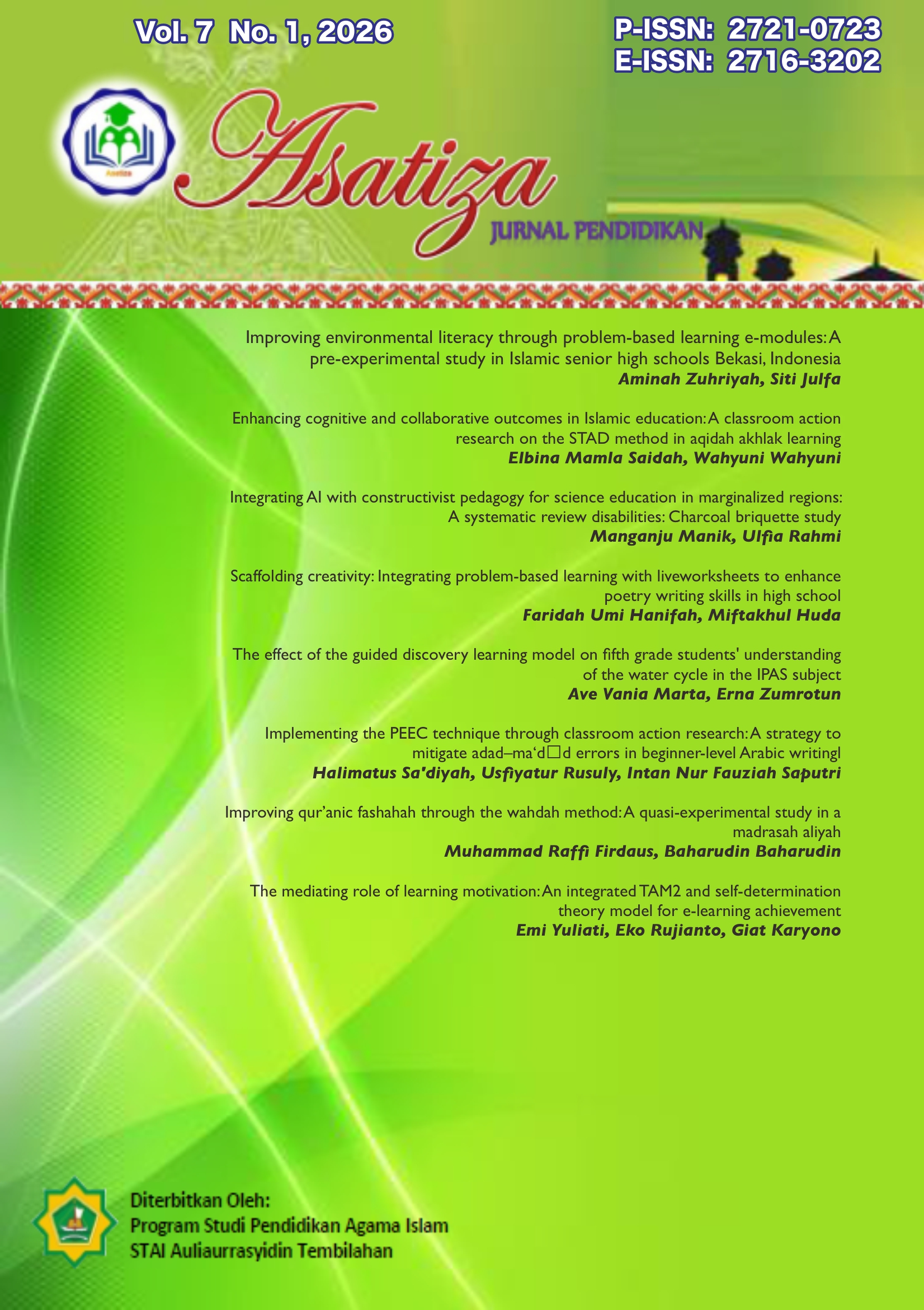
Improving qur’anic fashahah through the wahdah method: A quasi-experimental study in a madrasah aliyah
DOI:
https://doi.org/10.46963/asatiza.v7i1.3401Keywords:
Fashahah, Qur’an-Hadith Learning, Qur’anic Memorization, Wahdah MethodAbstract
While the Wahdah method is widely recognized for increasing the quantity of Qur’anic memorization, its specific effectiveness in improving recitation quality particularly faṣḥahah, encompassing fluency, articulatory accuracy, and proper application of tajwīd rules within formal madrasah settings remains underexplored. Qur’an Hadith instruction at the Madrasah Aliyah level commonly relies on conventional memorization-based practices that insufficiently address these qualitative aspects of recitation. This study aimed to examine the effectiveness of the Wahdah method in enhancing students’ faṣḥahah ability in a formal Madrasah Aliyah context. Using a quasi-experimental posttest-only control group design, the research was conducted at MAN 1 Bandar Lampung and involved two Grade XI classes selected through cluster sampling, assigned as experimental and control groups. Students’ faṣḥahah ability was assessed using a validated performance-based recitation instrument measuring fluency, articulatory precision (makhārij al-ḥurūf accuracy), and correct application of tajwīd rules. Data were analyzed using an Independent Samples t-test after confirming variance homogeneity. The results indicated a statistically significant difference between groups, with the experimental group achieving higher mean faṣḥahah scores than the control group (t (57) = 2.076, p = 0.042). Classroom observations supported these findings, revealing fewer articulation errors and more consistent tajwīd application among students exposed to intensive verse by verse repetition. The study concludes that the Wahdah method is a pedagogically effective approach, offering madrasah teachers a structured and practice-oriented technique to systematically improve students’ faṣḥahah by integrating memorization with sustained recitational accuracy.
Downloads
References
Abdelfttah, A., Khalil, M. I., & Abbas, H. (2025). Automatic pronunciation error detection and correction of the holy quran’ s learners using deep learning. IEEE International Conference on Intelligent Computing and Systems. https://doi.org/10.48550/arXiv.2509.00094
Al-Jarrah, M. A., Al-Jarrah, A., Jarrah, A., AlShurbaji, M., Magableh, S. K., Al-Tamimi, A.-K., Bzoor, N., & Al-Shamali, M. O. (2022). Accurate reader identification for the arabic holy quran recitations based on an enhanced vq algorithm. International Information and Engineering Technology Association, 36(6), 815–823. https://doi.org/10.18280/ria.360601
Ansarian, N. (2021). Majaz in the qur’an and its conditions with emphasis on the viewpoint of allameh tabatabaei keywords. Jurnal: Quarterly Journal of Studies of Qur’anic Sciences (JQSS), 2(6), 162–181. https://doi.org/10.22081/jqss.2021.60090.1102
Anwar, F., Taqiyuddin, M. F., Wijaya, K., Azmi, M. C. Y., & Izharman, I. (2022). Implementation of talaqqi, sima’i, wahdah, talqin and kitabah methods in memorizing the qur’an: How do teachers guide students. Khalifa: Journal of Islamic Education, 6(2), 152. https://doi.org/10.24036/kjie.v6i2.151
Ar, H., Abdullah, D., & Alqahtani, M. S. (2024). Constructing qur’an recitation classification using alexnet algorithm. Knowledge Engineering and Data Science, 7(2), 152–163. https://doi.org/10.17977/um018v7i22024p152-163
Do’a, L. F., & Purwidianto. (2023). Teacher in quran discourse: Formation of quranic mind at SMA 33 Negeri Jakarta. Jurnal Pendidikan Islam, 14(2), 60–65. https://doi.org/10.22236/jpi.v14i02.13333
El-sharawy, E. E., & Fathy, D. R. (2025). A comprehensive review of AI applications in quran recitation and tajweed learning. International Journal of Theoretical and Applied Research (IJTAR), 4(2), 000–000. https://doi.org/10.21608/IJTAR.2025.414755.1141
Engkizar, Sarianti, Y., Namira, S., Budiman, S., Susanti, H., & Albizar. (2022). Five methods of quran memorization in tahfidz house of fastabiqul khairat Indonesia. International Journal of Islamic Studies Higher Education, 1(1), 54–67. https://doi.org/10.24036/insight.v1i1.27
Fajrin, D. F., Syafe’i, I., Azizah, N., Hasanah, U., & Rahmatika, Z. (2025). The talaqqi method: its effectiveness on students’ ability to memorize the qur’an. Journal of Innovation and Research in Primary Education, 4(3), 410–419. https://doi.org/10.56916/jirpe.v4i3.1443
Fajriyani, V. K., & Murniyetti, M. (2022). Penggunaan metode wahdah dalam pembelajaran tahfidzul quran. An-Nuha: Jurnal Pendidikan Islam, 2(3), 564–571. https://doi.org/10.24036/annuha.v2i3.233
Farida, N. R. N., Ma`arif, M. A., & Kartiko, A. (2021). Implementation of the wahdah method in improving students’ ability to memorize the qur’an. Nazhruna: Jurnal Pendidikan Islam, 4(3), 518–530. https://doi.org/10.31538/nzh.v4i3.1084
Gade, S. (2024). Make a match type cooperative model: An effort to improve student learning outcomes in qur’an hadith learning. Madina: Journal of Islamic Studies, 1(1), 63–68. https://doi.org/10.62945/madina.v1i1.162
Hartati, S. (2024). Implementation of drill method to improve student learning outcomes in islamic education learning at SMA Negeri 1 Pancung Soal. Madina: Journal of Islamic Studies, 1(2), 78–85. https://doi.org/10.62945/madina.v1i2.287
Haryono, K., & Rajagede, R. A. (2022). Quran memorization technologies and methods: Literature review. IJID (International Journal on Informatics for Development), 11(1), 192–201. https://doi.org/10.14421/ijid.2022.3746
Hermawan, Z., & Asnawi, M. (2023). The role of teachers in improving the quality of reading the qur ’ an for early class santri. Educazione: Journal of Education and Learning, 01(01), 1–12. https://doi.org/10.61987/educazione.v1i1.493
Hinayah, S. N. (2024). The Application of tajweed science in the qur’an learning process at TPQ ponpes Sa’adatul Ikhwan NW rensing. Journal of Scientific Studies and Multidiciplinary Research, 1(2), 71–77. https://www.journal.formadenglishfoundation.org/index.php/JSSMR/article/view/45
Kakoh, N. A., & Helminswita, K. (2024). Sustainable Development : Memorizing the Quran Using the Takrir Method. International Journal of Islamic Teaching and Learning, 1(1), 30–36. https://doi.org/10.69637/ijiting.v1i1.22
Khafidah, W., Wildanizar, W., ZA, T., Nurhayati, N., & Raden, Z. (2020). The application of wahdah method in memorizing the qur’an for students of SMPN 1 Unggul Sukamakmur. International Journal of Islamic Educational Psychology (IJIEP), 1(1), 37–49. https://doi.org/10.18196/ijiep.1104
Latipah, E. (2022). Motives , self-regulation , and spiritual experiences of hafizh (The qur’an memorizer) in Indonesia. International Journal of Instruction, 15(1), 653–672. https://doi.org/10.29333/iji.2022.15137a
Loh Sandi, A. W., & Febrianto, A. (2020). Penerapan metode wahdah sebagai upaya meningkatkan tahfidzul quran siswa. Ta’dibuna: Jurnal Pendidikan Agama Islam, 3(2), 37–42. https://doi.org/10.30659/jpai.3.2.37-42
Manullang, S. O., Krisnadwipayana, U., & Krisnadwipayana, U. (2021). The effectiveness of al-quran memorization methods for millennials santri during covid-19 in Indonesia. Nazhruna: Jurnal Pendidikan Islam, 4(2), 195–207. https://doi.org/10.31538/nzh.v4i2.1334
Manurung, P., Saragih, A. H., & Hasibuan, P. (2024). A study of the philosophy of education and analysis of the principles of implementing education according to the al-qur’an. Pharos Journal of Theology, 105(2), 1–13. https://doi.org/10.46222/pharosjot.105.28
Mohammad, K. A., Kandil, A. H., El-bialy, A. M., & Fawzi, S. A. (2025). Detection of the tajweed rules in the qur’anic recitations. Indonesian Journal of Electrical Engineering and Computer Science, 39(2), 914–926. https://doi.org/10.11591/ijeecs.v39.i2.pp914-926
Muslim, F. R., Tumiran, M. A., & Abidin, M. Z. H. Z. (2024). Techniques for Memorizing the quran: A comparative study of the memory system tendencies of maahad integrasi tahfiz Selangor ( MITS ) students. UMRAN - International Journal of Islamic and Civilizational Studies, 2(2), 38–47. https://doi.org/10.11113/umran2024.11n2.647
Mustadamah. (2024). Increasing learning achievement in memorizing surah. Madina: Journal of Islamic Studies, 1(1), 8–13. https://doi.org/10.62945/madina.v1i1.150
Muthohharoh, N. M., Rusydiyah, E. F., A’la, B. A., & Khoiriyah, N. (2023). Memorizing the qur’an: The science behind children’s remarkable ability. State Islamic University Sunan Ampel Surabaya, Surabaya, Indonesia, 750, 103–113. https://doi.org/10.2991/978-2-38476-052-7
Nadrah, B., Alwahid, M. A., & Asmahasanah, S. (2025). The role of tahfidz teachers in improving the quality of qur’an memorization among students at huffadz qur’an school Taman Sari Persada. Jurnal Pendidikan Dan Pemikiran Islam, 5(1), 1–12. https://doi.org/10.69900/ag.v5i1.434
Naufal, A. G., Dahliana, Y., Prasetyo, A., Surakarta, U. M., Surakarta, U. M., Islam, U., & Kalijaga, N. S. (2024). The role of the tarteel application in maintaining the memorization of al- qur’an memorizers. Al-Wijdan: Journal of Islamic Education Studies, 9(4), 667–680. https://doi.org/10.58788/alwijdn.v9i4.5640
Neliwati, Batubara, R., Darwis, M., & Desriadi. (2025). Modernisation of memorising the qur’an: A comparison of traditional and modern methods. Scaffolding: Jurnal Pendidikan Islam Dan Multikulturalisme, 7(1), 424–437. https://doi.org/10.37680/scaffolding.v7i1.6727
Noor, N. M., Yunus, K., Yusoff, A. M. H., Nasir, N. A. M., & Yaacob, N. H. (2021). Spaced learning: A review on the use of spaced learning in language teaching and learning. Journal of Language and Linguistic Studies, 17(2), 1023–1031. https://doi.org/10.52462/jlls.71
Nor, W., Che, A., Mohd, W., Ishak, I., Fitri, A., & Ludin, M. (2022). The impact of listening to, reciting, or memorizing the quran on physical and mental health of muslims: Evidence from systematic review. International Journal of Public Healt Review, 67, 1–10. https://doi.org/10.3389/ijph.2022.1604998
Nurfadlilah, W. A., & Nurhayati, P. (2025). Management of al- qur ’ an learning strategies ummi method in children 5-6 years (Case study at the qur ’ an training center Al-Mady Yogyakarta). Proceeding International Conference on Religion, Science and Education, 4, 129–136.
Nurfitriani, R., Hidayat, M. A., & Musradinur, M. (2022). Implementasi metode kitabah dan metode wahdah dalam pembelajaran tahfidz siswa sekolah dasar. Pionir: Jurnal Pendidikan, 11(2), 87–99. https://doi.org/10.22373/pjp.v11i2.13642
Qaddri, M. Al, & Ilhamsyah, A. (2020). Penerapan metode wahdah dalam meningkatkan hafalan al- qur’an siswi asrama tahfidz MAN 2 Langkat. As-Syar’i: Jurnal Bimbingan & Konseling Keluarga, 2(2), 216–223. https://doi.org/10.47476/as.v2i2.465
Rasyidi, A. (2024). Methods for memorizing the qur’an at tahfizh islamic boarding in South Kalimantan (Multisite study: Tahfizh al-qur ’an islamic boarding school Darul Ihsan Banjarbaru, Yanbu’ul Qur’an Tapin and As-Salam Kotabaru). Education Studies and Teaching Journal, 1(1), 95–115.
S, S., Sukman, N. A. K., Dandirwalu, R., Hasanah, M., Putra, P., Al-Amin, Darheni, N., & Ishari, N. (2024). The influence of social environment and learning motivation on the ability to memorize the qur’an in Indonesian Islamic boarding schools. Journal of Law and Sustainable Development, 12(1), 1–27.
Salsabilla, P., & Dewi, K. (2024). Implementation of digital learning to improve students’ learning activity in the subject of al-qur’an hadith. Journal of Islamic Studies, 02 (December), 215–226.
Shahriar, S., & Tariq, U. (2021). Classifying maqams of qur’anic recitations using deep learning. IEEE Access, 9, 117271–117281. https://doi.org/10.1109/ACCESS.2021.3098415
Shaiakhmetov, D., Gimaletdinova, G., Cankurt, S., & Momunov, K. (2025). Evaluation of the Pronunciation of tajweed rules based on dnn as a step towards interactive recitation learning. IEEE.
Silvira, Y., & Suyadi. (2023). Tahfidzul qur’an based on brain based learning. Edumaspul-Jurnal Pendidikan, 7(1), 1–6.
Sumberita, N. (2024). Implementation of the takrir method in improving the ability to memorize the qur’an at SD Negeri 06 Anakan. Madina: Journal of Islamic Studies, 1(2), 71–77. https://doi.org/10.62945/madina.v1i2.286
Suryana, E., Supriadi, U., Fikri, M., Efriani, A., & Langputeh, S. (2024). Exploring memorization patterns in the tahfidz and tarjamah qur’an programs. Jurnal Pendidikan Islam, 10(2), 375–386. https://doi.org/10.15575/jpi.v10i2.29969
Yundianto, D., Khatami, M., Fathony, A., Armeini, A., & Syahputra, W. (2023). Memorizing the quran: Exploring academic hardiness, self- efficacy, and perceived social support in islamic schools. International Journal of Islamic Educational Psychology, 4(2), 225–243.
Yusup, N. M., Rahim, M. M. A., & Borham, A. H. (2025). Murajaah in quran memorization among Islamic students: A systematic literature review. International Journal of Modern Education (IJMOE), 7(24), 17–36. https://doi.org/10.35631/IJMOE.724002
Zahra, S. A., Azizah, N., Syafe, I., Anwar, S., & Yusnita, E. (2024). The ability to memorize the qur’an: How does the effectiveness of the wahdah and sima’i methods ? Jurnal Pendidikan dan Pembelajaran Indonesia, 5(1), 26–40. https://doi.org/10.53299/jppi.v5i1.937
Downloads
Published
Issue
Section
License
Copyright (c) 2026 Muhammad Raffi Firdaus, Baharudin Baharudin

This work is licensed under a Creative Commons Attribution-ShareAlike 4.0 International License.
Authors who publish with this journal agree to the following terms:
1. Copyright on any article is retained by the author(s).
2. The author grants the journal, right of first publication with the work simultaneously licensed under a Creative Commons Attribution shareAlike 4.0 International License that allows others to share the work with an acknowledgment of the work’s authorship and initial publication in this journal.
3. Authors are able to enter into separate, additional contractual arrangements for the non-exclusive distribution of the journal’s published version of the work (e.g., post it to an institutional repository or publish it in a book), with an acknowledgment of its initial publication in this journal.
4. Authors are permitted and encouraged to post their work online (e.g., in institutional repositories or on their website) prior to and during the submission process, as it can lead to productive exchanges, as well as earlier and greater citation of published work.
5. The article and any associated published material is distributed under the Creative Commons Attribution-ShareAlike 4.0 International License




2.png)