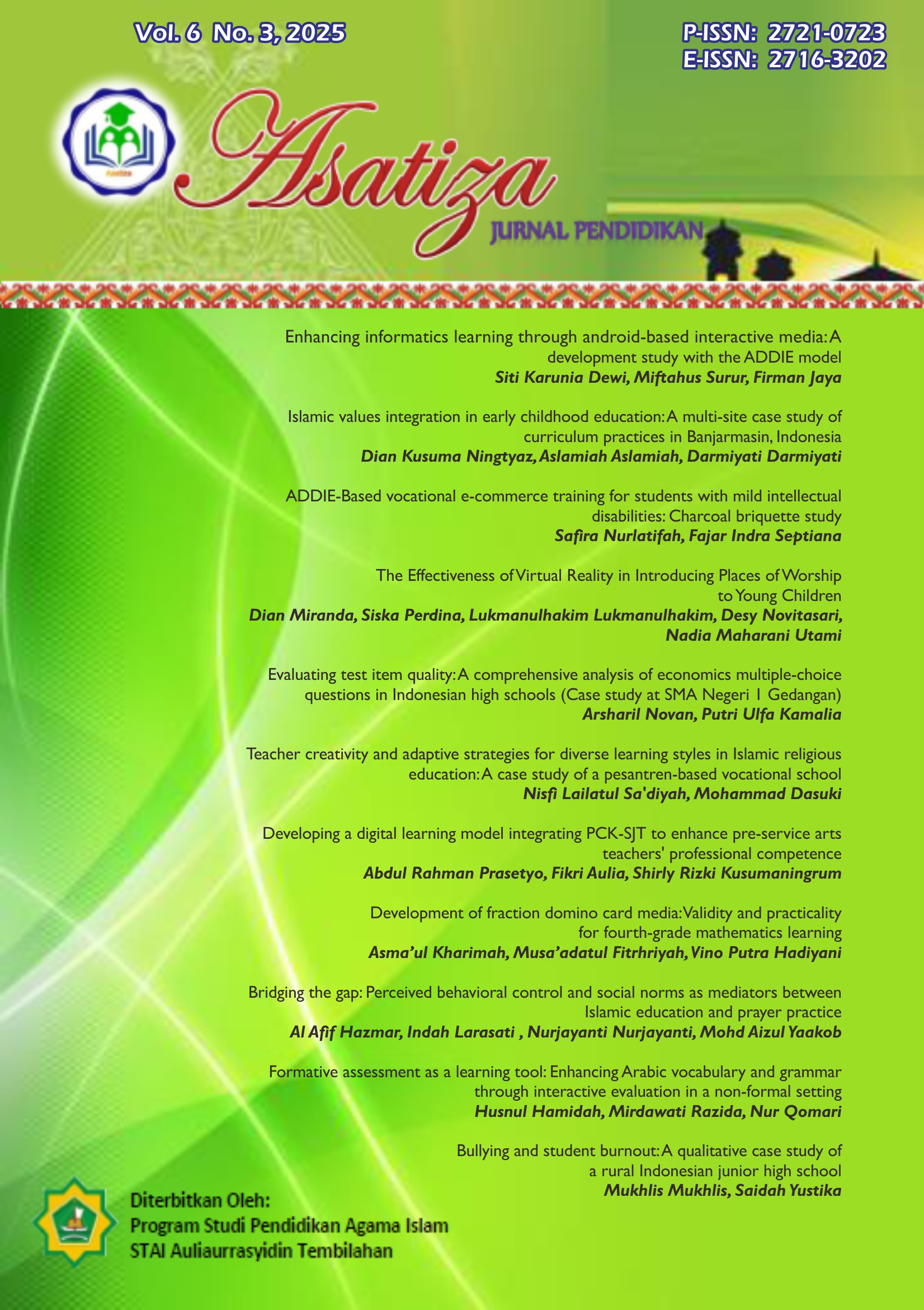
Formative assessment as a learning tool: Enhancing Arabic vocabulary and grammar through interactive evaluation in a non-formal setting
DOI:
https://doi.org/10.46963/asatiza.v6i3.3043Keywords:
Arabic Language Pedagogy, Formative Assessment, Non-Formal Education, Vocabulary AcquisitionAbstract
Despite the established theoretical potential of formative assessment, a significant gap exists in understanding its practical application and impact within Arabic language pedagogy, particularly in non-formal educational settings. This study addresses this gap by exploring the role of evaluation tools in enhancing vocabulary and grammar mastery at LKP Kampung Arab Al-Azhar Pare, a non-formal institution in Indonesia. Employing a qualitative descriptive methodology, data were collected through semi-structured interviews with five teachers and twenty students, non-participant observations, and document analysis. The findings reveal a comprehensive typology of evaluation tools, strategically implemented as active pedagogical strategies rather than mere measurement instruments. These tools, which range from digital gamified quizzes (e.g., Kahoot, Wordwall) to collaborative performance tasks, were found to significantly enhance student engagement, foster a deeper conceptual understanding of grammar, and reinforce the functional application of vocabulary. A critical factor in their efficacy was the consistent provision of explanatory, task-focused feedback from teachers. The study concludes that a formative, integrated evaluation system is instrumental in bridging the gap between assessing knowledge and actively cultivating it. This research offers a replicable framework for non-formal institutions and contributes to Arabic language pedagogy by empirically demonstrating how a holistic assessment approach can transform learning processes and outcomes.
Downloads
References
Ainin. (2006). Evaluasi dalam Pembelajaran Bahasa Arab (Teori dan Praktek). Malang: Misykat.
Atikah, & Amelia. (2024). Strategi penilaian dan evaluasi efektif untuk meningkatkan kemampuan siswa serta umpan balik dalam pembelajaran bahasa Indonesia. Jurnal Pendidikan dan Ilmu Bahasa, 2(3), 76–84. https://doi.org/10.59059/perspektif.v2i3.1454
Bamualim, M. (2020). Kedudukan Dan Tujuan Evaluasi Pembelajaran Bahasa Arab. Jurnal Al-Fawa’id: Jurnal Agama dan Bahasa, 10(2), 1–10. https://doi.org/10.54214/alfawaid.vol10.iss2.141
Black, P., & Wiliam, D. (1998). Assessment and classroom learning. Assessment in Education: Principles, Policy & Practice, 5(1), 7–74. https://doi.org/10.1080/0969595980050102
Creswell, J. W., & Poth, C. N. (2018). Qualitative inquiry and research design: Choosing among five approaches (4th ed.). SAGE Publications.
Hattie, J., & Timperley, H. (2007). The power of feedback. Review of Educational Research, 77(1), 81–112. https://doi.org/10.3102/003465430298487
Iskandar, N. M., & Rasmitadila. (2024). Peningkatan Kualitas Pembelajaran melalui Evaluasi yang Efektif: Tinjauan Terhadap Praktik dan Metode Evaluasi. Karimah Tauhid, 3(2), 2270–2287. https://doi.org/10.30997/karimahtauhid.v3i2.11945
Khofiah, & Nasiruddin. (2024). Interactive Learning of Arabic Grammar at Al-Azhar Course,. 9(November), 305–317. https://doi.org/10.21462/ijefl.v9i2.813
Lee, I. (2007). Feedback in Hong Kong secondary writing classrooms: Assessment for learning or assessment of learning? Assessing Writing, 12(3), 180–198. https://doi.org/10.1016/j.asw.2008.02.003
Magdalena, I., Utami, W. D., Rahma, S. B., Anggraini, I. A., & Wijaya, R. R. (2021). Instrumen Tes dan Non Tes dalam Evaluasi Pembelajaran. 8, 30461–30472.
Miles, M. B., Huberman, A. M., & Saldaña, J. (2014). Qualitative data analysis: A methods sourcebook (3rd ed.). SAGE Publications.
Palinkas, L. A., Horwitz, S. M., Green, C. A., Wisdom, J. P., Duan, N., & Hoagwood, K. (2015). Purposeful sampling for qualitative data collection and analysis in mixed method implementation research. Administration and Policy in Mental Health and Mental Health Services Research, 42(5), 533–544. https://doi.org/10.1007/s10488-013-0528-y
Pramukti, R. H., Ngatman, N., & Chamdani, M. (2021). Pengaruh penguasaan kosakata terhadap pemahaman isi wacana pada siswa kelas v SD se-Kecamatan Banyumas tahun ajaran 2020/2021. Kalam Cendekia: Jurnal Ilmiah Kependidikan, 9(3). https://doi.org/10.20961/jkc.v9i3.53892
Rahayu, I. S. D., & Purnawarman, P. (2019, June). The use of quizizz in improving students’ grammar understanding through self-assessment. In Eleventh Conference on Applied Linguistics (CONAPLIN 2018) (pp. 102-106). Atlantis Press. https://doi.org/10.2991/conaplin-18.2019.235
Ridho, U. (2018). Evaluasi dalam pembelajaran bahasa Arab. An Nabighoh Jurnal Pendidikan Dan Pembelajaran Bahasa Arab, 20(01), 19. https://doi.org/10.32332/an-nabighoh.v20i01.1124
Rogers, A. (2014). The base of the iceberg: Informal learning and its impact on formal and non-formal learning. Verlag Barbara Budrich.
Scriven, M. (1967). The methodology of evaluation. In R. W. Tyler, R. M. Gagné, & M. Scriven (Eds.), Perspectives of curriculum evaluation (pp. 39–83). Rand McNally.
Setyosari, P. (2010). Metodologi Penelitian Pendidikan dan Pengembangan. Jakarta: Kencana.
Wiliam, D. (2011). Embedded formative assessment. Solution Tree Press.
Zaid, A. H. bin, Widyanti, L. N., Ismail, M., & Jannah, D. A. M. (2024). Implementasi pendekatan komunikatif (Communication Approach) dalam meningkatkan keterampilan berbahasa Arab. Al Mi’yar: Jurnal Ilmiah Pembelajaran Bahasa Arab dan Kebahasaaraban, 7(2), 682. https://doi.org/10.35931/am.v7i2.3769
Downloads
Published
Issue
Section
License
Copyright (c) 2025 Husnul Hamidah, Mirdawati Razida, Nur Qomari

This work is licensed under a Creative Commons Attribution-ShareAlike 4.0 International License.
Authors who publish with this journal agree to the following terms:
1. Copyright on any article is retained by the author(s).
2. The author grants the journal, right of first publication with the work simultaneously licensed under a Creative Commons Attribution shareAlike 4.0 International License that allows others to share the work with an acknowledgment of the work’s authorship and initial publication in this journal.
3. Authors are able to enter into separate, additional contractual arrangements for the non-exclusive distribution of the journal’s published version of the work (e.g., post it to an institutional repository or publish it in a book), with an acknowledgment of its initial publication in this journal.
4. Authors are permitted and encouraged to post their work online (e.g., in institutional repositories or on their website) prior to and during the submission process, as it can lead to productive exchanges, as well as earlier and greater citation of published work.
5. The article and any associated published material is distributed under the Creative Commons Attribution-ShareAlike 4.0 International License



2.png)