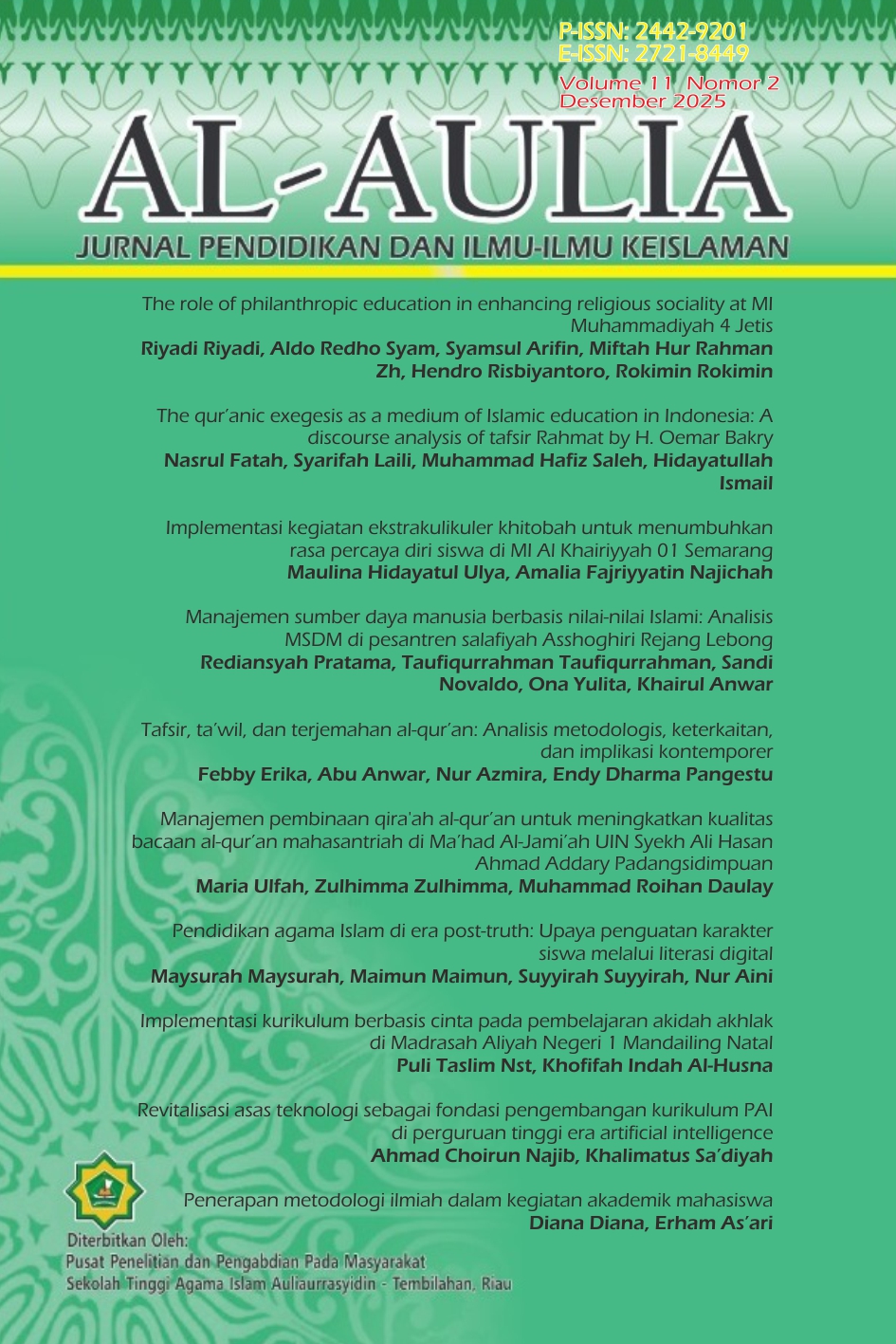
Revitalisasi asas teknologi sebagai fondasi pengembangan kurikulum PAI di perguruan tinggi era artificial intelligence
DOI:
https://doi.org/10.46963/aulia.v11i2.3482Keywords:
Islamic Religious Education, Curriculum, Principles of Technology, Artificial IntelligenceAbstract
This study aims to analyze the urgency of revitalizing technological principles as the foundation for developing Islamic Religious Education (PAI) curriculum in higher education in the era of Artificial Intelligence. The rapid development of AI demands an adaptive PAI curriculum, but limited understanding of technological principles remains instrumental and partial. This study uses a qualitative approach with a literature review method of relevant scientific articles, books, and documents analyzed descriptively and analytically. The results indicate that revitalizing technological principles needs to be done through repositioning technology as a conceptual framework for curriculum development, not just as a learning tool. These findings emphasize the importance of adaptive, critical, and valuable technology integration so that the PAI curriculum remains academically relevant and morally and spiritually sound. This study has implications for strengthening PAI curriculum development theory, learning practices in higher education, and Islamic education policy. Further research is recommended to examine the empirical implementation of revitalizing technological principles in the context of PAI learning.
References
Arjuna, A., Hasan, A. H., Maulana, A., Islam, U., Alauddin, N., & Makassar, U. I. N. (2025). Ppenerapan Asas-Asas Pengembangan Kurikulum Pada Pengembangan Kurikulum Pendidikan Agama Islamenerapan Asas-Asas Pengembangan Pendidikan Agama Islam. J-Telite: Journal Of Transforming Education Through Leadership, Innovation, And Teaching Excellence, 01(04), 259–272.
Hadi, H., Islam, U., & Mataram, N. (2025). Inovasi Kurikulum Pai : Harapan Dan Realita Di Era Digital Pada Sekolah Menengah. Jurnal Ilmiah Pendidikan Citra Bakti, 12(1), 217–229.
Hafifah, H., Hamka, H., & Anirah, A. (2024). Pengembangan Kurikulum Pendidikan Islam Dalam Era Digital : Tantangan Dan Peluang. Prosiding Kajian Islam Dan Integrasi Ilmu Di Era Society 5.0 (Kiiies 5.0), 5(3), 91–94.
Irsyad, M., & Zakir, S. (2023). Transformasi Ai Dan Kurikulum; Tantangan Pendidikan Islam Menghadapi Abad Ke-21. Al Aulia: Jurnal Pendidikan Dan Ilmu - Ilmu Islam, 9(2), 156–170. https://Ejournal.Stai-Tbh.Ac.Id/Al-Aulia/Article/Download/1395/508
Kasim, A., Muhammad, M., & Idrus, S. A. J. Al. (2025). Inovasi Pengembangan Kurikulum Pendidikan Agama Islam Di Era Digital: Menyongsong Tantangan Globalisasi Dan Perubahan Sosial. J-Kip (Jurnal Keguruan Dan Ilmu Pendidikan), 6(2), 398. https://doi.org/10.25157/J-Kip.V6i2.17363
Khairani, A., Rahma, R. N., & Sembiring, S. S. F. (2025). Integrasi Teknologi Dalam Pembelajaran Pendidikan Agama Islam: Peluang Dan Tantangan. Mesada: Journal Of Innovative Research, 5(1), 444–451. https://doi.org/10.47467/Elmujtama.V5i1.5625
Khofifah, K., Nur Rahma Putri, Fitotul Jannah, & Nita Yuli Astuti. (2024). Peran Teknologi Dalam Meningkatkan Efektivitas Pembelajaran Pendidikan Islam. Jurnal Pendidikan Islam Al-Affan, 4(2), 218–223. https://doi.org/10.69775/Jpia.V4i2.215
Musyafa, W., Pahrudin, A., Jatmiko, A., Koderi, & Syafe, I. (2025). Transcendental Awareness, Enabling The Ethical Use Of Artificial Intelligence For The Betterment Of Humanity. Pendas : Jurnal Ilmiah Pendidikan Dasar, 10(10), 04.
Nugraha, A., & Syafe’i, I. (2025). Curriculum Foundations For Arabic Language Education In The Ai Era: Holistic, Juridical, And Technological Perspectives. Journal Of Arabic Language Learning And Teaching (Jallt), 3(2), 151–160. https://doi.org/10.23971/Jallt.V3i2.395
Nurhidaya, M. (2025). Kurikulum Pendidikan Islam Di Indonesia ( Problematika , Tantangan Dan Lintasan Sejarah Kurikulum Di Indonesia ). Multidisciplinary Indonesian Center Journal (Micjo), 2, 356–365. https://e-jurnal.Jurnalcenter.Com/Index.Php/Micjo
Ocen, S., Elasu, J., Aarakit, S. M., & Olupot, C. (2025). Artificial Intelligence In Higher Education Institutions: Review Of Innovations, Opportunities And Challenges. Frontiers In Education, 10(March). https://doi.org/10.3389/Feduc.2025.1530247
Ramirez-Montoya, M. S., Morales-Menendez, R., Tworek, M., Escobar, C. A., Tariq, R., & Tenorio-Sepulveda, G. C. (2024). Complex Competencies For Leader Education: Artificial Intelligence Analysis In Student Achievement Profiling. Cogent Education, 11(1). https://doi.org/10.1080/2331186x.2024.2378508
Rifky, S. (2024). The Impact Of Using Artificial Intelligence On Higher Education. Indonesian Journal Of Multidisciplinary On Social And Technology, 2(1), 37–42. https://doi.org/10.31004/Ijmst.V2i1.287
Saprullah, & Sirozi, M. (2024). Mengembangkan Kurikulum Pendidikan Agama Islam ( Pai ) Yang Adaptif Terhadap Perkembangan Teknologi Digital. Imeij, Indo-Mathedu Intellectuals Journal, 5(3), 3716–3721.
Sari Hernawati, Hafizh, M., & Muhammad Nur Faizi Arya. (2024). Adjusting The Ideal Islamic Religious Education Curriculum To The Development Of Ai-Based Technology. Progresiva : Jurnal Pemikiran Dan Pendidikan Islam, 13(01), 129–144. https://doi.org/10.22219/Progresiva.V13i01.32931
Siallagan, J. A. S., Yuya, T. A. P., Arshyara, S., & Perawati. (2024). Penggunaan Kecerdasan Buatan Ai Mengakibatkan Krisis Pemikiran Kritis Pelajar Dalam Dunia Pendidikan Indonesia. Jurnal Pendidikan Tambusai, 8 Nomor 3(2018), 47679–47683.
Simbolon, N. T., Lumbantobing, D. W. J., Pasaribu, E., Putri, A. S., Panjaitan, N. R. P., Nasution, S. H., & Wulandari, A. N. (2025). Dampak Krisis Literasi Terhadap Prestasi Akademik Mengakibatkan Ketergantungan Pada Teknologi Dan Penurunan Minat. Jurnal Intelek Insan Cendikia, 2(3), 4586–4597. Https://Jicnusantara.Com/Index.Php/Jiic
Slimi, Z. (2023). The Impact Of Artificial Intelligence On Higher Education: An Empirical Study. European Journal Of Educational Sciences, 10(1), 17–33. https://doi.org/10.19044/Ejes.V10no1a17
Sońta, M., Hui, C., & Chagnard, J. (2023). Ai In Education. Asef Higher Education Innovation Laboratory, 1(1), 1–15.
Ubaedullah, D., Rokimin, & Suryono, F. (2025). Technology In Islamic Education Curriculum: Challenges And Opportunities. Jurnal Al Burhan, 5(2), 369–391. https://www.staidaf.ac.id/Jurnal/Jab/Article/View/609
Wagan, A. A., Khan, A. A., Chen, Y. L., Yee, P. L., Yang, J., & Laghari, A. A. (2023). Artificial Intelligence-Enabled Game-Based Learning And Quality Of Experience: A Novel And Secure Framework (B-Aiqoe). Sustainability (Switzerland) , 15(6). https://doi.org/10.3390/Su15065362
Yanti, N., Arono, Hiasa, F., Junaidi, F., Noermanzah, & Kurniawan, R. (2025). Indonesian Teachers’ Roles In Designing And Utilizing Ai-Powered Animated Videos: A Case Study On Classroom Practices And Character Development. International Journal Of Learning, Teaching And Educational Research, 24(6), 833–856. https://doi.org/10.26803/Ijlter.24.6.38
Zainuri, H., Aspriady, F., & Nurasikin, N. (2024). Sifat-Sifat Kurikulum Pai Dan Pendekatan Pembelajaran Pai. Azkiya: Jurnal Ilmiah Pengkajian Dan Penelitian Pendidikan Islam, 7(1), 77–92. https://doi.org/10.53640/Azkiya.V7i1.1685
Published
Issue
Section
License
Copyright (c) 2025 Ahmad Choirun Najib, Khalimatus Sa’diyah

This work is licensed under a Creative Commons Attribution-ShareAlike 4.0 International License.
Authors who publish with this journal agree to the following terms:
1. Copyright on any article is retained by the author(s).
2. The author grants the journal, right of first publication with the work simultaneously licensed under a Creative Commons Attribution License that allows others to share the work with an acknowledgment of the work’s authorship and initial publication in this journal.
3. Authors are able to enter into separate, additional contractual arrangements for the non-exclusive distribution of the journal’s published version of the work (e.g., post it to an institutional repository or publish it in a book), with an acknowledgment of its initial publication in this journal.
4. Authors are permitted and encouraged to post their work online (e.g., in institutional repositories or on their website) prior to and during the submission process, as it can lead to productive exchanges, as well as earlier and greater citation of published work.
5. The article and any associated published material is distributed under the Creative Commons Attribution-ShareAlike 4.0 International License