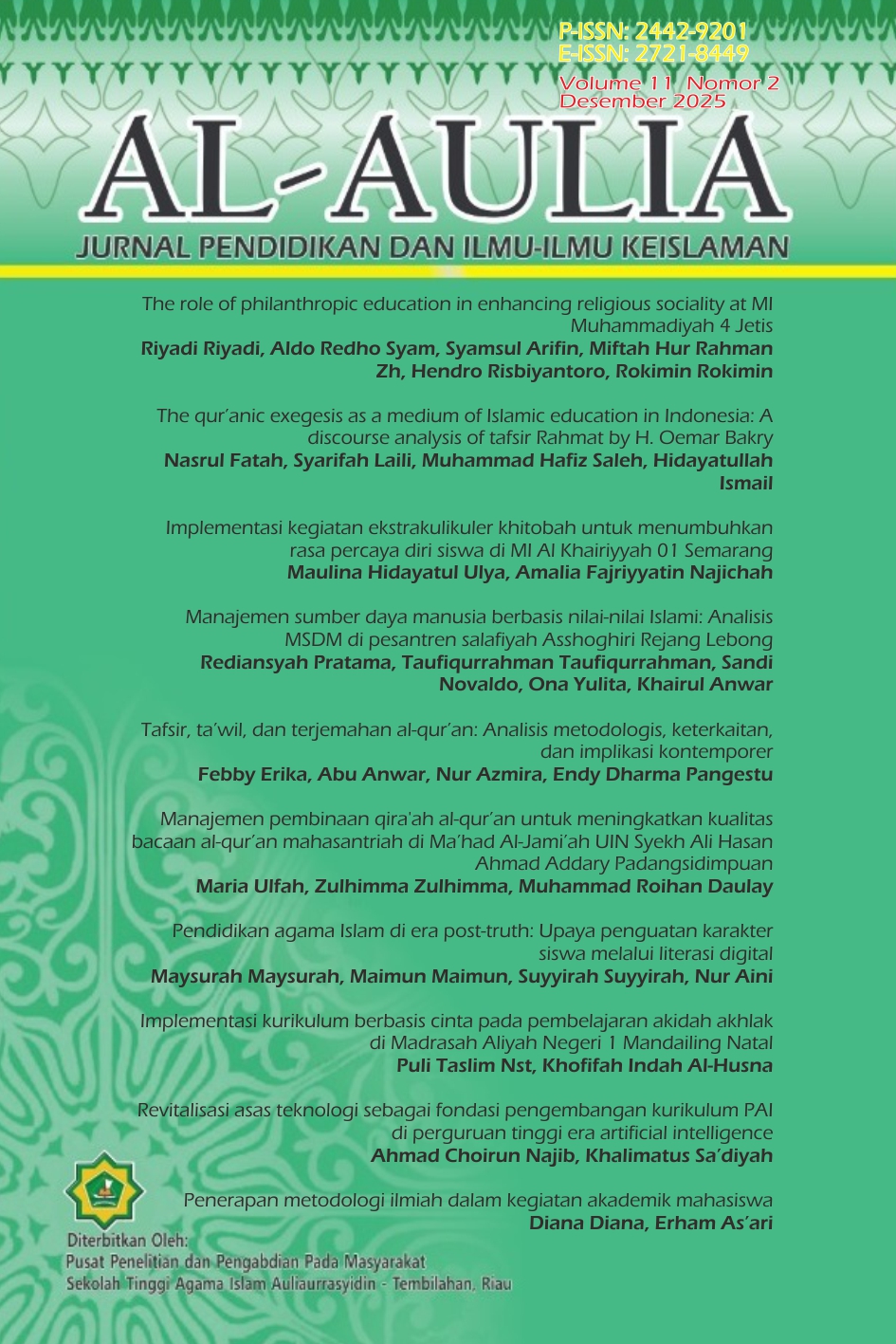
Manajemen sumber daya manusia berbasis nilai-nilai Islami: Analisis MSDM di pesantren salafiyah Asshoghiri Rejang Lebong
DOI:
https://doi.org/10.46963/aulia.v11i2.3363Keywords:
Human Resource Management, Salafiyah Islamic Boarding School, Islamic Values, Character BuildingAbstract
Islamic boarding schools as Islamic educational institutions require human resource management (HRM) that is in line with Islamic values. This study analyzes Islamic value-based HRM at the Salafiyah Asshoghiri Islamic Boarding School, focusing on the role of HR, challenges, planning, and evaluation. Using a qualitative case study approach, data were collected through interviews, observations, and documentation studies. The results of the study show that HR management at this Islamic boarding school is centered on the values of Honesty–Prayer–Fear of the Forbidden, which form the basis for recruitment, training, and supervision. The main challenges include character incompatibility, variations in discipline, and environmental influences. HR planning is carried out selectively and value-oriented, while continuous evaluation integrates behavioral observation and moral consistency. This model offers an effective approach to character building and institutional strengthening based on Islamic values.
References
Akhmad, S. K. (2024). Preserving tradition amid disruption: A systematic literature review (SLR) of pesantren development in Indonesia. Santri: Journal of Pesantren and Fiqh Sosial, 5(2). https://doi.org/10.35878/santri.v5i2.1396
Auwal Gano, A., Abdullahi, N., Lawan Adam, Z., & Setyawan, C. E. (2024). Integrating Islamic principles into human resource management: Advancing organizational success through Islamic education and ethical practices. Tadibia Islamika, 4(2), 62–74. https://doi.org/10.28918/tadibia.v4i2.9125
Berkah, D., & Zamroni, M. A. (2024). Management of Islamic Boarding School Shapes the Character of Santri Discipline. Chalim Journal of Teaching and Learning, 3(2), 147–159. https://doi.org/10.31538/cjotl.v3i2.1109
Faisal, S. (2023). Twenty-Years Journey of Sustainable Human Resource Management Research: A Bibliometric Analysis. Administrative Sciences, 13(6), 139. https://doi.org/10.3390/admsci13060139
Gazali, E., & Budiana, A. A. (2023). A Bibliometric Analysis of Pesantren’s Educational Impact: Insights from The Scopus Database (1994–2022). Jurnal Pendidikan Islam, 12(1), 15–33. https://doi.org/10.14421/jpi.2023.121.15-33
Hanafi, Y., Taufiq, A., Saefi, M., Ikhsan, M. A., Diyana, T. N., Thoriquttyas, T., & Anam, F. K. (2021). The new identity of Indonesian Islamic boarding schools in the “new normal”: The education leadership response to COVID-19. Heliyon, 7(3), e06549. https://doi.org/10.1016/j.heliyon.2021.e06549
Hastasari, C., Setiawan, B., & Aw, S. (2022). Students’ communication patterns of islamic boarding schools: The case of Students in Muallimin Muhammadiyah Yogyakarta. Heliyon, 8(1), e08824. https://doi.org/10.1016/j.heliyon.2022.e08824
Klapper, R., Berg, L., & Upham, P. (2020). Probing Alignment of Personal and Organisational Values for Sustainability: An Assessment of Barrett’s Organisational Consciousness Model. Sustainability, 12(18), 7584. https://doi.org/10.3390/su12187584
Koman, G., Boršoš, P., & Kubina, M. (2024). Sustainable Human Resource Management with a Focus on Corporate Employee Recruitment. Sustainability, 16(14), 6059. https://doi.org/10.3390/su16146059
Kutieshat, R., & Farmanesh, P. (2022). The Impact of New Human Resource Management Practices on Innovation Performance during the COVID 19 Crisis: A New Perception on Enhancing the Educational Sector. Sustainability, 14(5), 2872. https://doi.org/10.3390/su14052872
Mucinskas, D., Clark, S., Barendsen, L., & Gardner, H. (2025). An increase in educator expectations of student character growth during participation in a community of practice. Frontiers in Education, 10, 1466295. https://doi.org/10.3389/feduc.2025.1466295
Nastase, C., Adomnitei, A., & Apetri, A. (2025). Strategic Human Resource Management in the Digital Era: Technology, Transformation, and Sustainable Advantage. Merits, 5(4), 23. https://doi.org/10.3390/merits5040023
Niswah, C., Sholihin, M., Zasvenda, M. Y., Amirullah, E., & Dani, A. (2025). Analisis Peran Lembaga Pendidikan Pesantren Dalam Membagun Karakter dan Ilmu Pengetahuan. Jurnal Ilmiah Multidisipin, 3(6), 308–316. https://doi.org/10.60126/jim.v3i6.984
Nurkhin, A., Rohman, A., & Prabowo, T. J. W. (2024). Accountability of pondok pesantren; a systematic literature review. Cogent Business & Management, 11(1), 2332503. https://doi.org/10.1080/23311975.2024.2332503
Rasmitadila, R., Rachmadtullah, R., Prasetyo, T., Humaira, M. A., Sari, D. A., Samsudin, A., & ZamZam, R. (2025). Professional development for Indonesian elementary school teachers: Increased competency and sustainable teacher development programs. F1000Research. https://doi.org/10.12688/f1000research.156946.3
Sarkadi, Casmana, A. R., Hisyam, C. J., & Wardatussa’idah, I. (2022). Integrating Character Education Into the RECE Learning Model Through Pancasila and Citizenship Education Subjects. Frontiers in Education, 7, 841037. https://doi.org/10.3389/feduc.2022.841037
Supratno, H., Subandiyah, H., & Permata Raharjo, R. (2018). Character Education in Islamic Boarding School as a Medium to Prevent Student Radicalism. Proceedings of the 2nd Social Sciences, Humanities and Education Conference: Establishing Identities through Language, Culture, and Education (SOSHEC 2018). 2nd Social Sciences, Humanities and Education Conference: Establishing Identities through Language, Culture, and Education (SOSHEC 2018), Surabaya, Indonesia. https://doi.org/10.2991/soshec-18.2018.86
Syadiyah, C., & Rindaningsih, I. (2024). Effective human resource management strategies in Islamic boarding schools. International Journal Multidisciplinary (IJMI), 1(4), 94–100. https://doi.org/10.61796/ijmi.v1i4.252
Syahir, A. N. A., Abidin, M. S. Z., Sa’ari, C. Z., & Rahman, M. Z. A. (2025). Workplace Spirituality and Its Impact on Employee Well-Being: A Systematic Literature Review of Global Evidence. Journal of Religion and Health, 64(5), 3313–3345. https://doi.org/10.1007/s10943-025-02350-2
Yamin, Moh., Basri, H., & Suhartini, A. (2023). Learning Management in Salaf Islamic Boarding Schools. At-Tadzkir: Islamic Education Journal, 2(1), 25–36. https://doi.org/10.59373/attadzkir.v2i1.10
Zukdi, I., Trinova, Z., & Nasution, I. (n.d.). The role of Islamic boarding schools in building the character of the nation.
Downloads
Published
Issue
Section
License
Copyright (c) 2025 Rediansyah Pratama, Taufiqurrahman Taufiqurrahman, Sandi Novaldo, Ona Yulita, Khairul Anwar

This work is licensed under a Creative Commons Attribution-ShareAlike 4.0 International License.
Authors who publish with this journal agree to the following terms:
1. Copyright on any article is retained by the author(s).
2. The author grants the journal, right of first publication with the work simultaneously licensed under a Creative Commons Attribution License that allows others to share the work with an acknowledgment of the work’s authorship and initial publication in this journal.
3. Authors are able to enter into separate, additional contractual arrangements for the non-exclusive distribution of the journal’s published version of the work (e.g., post it to an institutional repository or publish it in a book), with an acknowledgment of its initial publication in this journal.
4. Authors are permitted and encouraged to post their work online (e.g., in institutional repositories or on their website) prior to and during the submission process, as it can lead to productive exchanges, as well as earlier and greater citation of published work.
5. The article and any associated published material is distributed under the Creative Commons Attribution-ShareAlike 4.0 International License