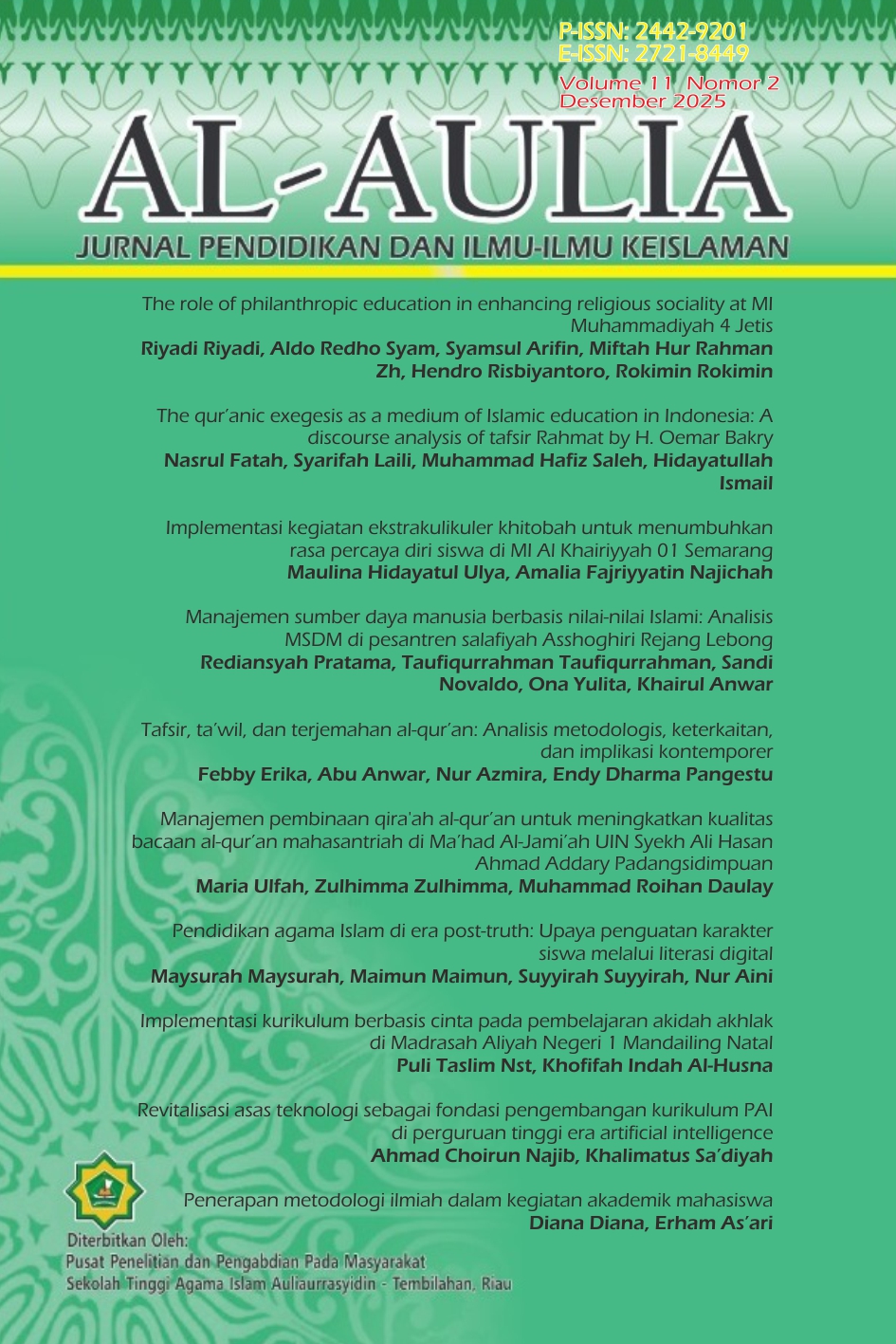
The qur’anic exegesis as a medium of Islamic education in Indonesia: A discourse analysis of tafsir Rahmat by H. Oemar Bakry
DOI:
https://doi.org/10.46963/aulia.v11i2.3298Keywords:
Tafsir Rahmat, pedagogical exegesis, nusantara exegesisAbstract
This study aims to examine Tafsir Rahmat by H. Oemar Bakri as a representative work of the Nusantara exegetical tradition with a pedagogical orientation, functioning as a medium of Islamic education in the early twentieth century. The work emerged amid the dynamic efforts of Indonesian Muslims to balance the spirit of modernity with Islamic traditional values. Through communicative Malay and a simple interpretive style, Oemar Bakri presented tafsir as a means of da‘wah and moral education, particularly for the younger generation. Employing critical discourse analysis and contextual hermeneutics, this study explores the linguistic, ideological, and social dimensions embedded in the text. The findings reveal that Tafsir Rahmat not only interprets Qur’anic verses but also instills Islamic educational values emphasizing moral development, social responsibility, and religious character. Its pedagogical tone highlights the role of tafsir as a living educational discourse within the social and cultural context of Indonesian Muslim society.
References
Anam, M. (2020). Sejarah Tafsir Indonesia. Al-I’jaz, 2(1), 42–52.
Anisa Nilam Cahya. (2023). Model representasi kontemporer: Studi Pemikiran Oemar Bakry Terhadap Ilmu Pengetahuan dan Teknologi. Jurnal Moderasi: the Journal of Ushuluddin and Islamic Thought, and Muslim Societies, Vol. 3(No. 2).
Anwar, M. K., & Hasanudin, F. F. (2022). Analisis Pemikiran Oemar Bakry Tentang Politik Pergerakan Dalam Tafsir Rahmat. Jurnal Maqosid, 10(01), 12–20.
Ari, A. W. (2019). Sejarah tafsir nusantara. Jurnal Studi Agama, 3(2), 113–127.
Azra, A. (2013). Islam Nusantara: Jaringan Global dan Lokal Islam di Indonesia. Prenada Media.
Bailin, S., Case, R., Coombs, J. R., & Daniels, L. B. (1999). Conceptualizing critical thinking. Journal of curriculum studies, 31(3), 285–302.
Bakry, H. O. (1984). Tafsir Rahmat. Mutiara.
Daiyan, A. (2021). Lokalitas tafsir rahmat karya H . Oemar Bakry. Jurnal At Tahfidz: Jurnal Ilmu Al- Qur ’ an dan Tafsir, 3(01), 70–87.
Drajat, M. (2018). Sejarah Madrasah di Indonesia. Al-Afkar, Journal for Islamic Studies, 192–206.
Ghozali, M. (2021). Dialektika Sains, Tradisi dan al-Qur’an: Representasi Modernitas dalam Tafsir Rahmat karya Oemar Bakry. AL QUDS : Jurnal Studi Alquran dan Hadis, 5(2), 843–858. https://doi.org/10.29240/alquds.v5i2.3394
Gusmian, Islah. (2015). Tafsir Al-Qur’an di Indonesia: Sejarah Dan Dinamika. Nun: Jurnal Studi Alquran dan Tafsir di Nusantara, 1(1). https://doi.org/10.32495/nun.v1i1.8
Halim, A. (2022). Signifikansi dan implementasi berpikir kritis dalam proyeksi dunia pendidikan abad 21 pada tingkat sekolah dasar. Jurnal Indonesia Sosial Teknologi, 3(3).
Hamad, I. (2007). Lebih Dekat dengan Analisis Wacana. Mediator, 8(2), 325–344.
Hidayat, M. R. (2023). Epistemological Construction of Tafsir At-Tafsir Al-Madrasi by H. Oemar Bakry. Hermeneutik: Jurnal Ilmu Al Qur’an dan Tafsir, 17(03), 255–272.
Hidayat, M. R., Wijaya, R., Hs, M. A., & Akmaluddin, M. (2023). Virtual Da ’ wah Authority in Tafsir Rahmat H . Oemar Bakry : An Analysis of Intertextuality from Julia Kristeva The spirit of da ’ wah in Indonesia in each individual Muslim has developed so rapidly . Da ’ wah activities were only interpreted as lectures. An Nida’, 47(1), 91–105. https://doi.org/10.24014/an-nida.v47i1.23022
Ismail, H., Fatah, N., & Jamal, K. (2024). Respon Sosiologis dalam Tafsir Nusantara (Kajian terhadap Tafsir Rahmat Karya H. Oemar Bakry). Al-Fikra: Jurnal Ilmiah Keislaman, 23(1), 98–108.
Jaelani, J. (2023). Modernitas Kehidupan Beragama Dalam Perkembangan Pendidikan Islam:(Studi Analisis Pemikiran Muhammad Abduh). Civilization Research: Journal of Islamic Studies, 2(2), 168–187.
Jamarudin, A., Syahriza, R., & Hilmi, F. (2022). Pancasila Values and the Interpretation Paradigm of Archipelago Mufassir. ICONIK International Conference: Transdisciplinary Paradigm on Islamic Knowledge, 2022, 633–641. https://doi.org/10.18502/kss.v7i8.10781
Judhananto, M. N., & Sitorus, F. K. (2025). Fusion of Horizons : Pemikiran Gadamer Mengenai Dialog dan Pemahaman dalam Kehidupan Manusia. Jurnal ISO: Jurnal Ilmu Sosial, Politik dan Humaniora, 5(1), 1–12.
Muliati, I., Sulaiman, S., Hoktaviandri, H., & Rahman, R. (2020). Pemikiran Pendidikan Muhammad Abduh. Jurnal Kawakib, 1(1), 44–53.
Musthofa, M. A., & Ali, H. (2021). Faktor yang mempengaruhi berpikir kritis dalam pendidikan Islam di Indonesia: Kesisteman, tradisi, budaya. Jurnal Ilmu Manajemen Terapan, 3(1), 1–19.
Qadafi, M., Iswantir, M., & Akbar, A. (2024). Moderasi pendidikan islam awal abad 20 di Sumatera Barat. Jurnal Ilmiah Research Student, 1(3), 78–83.
Rahman, R. (2015). Modernisasi Pendidikan Islam Awal Abad 20. Humanus, 15, 174–183.
Rahmatullah. (2017). Menakar Hermeneutika Fusion of Horizons H . G . Gadamer dalam Pengembangan Tafsir Maqasid Alquran. Nun: Jurnal Studi Alquran dan Tafsir di Nusantara, 3(2), 149–168.
Saeed, A. (2016). Reading the Qur’an in the Twenty-First Century: A Contextualist Approach. Routledge.
Syamsuddin, S. (2020). Al-Qur’an Dan Pembinaan Karakter Umat. Lembaga Ladang Kata.
Tamam, A. B. (2018). Model penelitian tafsir ; Studi karya Howard M . Federspiel “ Popular Indonesian Literature of the qur ’ an ”. Madinah: Jurnal Studi Islam, 5(2), 125–138.
Ulum, B., & Hasan, N. (2024). Integrasi metode hermeneutik dalam tafsir tarbawi: Tantangan dan Implikasi dalam Pendekatan Pedagogis al-Qur ’ an. El Banat, 14(66), 116–131.
Usman, A. M., & Umar, M. (2021). Modernisasi Pendidikan Islam; Telaah Pemikiran Muhammad Abduh. Jurnal Ilmiah Iqra’, 15(2), 237–258.
Downloads
Published
Issue
Section
License
Copyright (c) 2025 Nasrul Fatah, Syarifah Laili, Muhammad Hafiz Saleh, Hidayatullah Ismail

This work is licensed under a Creative Commons Attribution-ShareAlike 4.0 International License.
Authors who publish with this journal agree to the following terms:
1. Copyright on any article is retained by the author(s).
2. The author grants the journal, right of first publication with the work simultaneously licensed under a Creative Commons Attribution License that allows others to share the work with an acknowledgment of the work’s authorship and initial publication in this journal.
3. Authors are able to enter into separate, additional contractual arrangements for the non-exclusive distribution of the journal’s published version of the work (e.g., post it to an institutional repository or publish it in a book), with an acknowledgment of its initial publication in this journal.
4. Authors are permitted and encouraged to post their work online (e.g., in institutional repositories or on their website) prior to and during the submission process, as it can lead to productive exchanges, as well as earlier and greater citation of published work.
5. The article and any associated published material is distributed under the Creative Commons Attribution-ShareAlike 4.0 International License