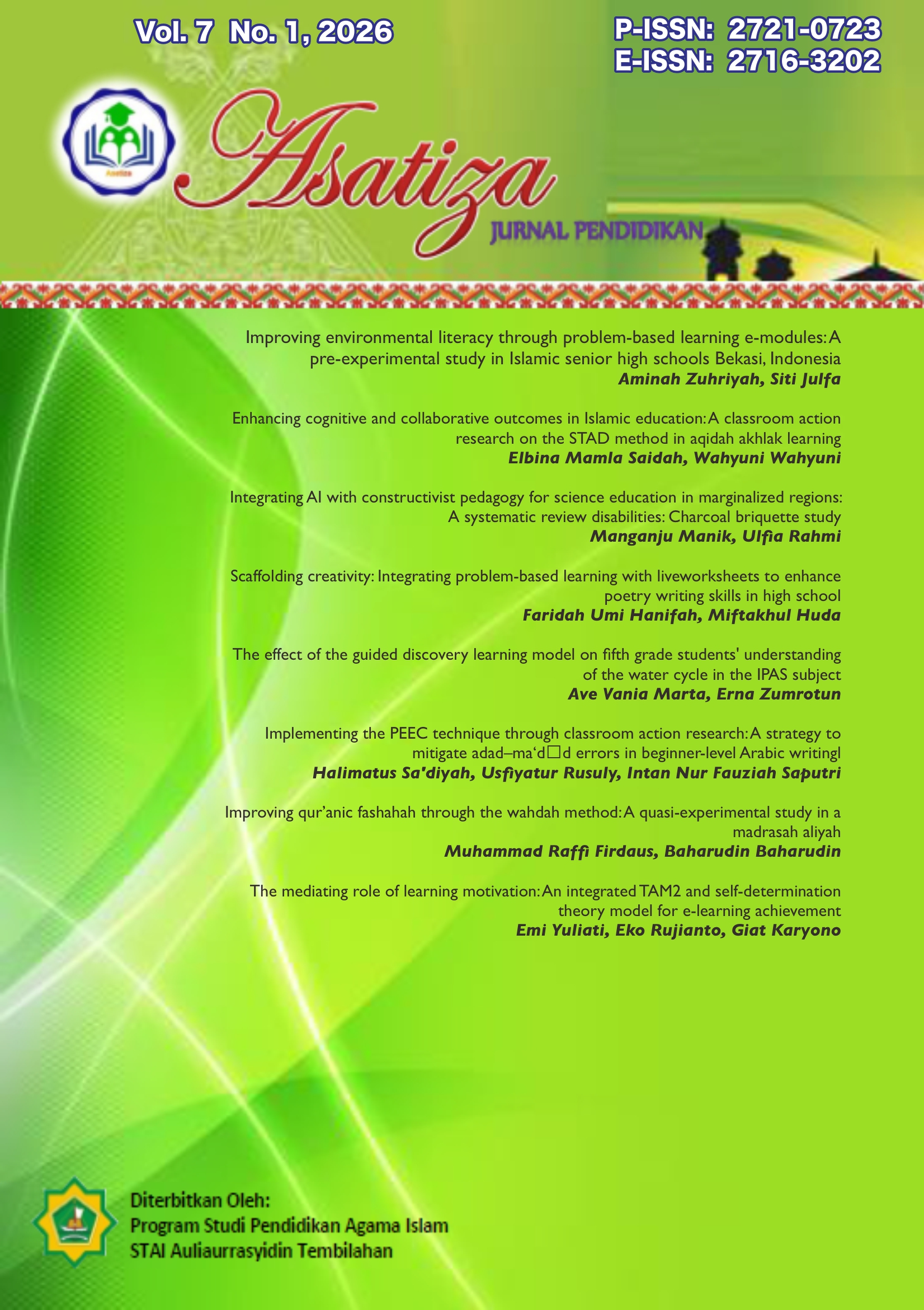
Improving environmental literacy through problem-based learning e-modules: A pre-experimental study in Islamic senior high schools Bekasi, Indonesia
DOI:
https://doi.org/10.46963/asatiza.v7i1.2993Keywords:
Environmental Literacy, Environmental Issues, E-ModuleAbstract
Environmental literacy is an individual's ability to understand environmental systems and their problems, and to have the knowledge, attitudes, and skills to solve them responsibly. This study aims to improve environmental literacy involving the knowledge, skills, and attitudes of individuals needed to understand, analyze, and solve environmental problems effectively. The quantitative research method with a one-group pretest-posttest design. The study was conducted at Al-Fajar Islamic High School, Bekasi. The research sample involved 20 grade X students. Data collection was carried out through a written pretest (secondary data) and posttest (primary data). Data analysis: descriptive analysis and t-test. The results of the study showed a significant difference in environmental literacy scores seen from the pretest (Mean = 60.50, SD = 6.669) and posttest (Mean = 82.00, SD = 4.401) scores. Hypothesis testing with p-Value (sig. (2-tailed) = .000, then .000 < 0.05. means Ho is rejected, Ha is accepted, meaning there is a difference. The conclusion is that there is a difference in student learning outcomes (pretest-posttest) after being given treatment using a problem-based learning module to improve environmental literacy involving students' knowledge, attitudes, and environmental problem-solving skills.
Downloads
References
Abbott, P., Mugisha, R., Mtika, P., & Nzabalirwa, W. (2020). Failing adult learners: Why Rwanda’s adult literacy education is not delivering. International Journal of Educational Development, 79, 1–9. https://doi.org/10.1016/j.ijedudev.2020.102288
Ahmadi Z.S. (2022). Review Article: Peningkatan literasi lingkungan siswa di sekolah. Educatoria: Jurnal Ilmiah Ilmu Pendidikan, 2(3), 175–180. https://doi.org/10.36312/ejiip.v2i3.105
American Psychological Association. (2020). Publication manual of the American Psychological Association (7th ed.).
Arif, M., & Changxiao, L. (2022). Impacts of environmental literacy on ecological networks in the Three Gorges Reservoir, China. Ecological Indicators, 145, 1–12. https://doi.org/10.1016/j.ecolind.2022.109571
Awaluddin, R., & Firmansyah, E. (2025). Pengembangan modul flipbook digital dengan pendekatan STEAM pada mata kuliah pengetahuan lingkungan dalam meningkatkan Pemahaman dan Sikap Peduli Lingkungan Mahasiswa. JagoMIPA: Jurnal Pendidikan Matematika dan IPA, 5(4), 1256–1273. https://doi.org/10.53299/jagomipa.v5i4.2722
Cohen, J. (1988). Statistical power analysis for the behavioral sciences (2nd ed.). Routledge.
Cohen, L., Manion, L., & Morrison, K. (2018). Research methods in education (8th ed.). Routledge.
Creswell, J. W., & Creswell, J. D. (2018). Research design: Qualitative, quantitative, and mixed methods approaches (5th ed.). Sage.
Daga, A. T. (2025). Inovasi Kurikulum Rerespon Tantangan Pendidikan Abad 21. Feniks Muda Sejahtera.
Fang, W. T., Hassan, A., & & LePage, B. A. (2023). The living environmental education, Sustainable Development Goals Series (pp. 2132–2140). Springer. https://doi.org/10.1007/978-981-19-4234-1_4
Fitri, N. A., Imamuddin, M., Isnaniah, I., & & Haida Fitri. (2024). Kesulitan siswa dalam menyelesaikan soal cerita pada matematika berdasarkan langkah-langkah pemecahan masalah polya. Jurnal Edu Research Indonesian Institute For Corporate Learning and Studies (IICLS), 5(November), 864–874. https://doi.org/10.47827/jer.v5i3.467
Fraenkel, J. R., Wallen, N. E., & Hyun, H. H. (2019). How to design and evaluate research in education (10th ed.). McGraw-Hill.
Gulam, A. B., & Arenas, J. C. (2024). Mathematics performance and Polya’s method in problem solving. World Journal of Advanced Research and Reviews, 23(3), 2156–2162. https://doi.org/10.30574/wjarr.2024.23.3.2873
Hardanti, P., Murtinugraha, R. E., & & Arthur, R. (20224). Studi literatur: Pemanfaatan pendekatan TPACK (Technological, Pedagogical, and Content Knowledge) pada pengembangan e-modul pembelajaran. Jurnal Teknologi Pendidikan, 1(3), 1–11. https://doi.org/10.47134/jtp.v1i3.307
K.Indra. (2025). Total korban meninggal dunia akibat bencana banjir dan longsor di 3 provinsi sebanyak 1.053 jiwa. Detiknew. https://news.detik.com/berita/d-8262977/terus-bertambah-korban-meninggal-bencana-sumatera-kini-1-053-orang
Khansa, S., Tantri, K., & Safitri, D. (2024). Ancaman keselamatan dan kenyamanan lingkungan hidup di sekitar area pembuangan sampah. Jurnal Ekologi, Masyarakat Dan Sains, 5(1), 93–99. https://doi.org/10.55448/fj76vf28
Mahardhika, Z. M., Hapsari, I. M., & & Kharisma, R. R. (2024). Urgensi reformasi hukun lingkungan terhadap perubahan iklim di Indonesia. Jurnal Kebijakan Pembangunan, 19, 235–244. https://doi.org/10.47441/jkp.v19i2.376
Maurer, M., & Bogner, F. X. (2020). Modelling environmental literacy with environmental knowledge, values and (reported) behaviour. Studies in Educational Evaluation, 65, 1–9. https://doi.org/10.1016/j.stueduc.2020.100863
National Research Council. (2012). A framework for K-12 science education: Practices, crosscutting concepts, and core ideas. National Academies Press.
Nurwidodo, N., Romdaniyah, S. W., & Sudarmanto, S., Rosanti, D., & Kurniawati, K., & Abidin, Z. (2021). Analisis profil berpikir kritis, kreatif, keterampilan kolaboratif, dan literasi lingkungan siswa kelas 8 SMP Muhammadiyah sebagai impak pembelajaran modern. Bioscientist: Jurnal Ilmiah Biologi, 9(2), 605–619. https://doi.org/10.33394/bioscientist.v9i2.4642
Pallant, J. (2020). SPSS survival manual: A step by step guide to data analysis using IBM SPSS (7th ed.). Routledge.
Rofiqi, A. (2024). Environmental literacy research trends in education: A systematic literature review. Assimilation: Indonesian Journal of Biology Education, 7(2), 81–94. https://doi.org/10.17509/aijbe.v7i2.69055
S.A.E.Sartika., I.G.P. Suharta, & I. W. P. A. (2024). Analisis faktor penyebab terjadinya kesalahan siswa dalam menyelesaikan soal cerita pada materi bangun ruang sisi datar berdasarkan prosedur newman. Jurnal Pendidikan dan Pembelajaran Matematika Indonesia, 13(1), 1–9. https://doi.org/10.23887/jppmi.v13i1.3428
Seprina, Z., Fitria, E., & & Nia Rulen, B. (2025). Edukasi tentang pencegahan perilaku buang sampah sembarangan sejak dini melalui video animasi di SDN 024 Tarai Bangun. Ensiklopedia Research and Community Service Review, 4(2), 25–27.
Setiawan, B., Kurnia, I. R., Hafifah, D. N., & Iasha, V. (2025). Pendekatan STEM untuk meningkatkan literasi lingkungan dan kesadaran sosial-ekologis siswa sekolah dasar berbasis tujuan pembangunan berkelanjutan (SDGs). International Journal of Education and Learning Studies (IJELS), 6(1), 49–62. https://doi.org/10.64421/ijels.v1i1.5
Sidiq, M N., B, S., & Saefudin, &. (2020). Pengaruh penerapan problem based learning terhadap literasi lingkungan siswa SMP pada materi pencemaran lingkungan. Assimilation: Indonesian Journal of Biology Education, 3(1), 18–24. https://doi.org/10.17509/aijbe.v3i1.23369
Sugiyono. (2019). Metode penelitian pendidikan (Pendekatan kuantitatif, kualitatif, dan R&D). Alfabeta.
Suryani, Y., Iskandar, I., Nurfitriani, F. N., Pratiwi, R. T., Hasan, M., Arisah, N., Aeni, N., Dzhelilov. (2024). Developing E-module accounting cycle based on problem-based learning (pbl): can it improve students’ critical thinking abilities? Jurnal Iqra’: Kajian Ilmu Pendidikan, 9(1), 82–96. https://doi.org/10.25217/ji.v9i1.4535
Tabachnick, B. G., & Fidell, L. S. (2019). Using multivariate statistics (7th ed.). Pearson.
Vygotsky, L. S. (1978). Mind in society: The development of higher psychological processes. Harvard University Press.
Wulansari, E. W., Kantun, S., & Suharso, P. (2018). Pengembangan e-modul pembelajaran ekonomi materi pasar modal untuk siswa kelas xi IPS MAN 1 Jember Tahun Ajaran 2016/2017. Jurnal Pendidikan Ekonomi: Jurnal Ilmiah Ilmu Pendidikan, Ilmu Ekonomi, dan Ilmu Sosial, 12(1), 1–7. https://doi.org/10.19184/jpe.v12i1.6463
Yusuf, M., Dwi, J., & Tarisya, R. (2023). Transformasi pendidikan digital 5.0 melalui integrasi inovasi ilmu pengetahuan dan teknologi. Jurnal MENTARI: Manajemen Pendidikan Dan Teknologi Informasi, 2(1), 11–19. https://doi.org/10.33050/mentari.v2i1
Zuhriyah, A. (2025). Pendidikan Lingkungan Hidup. In Selat Media.
Downloads
Published
Issue
Section
License
Copyright (c) 2026 Aminah Zuhriyah, Siti Julfa

This work is licensed under a Creative Commons Attribution-ShareAlike 4.0 International License.
Authors who publish with this journal agree to the following terms:
1. Copyright on any article is retained by the author(s).
2. The author grants the journal, right of first publication with the work simultaneously licensed under a Creative Commons Attribution shareAlike 4.0 International License that allows others to share the work with an acknowledgment of the work’s authorship and initial publication in this journal.
3. Authors are able to enter into separate, additional contractual arrangements for the non-exclusive distribution of the journal’s published version of the work (e.g., post it to an institutional repository or publish it in a book), with an acknowledgment of its initial publication in this journal.
4. Authors are permitted and encouraged to post their work online (e.g., in institutional repositories or on their website) prior to and during the submission process, as it can lead to productive exchanges, as well as earlier and greater citation of published work.
5. The article and any associated published material is distributed under the Creative Commons Attribution-ShareAlike 4.0 International License




2.png)