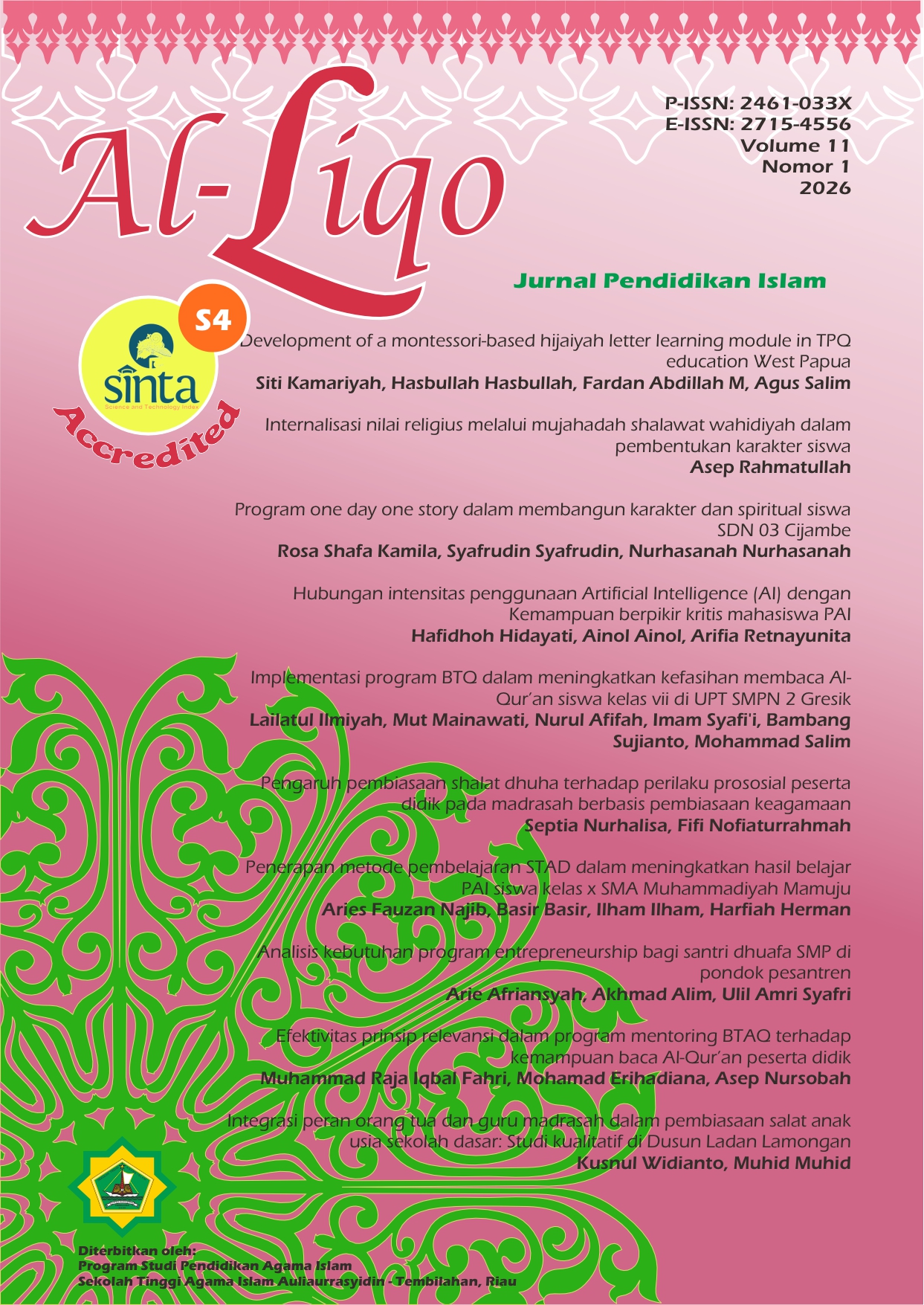
Internalisasi nilai religius melalui mujahadah shalawat wahidiyah dalam pembentukan karakter siswa
DOI:
https://doi.org/10.46963/alliqo.v11i1.3618Keywords:
Internalization, Mujahadah, Religious Values, Shalawat WahidiyahAbstract
This study examines the internalization of religious values through Mujahadah Shalawat Wahidiyah in shaping students’ character at Wahidiyah Senior High School, Kediri, East Java. Using a qualitative case study approach, data were collected through participatory observation, interviews with six informants, and documentation. The findings reveal that Mujahadah Shalawat Wahidiyah promotes key religious values, including sincerity, patience, honesty (siddiq), trustworthiness, and tabligh. The internalization process occurs through value transformation, value transaction, and transinternalization, supported by shalawat recitation, social interaction, and spiritual experiences. Students who regularly participate demonstrate improved emotional stability, prayer discipline, self-control, respectful communication, and social awareness. The study concludes that Mujahadah Shalawat Wahidiyah effectively strengthens students’ religious character by integrating cognitive, affective, and psychomotor dimensions while offering a practical model for spirituality-based character education in secondary schools.
Downloads
References
Aisah, A., & Sunanda, A. (2016). Nilai Religius Pada Novel Kubah Karya Ahmad Tohari: Tinjauan Sosiologi Sastra Dan Implementasinya Sebagai Bahan Pembelajaran Sastra Di Sma N 2 Sukoharjo [Phd Thesis, Universitas Muhammadiyah Surakarta]. https://eprints.ums.ac.id/46494/
Asom, M. (2017). Mujahadah Sholawat Wahidiyah dalam Pembentukan Akhlak Fast Siswa Di SMP Saljul Qulub Pondok Pesantren Kedunglo Miladiyyah Kota Kediri. Spiritualita, 1(2), 69-83. https://Doi.Org/10.30762/Spr.V1i2.644
Badriyan, M. K., Hidayat, N., & Daheri, M. (2024). Pembentukan Karakter Religius Santri Dalam Kegiatan Mujahadah. Nusantara: Jurnal Pendidikan Indonesia, 4(1), 97–114. https://journal.rumahindonesia.org/index.php/njpi
Bandura, A., & Walters, R. H. (1977). Social Learning Theory (Vol. 1). Prentice HallEnglewoodCliffs,Nj. http://Www.Asecib.Ase.Ro/Mps/Bandura_Sociallearningtheory.Pdf
Bimanyu, F. W., & Dwijayanto, A. (T.T.). Implementasi Kegiatan Mujāhadah Dan Orientasi Kepesantrenan Dalam Penguatan Karakter Religius Siswa Kelas 6 Mi Al Uswah Slogohimo. Diambil 20 Januari 2026, Dari https://Digilib-Pps.Insuriponorogo.Ac.Id/File_Jurnal/4b5a01ac7c4e78793bb70a6574abae44.Pdf
Creswell, J. W., & Clark, V. L. P. (2017). Designing And Conducting Mixed Methods Research. Sage Publications.
Creswell, J. W., & Creswell, J. D. (2017). Research Design: Qualitative, Quantitative, And Mixed Methods Approaches. Sage Publications. 8
Fajri, B., & Abdulghani, N. A. (2025). Symbolic Interactionism Between Students And Caregivers In Pesantren. Al-Jadwa: Jurnal Studi Islam, 5(1), 1–19. https://doi.org/10.38073/aljadwa.3310
Fajri, B., & Biantoro, O. F. (2023). Nilai-Nilai Sholawat Wahidiyah Dalam Menumbuhkan Kecerdasan Spiritual Dan Akhlakul Karimah. Jurnal Pendidikan Islam, 13(1), 72–92. https://doi.org/10.38073/jpi.v13i1.1098
Guba, E. G., & Lincoln, Y. S. (1994). Competing Paradigms In Qualitative Research. Handbook Of Qualitative Research, 2(163–194), 105.
Hamdani, S. R., & Amik, M. I. B. (2024). Implementasi Kegiatan Sholawat Wahidiyah Sebagai Pendidikan Akhlak Di Kampung Lg. Banjarejo–Kalimantan Timur. Journal Of Islamic Studies & Social Science, 1(1), 43–52. https://doi.org/10.64019/jisss.v1i1.7
Hosna, R. (2018b). Internalisasi Nilai-Nilai Tasawuf Dalam Shalawat Wahidiyah Bagi Pembentukan Karakter Mulia (Studi Kasus Di Smk Ihsanniat Rejoagung Ngoro Jombang). Fitrah: Jurnal Kajian Ilmu-Ilmu Keislaman, 4(1), 67–90. https://Doi.Org/10.24952/Fitrah.V4i1.877
Huberman, M., & Miles, M. B. (2002). The Qualitative Researcher’s Companion. Sage.
Maghfiroh, D. A. (2018). Perkembangan Tassawuf Sholawat Wahidiyah Di Pondok Pesantern At-Tahdzib Jombang Tahun 1993-2001. Journal Pendidikan Sejarah Avatara, 6(2). https://Ejournal.Unesa.Ac.Id/Index.Php/Avatara/Article/View/24635
Maisah, M., Kamal, M., Indrawan, I., Julianza, A., & Ariyanto, S. Y. (2020). Noble Industry: Pendidikan Multikultural Pesantren Dan Boarding School (Studi Terhadap Pesantren Salafy Dan Madrasah Berasrama Non-Pesantren Di Jambi). Jurnal Manajemen Pendidikan Dan Ilmu Sosial, 1(1), 1-8.
Moleong, L. J., & Surjaman, T. (2014). Metodologi Penelitian Kualitatif. https://Lib.Unj.Ac.Id/Slims2/Index.Php?P=Show_Detail&Id=1832
Muhaimin. Et Al. (1996). Strategi Belajar Mengajar: Penerapannya Dalam Pembelajaran Pendidikan Agama. Citra Media.
Mukaffa, Z. (2017). Transformasi Negasi Dimensi Kehambaan Pengamal Sholawat Wahidiyah Dan Implementasinya Pada Lembaga Pendidikan Formal. Islamica: Jurnal Studi Keislaman, 12(1), 204–229. http://repository.uinsa.ac.id/id/eprint/3345/1/Zumrotul%20Mukaffa_artikel_Transformasi%20negasi%20dimensi%20kehambaan.pdf
Mustaqim, M. (2021). Pendidikan Karakter Pada Jemaah Pengamal Wahidiyah Di Kabupaten Ngawi, Jawa Timur: Studi Perubahan Perilaku Sosial Keagamaan [Phd, Uin Sunan Ampel Surabaya]. http://Digilib.Uinsa.Ac.Id/50450/
Ni’mah, Z. A. (2020). Selawat Nabi In The Construction Of Local Sufis And Revivalists In Indonesia. Didaktika Religia, 8(2), 311–334.
Ruhdiyanto, D., Aldiansyah, R., Salsabila, N. A., Maulida, S. N., Nurseha, A., Maemunah, N., & Roni, R. (2023). Tradisi Pembacaan Sholawat Wahidiyah Keliling Sebagai Metode Pendekatan Diri Kepada Allah Swt Di Desa Gardu. Perspektif : Jurnal Pendidikan Dan Ilmu Bahasa, 1(3), 45–52. https://Doi.Org/10.59059/Perspektif.V1i3.409
Saputra, E. (2023). Pembiasaan Pembacaan Mujahadah Yasin Tahlil Dan Implikasinya Terhadap Karakter Religius Santri Pondok Pesantren Al Munawwir Komplek T Asy-Syathibi Krapyak Yogyakarta Tahun Ajaran 2022/2023 [Phd Thesis, Uin Sunan Kalijaga Yogyakarta]. https://Digilib.Uin-Suka.Ac.Id/Id/Eprint/61118/
Setyowati, E. (2020). Peran Majelis Sholawat Wahidiyyah Sebagai Instrumen Pembangunan Pendidikan Karakter (Studi Di Pondok Pesantren Kedunglo Kota Kediri). Tasamuh: Media Pengembangan Ilmu-Ilmu Keislaman, Filsafat, Dan Sosial, 3(1), 63–76. https://publikasiilmiah.unwahas.ac.id/TSM/article/view/5864
Sholiha, D. A., Alfa, F., & A’yun, Q. (2021). Pembentukan Karakter Religius Siswa Melalui Kegiatan Keagamaan Mujahadah Di Pondok Pesantren Kedunglo Ii Kepanjen Malang. Vicratina: Jurnal Ilmiah Keagamaan, 6(5), 92–101.
Spradley, J. P. (2016). Participant Observation. Waveland Press.
Stark, R., & Glock, C. Y. (1970). American Piety: The Nature Of Religious Commitment (Vol. 1). Univ Of California Press.
Syafe’i, I. (2017). Pondok Pesantren: Lembaga Pendidikan Pembentukan Karakter. Al-Tadzkiyyah: Jurnal Pendidikan Islam, 8(1), 61–82. https://ejournal.radenintan.ac.id/index.php/tadzkiyyah
Umar, M. (2023). Spirituality Of Ṣalawat Waḥîdiyyah In Forming A Sakinah Family: Study On The Psw Congregation In Rejoagung Ngoro Jombang. Al Hakam: The Indonesian Journal Of Islamic Family Law And Gender Issues, 3(2), 141–160.
Wicaksono, S., & Ari, M. K. H. A. A. (2024). Religion And Human Rights: Wahidiyah Phenomenon And Local Religious Traditions In Kediri. Al-Bustan: Jurnal Studi Islam Dan Sosial Keagamaan, 1(2), 131–151. https://doi.org/10.2024/fkwysz19
Yin, R. K. (2018). Case Study Research And Applications (Vol. 6). Sage Thousand Oaks.
Downloads
Published
Issue
Section
License
Copyright (c) 2026 Asep Rahmatullah

This work is licensed under a Creative Commons Attribution-ShareAlike 4.0 International License.
Authors who publish with this journal agree to the following terms:
1. Copyright on any article is retained by the author(s).
2. The author grants the journal, right of first publication with the work simultaneously licensed under a Creative Commons Attribution shareAlike 4.0 International License that allows others to share the work with an acknowledgment of the work’s authorship and initial publication in this journal.
3. Authors are able to enter into separate, additional contractual arrangements for the non-exclusive distribution of the journal’s published version of the work (e.g., post it to an institutional repository or publish it in a book), with an acknowledgment of its initial publication in this journal.
4. Authors are permitted and encouraged to post their work online (e.g., in institutional repositories or on their website) prior to and during the submission process, as it can lead to productive exchanges, as well as earlier and greater citation of published work.
5. The article and any associated published material is distributed under the Creative Commons Attribution-ShareAlike 4.0 International License




2.png)