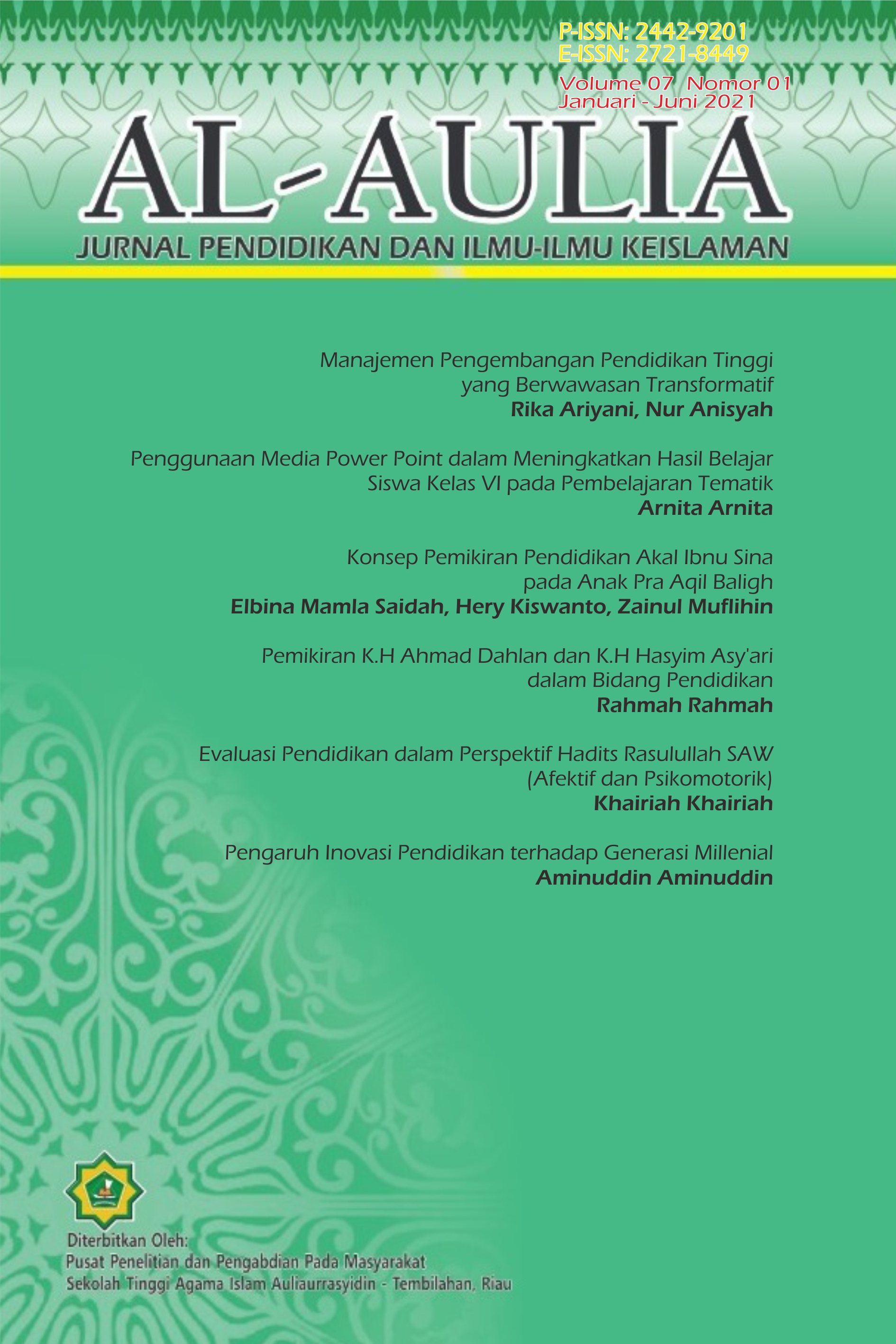
Konsep Pemikiran Pendidikan Akal Ibnu Sina pada Anak Pra Aqil Baligh
Keywords:
Education, Ibnu Sina, Pra-Aqil BalighAbstract
Baligh is the last stage of development of an individual according to the perspective of Islamic studies. This means that if a person has reached puberty, then a child is said to be mature physically, intellectually and emotionally as mentioned by Abu Zahrah that child development is divided into 4 stages, namely first Ash-Shobiy or At-Tifl (small children), second Mumayyiz (able to distinguish something), the third is Cheapiq (towards the age of puberty) and the fourth is Baligh. Ibn Sina was a polymath, who gave birth to many works of thought, including in the field of Education. Several studies on Ibn Sina's educational thoughts have been widely explored and published. Idris Irsyad revealed Ibn Sina's concept of goals, curriculum, methods and how to become a competent teacher. This research uses a literature study method, the object of this research is the concept of reason according to Ibn Sina. The method of data collection is a literature study by carrying out literal descriptions that support theories about intellectual education that affect pre-aqil baligh children.
Downloads
Published
Issue
Section
License
Authors who publish with this journal agree to the following terms:
1. Copyright on any article is retained by the author(s).
2. The author grants the journal, right of first publication with the work simultaneously licensed under a Creative Commons Attribution License that allows others to share the work with an acknowledgment of the work’s authorship and initial publication in this journal.
3. Authors are able to enter into separate, additional contractual arrangements for the non-exclusive distribution of the journal’s published version of the work (e.g., post it to an institutional repository or publish it in a book), with an acknowledgment of its initial publication in this journal.
4. Authors are permitted and encouraged to post their work online (e.g., in institutional repositories or on their website) prior to and during the submission process, as it can lead to productive exchanges, as well as earlier and greater citation of published work.
5. The article and any associated published material is distributed under the Creative Commons Attribution-ShareAlike 4.0 International License