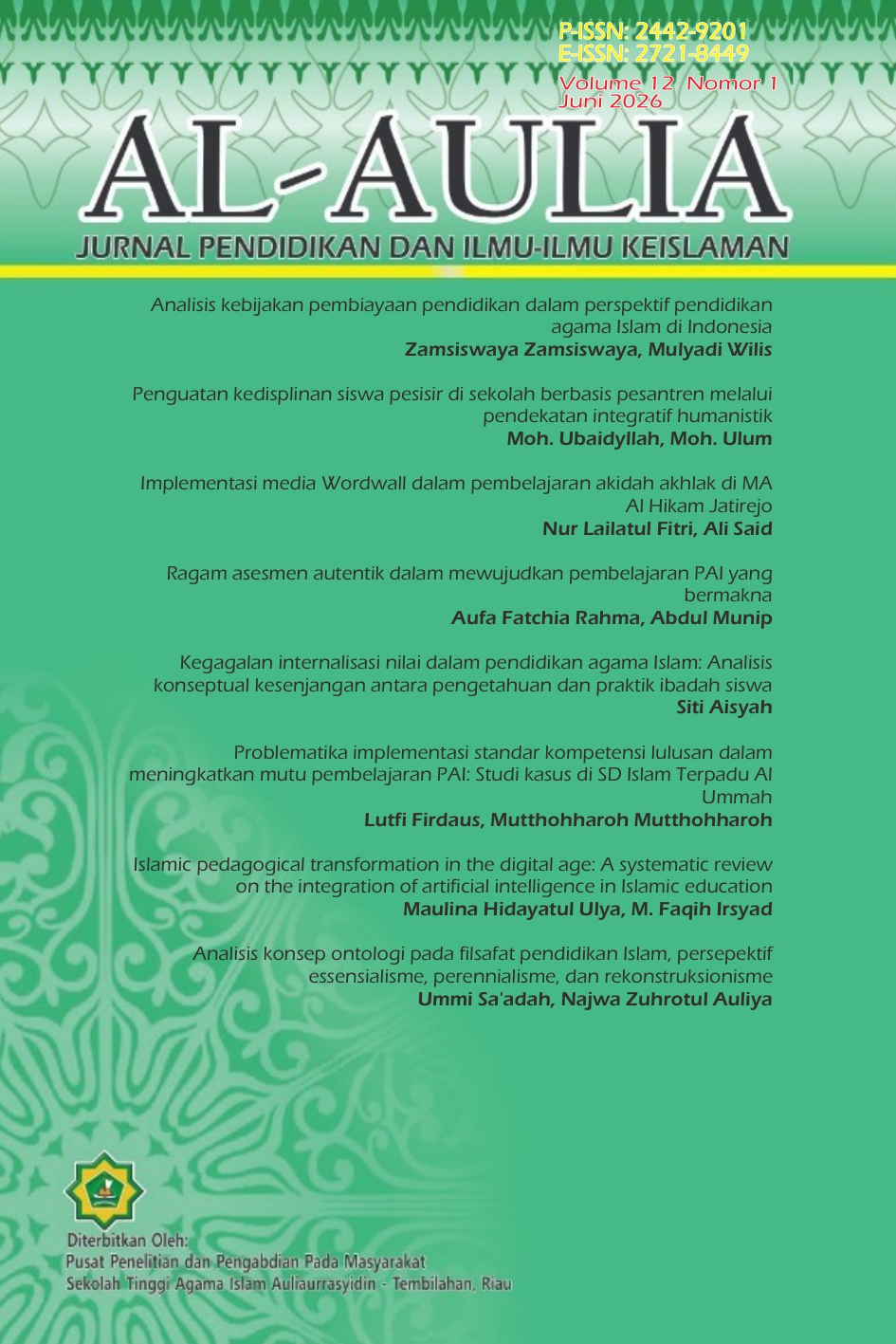
Implementasi media Wordwall dalam pembelajaran akidah akhlak di MA Al Hikam Jatirejo
DOI:
https://doi.org/10.46963/aulia.v12i1.3738Keywords:
Learning Media, Wordwall, Akidah AkhlakAbstract
This study aims to analyze the implementation of wordwall media in faith and morals learning at MA Al-Hikam Jatirejo Diwek Jombnag and its ability to improve the effectiveness of the learning process, especially in the subject of faith and morals. The use of wordwall media shows that teachers have utilized media as a are more interesting for students. This study uses a qualitative case study method with data collection techniques through observation, interviews, documentation, and triangulation. The result of the study indicate that wordwall media is able to increase students engagement and motivation because the presentation of material and evaluation is more varield and interactive. Faith and morals learning takes place through the stages of planning, implementation, and closing that refer to the independent curricuclum teaching module. The implementation of wordwall media has been proven to clarify the material, reducce bboredom, and strengthen student understanding. These findings confirm that the integration of wordwall media in faith and morals learning has a positive impact on students activity, understanding, and learning experiences, andis an effective and relevant alternative learning medium.
References
Azzahra, N. T., Ali, S. N. L., & Bakar, M. Y. A. (2025). Teori konstruktivisme dalam dunia pembelajaran. Jurnal Ilmiah Research Student, 2(2), 64–75. https://doi.org/10.61722/jirs.v2i2.4762
Bloom, B. S. (2010). A taxonomy for learning, teaching, and assessing: A revision of Bloom’s taxonomy of educational objectives. Longman.
Damanik, M. Z., & Ningrum, D. A. A. (2025). Pembelajaran akidah akhlak. At-Tarbiyah: Jurnal Penelitian dan Pendidikan Agama Islam, 2(2), 509–520. https://journal.staittd.ac.id/index.php/at/article/view/445
Lusiana, L., Fahrieyah, L. (2024). Pembelajaran kontekstual dalam pendidikan Islam. Jurnal Ilmiah Multidisipin, 2(2), 95–103. https://ejournal.lumbungpare.org/index.php/jim/article/view/198
Fauqannuri, I. R. (2022). Penerapan Media Berbasis Wordwall dalam Meningkatkan Motivasi dan Hasil Belajar Siswa Kelas Vii B Mata Pelajaran Pendidikan Agama Islam di SMPN 2 Panji Situbondo Tahun Pelajaran 2021/2022. UIN Kiai Haji Achmad Siddiq Jember.
Harsiwi, U. B., & Arini, L. D. D. (2020). Pengaruh pembelajaran menggunakan media pembelajaran interaktif terhadap hasil belajar siswa di sekolah dasar. Jurnal Basicedu, 4(4), 1104–1113. https://doi.org/10.31004/basicedu.v4i4.505
Hartati, F. R., Sumartiningsih, S., & Yuwono, A. (2024). Penggunaan media Wordwall untuk meningkatkan hasil belajar siswa SD: Literatur review. Jurnal Educatio Fkip Unma, 10(4), 1306-1314. https://doi.org/10.31949/educatio.v10i4.10206
Haryadi, R., & Al Kansaa, H. N. (2021). Pengaruh media pembelajaran e-learning terhadap hasil belajar siswa. AtTàlim: Jurnal Pendidikan, 7(1), 2548–4419
Hatija, M., & Rahim, R. (2023). Analisis tingkat kongnitif, afektif, psikomotorik RPP aqidah akhlak kelas xi Madrasah Aliyah Negeri (MAN) Palopo berdasarkan revisi taksonomi Bloom. Jurnal Andi Djemma| Jurnal Pendidikan, 6(1), 39–47. https://doi.org/10.35914/jad.v6i1.1730
Matthew B. Miles, Michael Huberman’s, J. S. (2014). Qualitative Data Analysis.
Nurhayati, D. (2024). Efektivitas wordwall sebagai media pembelajaran berbasis game based learning terhadap hasil belajar siswa pada mata pelajaran Akidah Akhlak kelas XI MAN Kota Blitar. Universitas Islam Negeri Maulana Malik Ibrahim
Nurhayati, N., Apriyanto, A., Ahsan, J., & Hidayah, N. (2024). Metodologi Penelitian Kualitatif: Teori dan Praktik. PT. Sonpedia Publishing Indonesia.
Piaget, J. (2015). The grasp of consciousness (psychology revivals): Action and concept in the young child. Psychology Press.
Purnamasari, S., Rahmanita, F., Soffiatun, S., Kurniawan, W., & Afriliani, F. (2022). Bermain bersama pengetahuan peserta didik melalui media pembelajaran berbasis game online word wall. Jurnal Pengabdian Masyarakat, 3(1), 70–77. https://doi.org/10.32493/AL-JPKM.V3I1.17052
Ramatulloh, D. K., & Said, A. (2024). Penggunaan media pembelajaran power point dalam meningkatkan motivasi belajar siswa pada mata pelajaran fiqih di SMK Islam Mbah Bolong Watugaluh Diwek Jombang. Jurnal Ilmiah Penelitian Mahasiswa, 2(4), 534–540. https://doi.org/10.61722/jipm.v2i4.320
Sagala, T. L. (2026). Pengaruh media pembelajaran interaktif wordwall terhadap hasil belajar siswa pada mata pelajaran IPA siswa kelas v SD Negeri 101858 Talapeta TP 2025/2026. Universitas Quality.
Sitanggang, C., Simalango, M., Purba, R., & Fahruzi, D. (2024). Analisis pengaruh penggunaan media audiovisual dalam meningkatkan minat dan motivasi belajar siswa. Jurnal Pendidikan dan Keguruan, 1(12), 3484–3492. https://adisampublisher.org/index.php/edu/article/view/927
Taabudillah, M. H., Muslim, H., & Habibi, M. S. (2026). Implementasi kurikulum berbasis cinta melalui pendekatan pembelajaran mendalam (Deep learning): Pembelajaran pendidikan agama Islam. Sosiotekno: Jurnal Ilmu Sosial dan Teknologi, 1(1), 34–41.
Zahrati, H. (2025). Penggunaan media pembelajaran interaktif berbasis aplikasi Wordwall pada mata pelajaran pendidikan agama Islam dan budi pekerti kelas x di SMA Negeri 5 Jember
Downloads
Published
Issue
Section
License
Copyright (c) 2026 Nur Lailatul Fitri, Ali Said

This work is licensed under a Creative Commons Attribution-ShareAlike 4.0 International License.
Authors who publish with this journal agree to the following terms:
1. Copyright on any article is retained by the author(s).
2. The author grants the journal, right of first publication with the work simultaneously licensed under a Creative Commons Attribution License that allows others to share the work with an acknowledgment of the work’s authorship and initial publication in this journal.
3. Authors are able to enter into separate, additional contractual arrangements for the non-exclusive distribution of the journal’s published version of the work (e.g., post it to an institutional repository or publish it in a book), with an acknowledgment of its initial publication in this journal.
4. Authors are permitted and encouraged to post their work online (e.g., in institutional repositories or on their website) prior to and during the submission process, as it can lead to productive exchanges, as well as earlier and greater citation of published work.
5. The article and any associated published material is distributed under the Creative Commons Attribution-ShareAlike 4.0 International License