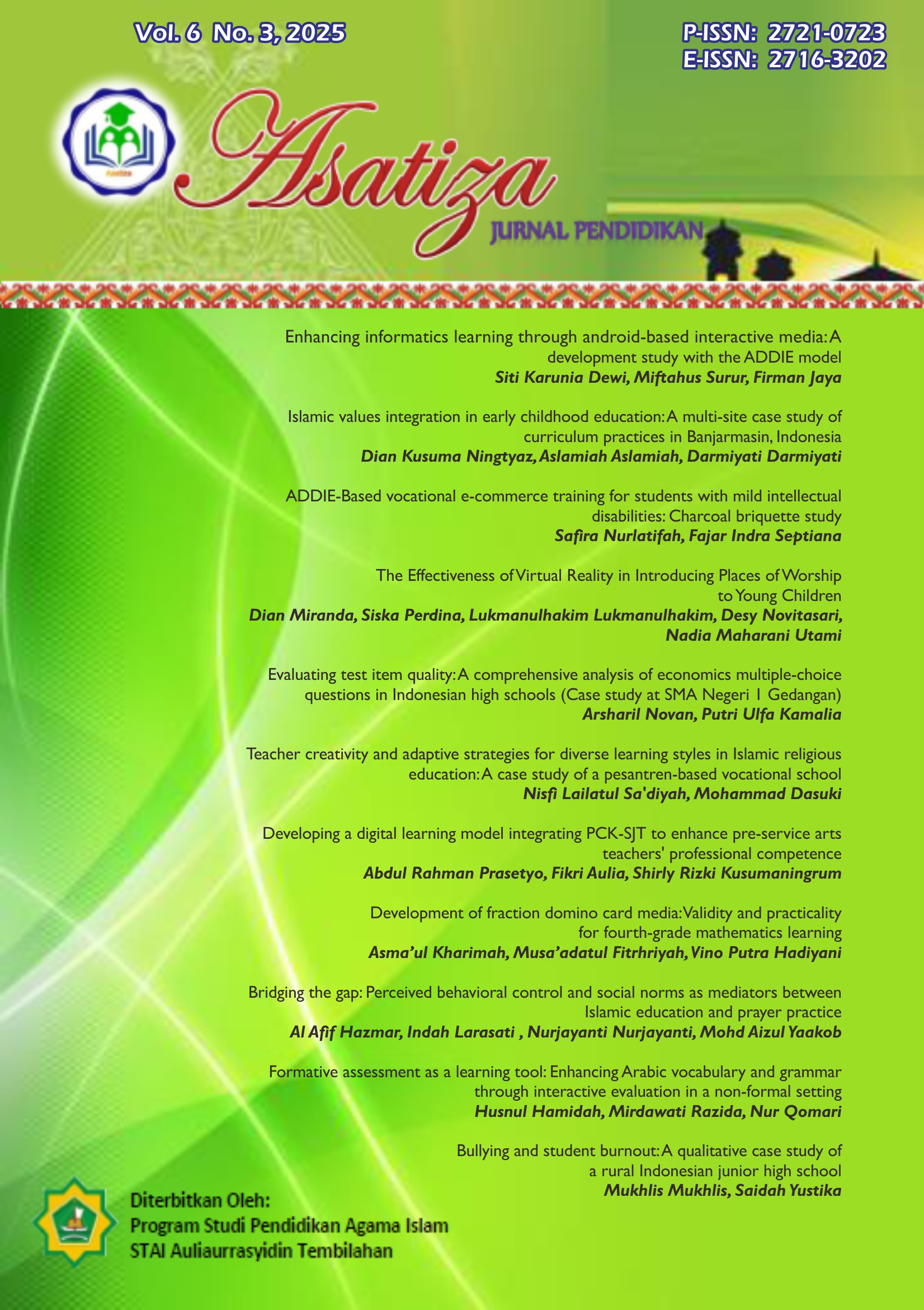
Evaluating test item quality: A comprehensive analysis of economics multiple-choice questions in Indonesian high schools (Case study at SMA Negeri 1 Gedangan)
DOI:
https://doi.org/10.46963/asatiza.v6i3.3168Keywords:
Question Item Analysis, Daily Assessment, Multiple-Choice QuestionsAbstract
This study aims to evaluate the psychometric characteristics of multiple-choice question items in the daily assessment instrument of Economics subjects in phase F at SMA Negeri 1 Gedangan. The instrument was developed through the first three stages of a 4D model (Define, Design, Develop) and analyzed using the Classical Test Theory (CTT) approach. Content validity was tested using the Aiken's V index, while empirical validity, difficulty level, differentiation, trick effectiveness, and reliability were analyzed quantitatively. The validation results showed that nine out of ten questions had sufficient content validity (V ≥ 0.50), but one question was declared invalid and removed. Quantitative analysis showed that 90% of the questions were relatively easy (P > 0.80), 35% had good differentiation (D ≥ 0.40), and the reliability of the instrument was in the medium category (KR-20 = 0.692). Some tricksters do not function optimally, indicating the need for improvements in the design of the answer choice. These findings affirm the importance of question item analysis in improving the quality of economic learning evaluation, especially in supporting formative assessments in accordance with the principles of the Independent Curriculum.
Downloads
References
Aiken, L. R. (1985). Three coefficients for analyzing the reliability and validity of ratings. Educational and Psychological Measurement, 45(1), 131–142. https://doi.org/10.1177/0013164485451012
Akhiralimi, N., Fitriani, A., Sari, I. P., & Maulidah, R. (2022). Analisis keterampilan berpikir tingkat tinggi siswa SMA pada pembelajaran fisika. Jurnal Eksakta Pendidikan (Jep), 6(2), 204–213. https://doi.org/10.24036/jep/vol6-iss2/696
Arifin, Z. (2013). Evaluasi pembelajaran. Remaja Rosdakarya.
Eleragi, A. M. S., Miskeen, E., Hussein, K., Rezigalla, A. A., Adam, M. I. E., Al-Faifi, J. A., Alhalafi, A., Al Ameer, A. Y., & Mohammed, O. A. (2025). Evaluating the multiple-choice questions quality at the College of Medicine, University of Bisha, Saudi Arabia: a three-year experience. BMC Medical Education, 25(1), 2–9. https://doi.org/10.1186/s12909-025-06700-2
Gebremichael, M. W., Baraki, B., Mehari, M. A., & Assalfew, B. (2025). Item analysis of multiple choice questions from assessment of health sciences students, Tigray, Ethiopia. BMC Medical Education, 25(1). https://doi.org/10.1186/s12909-025-06904-6
Habsy, B. A., Satsabhila, A., Syakilah, N. J. F., & Sanallah, A. K. (2024). Hakikat pendidikan dan pembelajaran, serta tanggung jawab dan kompetensi guru. Tsaqofah, 4(6), 4189–4203. https://doi.org/10.58578/tsaqofah.v4i6.4158
Haladyna, T. M. (2004). Developing and Validating Multiple-choice Test Items. Lawrence Erlbaum Associates. https://doi.org/10.4324/9780203825945
Hartono, I. D. I., Tenriawaru, A. B., & Ningsih, K. (2024). Analisis butir soal penilaian sumatif IPA kelas vii SMP Negeri 3 Pontianak menggunakan anates. Jurnal Kajian Pembelajaran Dan Keilmuan, 8(2), 162–171. https://doi.org/10.26418/jurnalkpk.v8i2.78282
Kemendikbudristek. (2022). Panduan Pembelajaran dan Asesmen. Badan Standar, Kurikulum, Dan Asesmen Pendidikan Kementerian Pendidikan, Kebudayaan, Riset, Dan Teknologi Republik Indonesia, 123.
Khuzaemah Allaely, N. S. (2024). Pentingnya proses evaluasi dalam pembelajaran di sekolah menengah pertama. Jurnal Bahasa Dan Sastra Indonesia Serta Pengajarannya, 2(2), 139–148. https://journal.uinjkt.ac.id/index.php/bestari/article/view/46246
Kurniawati, F. (2021). Exploring teachers’ inclusive education strategies in rural Indonesian primary schools. Educational Research, 63(2), 198–211. https://doi.org/10.1080/00131881.2021.1915698
Meguellati, S., Samia, A., Ferhat, A., Djelloul, A., & Khalifa, Z. A. (2024). A critical analysis of the use of classical test theory (CTT) in psychological testing: A comparison with item response theory (IRT). Pakistan Journal of Life and Social Sciences, 22(2), 9442–9449. https://doi.org/10.57239/PJLSS-2024-22.2.00715
Mitra Prawiki Suci, & Helendra. (2022). Analisis kualitas butir soal ujian akhir semester ganjil tahun pelajaran 2020/2021 mata pelajaran biologi kelas x SMA Negeri 1 Teluk Sebong. Biodidaktika: Jurnal Biologi Dan Pembelajarannya, 17(2), 13–23.
Mytra, P., Wardawaty, A., & Kusnadi, R. (2021, September). Society 5.0 in education: Higher order thinking skills. In BIS-HSS 2020: Proceedings of the 2nd Borobudur International Symposium on Humanities and Social Sciences, BIS-HSS 2020, 18 November 2020, Magelang, Central Java, Indonesia (Vol. 242). European Alliance for Innovation. http://dx.doi.org/10.4108/eai.18-11-2020.2311812
Nitko, A. J., & Brookhart, S. M. (2011). Educational assessment of students (6th ed.). Pearson.
Pratama, D. (2019). Analysis of Clasical Test Theory (Ctt) Approch on academic ability test instrument. Jisae: Journal of Indonesian Student Assesment and Evaluation, 5(2), 43–54. https://doi.org/10.21009/jisae.052.05
Rahmi, E., & Friyatmi, F. (2022). Financial Management Behavior of Student during the Covid 19 Pandemic BT - Proceedings of the Eighth Padang International Conference on Economics Education, Economics, Business and Management, Accounting and Entrepreneurship (PICEEBA-8 2021). 663–668. https://doi.org/10.2991/aebmr.k.220702.099
Rohanah, L., Mirawati, M., & Anwar, W. S. (2020). Pengaruh interaksi sosial terhadap aktivitas belajar peserta didik. Jurnal Pendidikan Dan Pengajaran Guru Sekolah Dasar (JPPGuseda), 03(September), 139–143. http://journal.unpak.ac.id/index.php/jppguseda
Savika, H. I., Zuhriyah, I. A., & Susilawati, S. (2025). Peran guru dalam analisis butir soal di sekolah dasar. JIIP - Jurnal Ilmiah Ilmu Pendidikan, 8(3), 3313–3319. https://doi.org/10.54371/jiip.v8i3.7534
Sholikhah, S., Sugiharto, B., & Raharjo, S. B. (2023). Analisis kemampuan berpikir tingkat tinggi (HOTS) peserta didik di SMA Negeri 1 Ngemplak dalam menyelesaikan soal asam basa. Prosiding SNPS (Seminar Nasional Pendidikan Sains), September, 267–275. https://proceeding.uns.ac.id/snps/issue/view/21
Siregar, N. H., Remiswal, R., & Khadijah, K. (2024). Analisis butir soal ujian tengah semester pada mata pelajaran pendidikan agama Islam. Urwatul Wutsqo: Jurnal Studi Kependidikan dan Keislaman, 13(2), 179–189. https://doi.org/10.54437/urwatulwutsqo.v13i2.1637
Thiagarajan, S. (1974). Instructional development for training teachers of exceptional children: A sourcebook. Council for Exceptional Children.
Zuriyati, Z. (2016). Analisis butir soal. Kencana.
Downloads
Published
Issue
Section
License
Copyright (c) 2025 Arsharil Novan, Putri Ulfa Kamalia

This work is licensed under a Creative Commons Attribution-ShareAlike 4.0 International License.
Authors who publish with this journal agree to the following terms:
1. Copyright on any article is retained by the author(s).
2. The author grants the journal, right of first publication with the work simultaneously licensed under a Creative Commons Attribution shareAlike 4.0 International License that allows others to share the work with an acknowledgment of the work’s authorship and initial publication in this journal.
3. Authors are able to enter into separate, additional contractual arrangements for the non-exclusive distribution of the journal’s published version of the work (e.g., post it to an institutional repository or publish it in a book), with an acknowledgment of its initial publication in this journal.
4. Authors are permitted and encouraged to post their work online (e.g., in institutional repositories or on their website) prior to and during the submission process, as it can lead to productive exchanges, as well as earlier and greater citation of published work.
5. The article and any associated published material is distributed under the Creative Commons Attribution-ShareAlike 4.0 International License




2.png)