
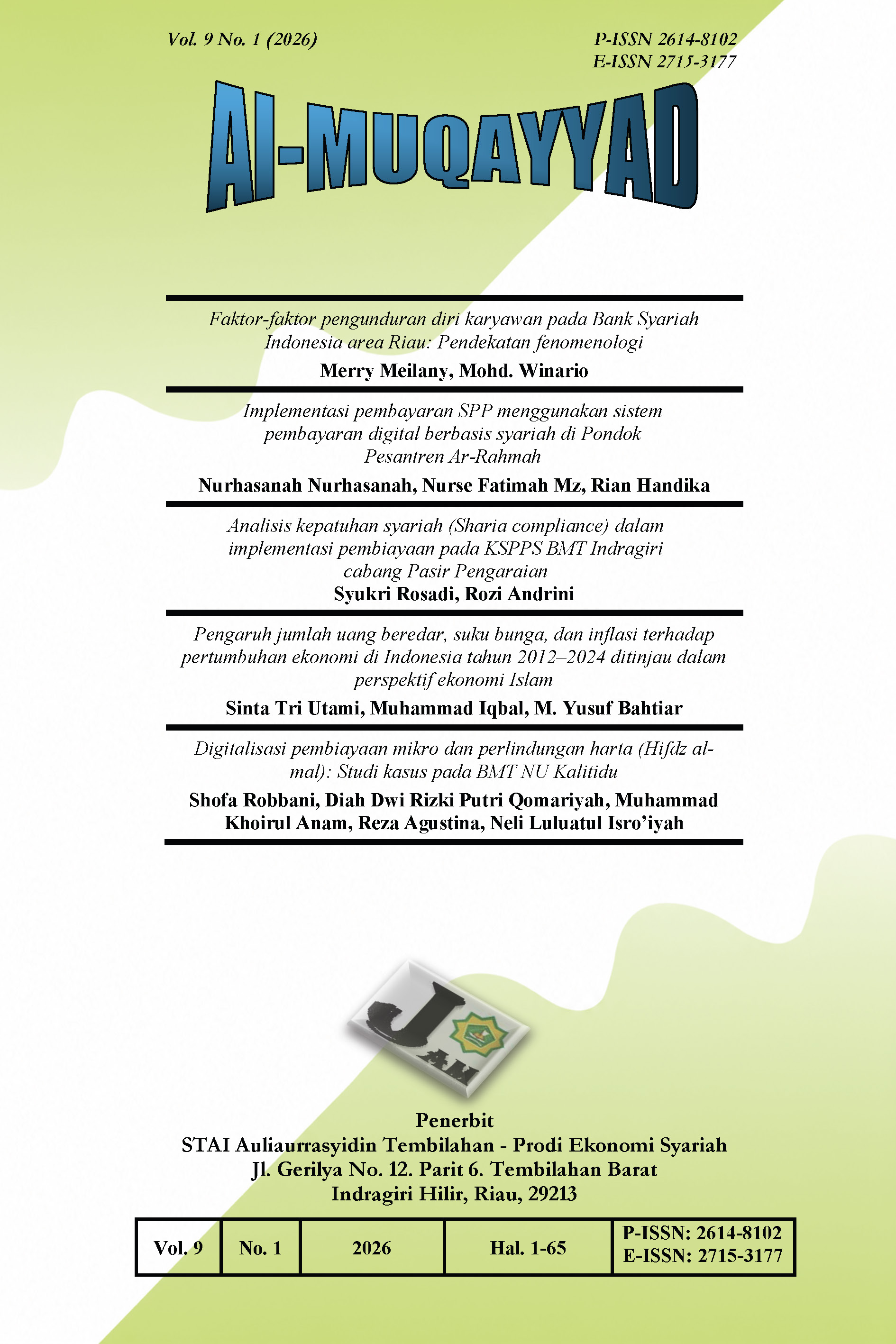
Pengaruh jumlah uang beredar, suku bunga, dan inflasi terhadap pertumbuhan ekonomi di Indonesia tahun 2012–2024 ditinjau dalam perspektif ekonomi Islam
DOI:
https://doi.org/10.46963/jam.v9i1.3715Keywords:
Economic Growth, Money Supply, Interest Rates, Inflation, Islamic EconomicsAbstract
This study aims to analyze the influence of money supply, interest rates, and inflation on economic growth in Indonesia for the 2012-2024 period using the VECM with quarterly data of 52 observations. The cointegration test results indicate a long-term relationship among the variables. In the long run, inflation has a significant effect on GDP, while money supply has a negative but very small effect, and interest rates have no significant effect. Overall, the three monetary variables collectively contribute less than 1% to GDP variations, thus they are not the main factors driving economic growth. The policy implications of these findings include the need to prioritize inflation control and reevaluate the effectiveness of interest rate instruments and money supply expansion in promoting growth. The contribution of this research lies in using a study period that covers various economic shocks (taper tantrum, pandemic, and recovery) and applying the VECM method capable of separating short-run and long-run effects. From the perspective of Islamic economics, these findings support the principles of distributive justice and the prohibition of usury (riba), as interest-based instruments prove ineffective, making the development of Sharia-based monetary policy through profit-sharing schemes a more relevant and equitable alternative.
Downloads
References
Fauzi, A., Damayanty, P., Pane, C. S., Julianti, E. A. C., Elok, P. G., & Rivai, I. (2023). Analisis dampak kebijakan moneter dan tingkat suku bunga terhadap pertumbuhan ekonomi. Jurnal Ekonomi Dan Manajemen, 2(2), 56. https://doi.org/10.56127/jekma.v2i2.713
Ambarwati, A. D., Sara, I. M., & Aziz, I. S. A. (2021). Pengaruh jumlah uang beredar (JUB), BI rate dan inflasi terhadap pertumbuhan ekonomi di Indonesia periode 2009-2018. Warmadewa Economic Development Jurnal (WEDI), 4(1), 21–27. https://doi.org/10.22225/wedj.4.1.3144.21-27
Edquist, H., Goodridge, P., & Haskel, J. (2021). The internet of things and economic growth in a panel of countries. Economics of Innovation and New Technology, 30(3), 262–283. https://doi.org/10.1080/10438599.2019.1695941
Fauziah, N. W., & Segaf. (2022). Seberapa pengaruh penetapan nisbah bagi hasil, inflasi, dan jumlah uang beredar terhadap deposito mudharabah di Indonesia. Jurnal Tabarru’: Islamic Banking and Finance, 5(2), 439–440. https://doi.org/10.25299/jtb.2022.vol5(2).9681
Friedman, M. (1963). Inflation: Causes and consequences. bombay: asia publishing house. Diakses dari https://miltonfriedman.hoover.org/internal/media/dispatcher/214232/full
Salim, A., & Fadilla. (2021). Pengaruh inflasi terhadap pertumbuhan ekonomi Indonesia. Ekonomika Sharia: Jurnal Pemikiran Dan Pengembangan Ekonomi Syariah, 7(1), 17–18. https://doi.org/10.36908/esha.v7i1.268
Siregar, R. H., & Lubis, I. (2024). Analisis regresi pengaruh inflasi, suku bunga dan pengangguran terhadap pertumbuhan ekonomi di Sumatera Utara. Journal of Islamic Business Management Studies (JIBMS), 5(2), 96–107. https://doi.org/10.51875/jibms.v5i2.343
Sitepu, A. A., Tantular, B., Darmawan, G., & Septiani, R. (2023). Pemodelan Produk Domestik Bruto (PDB) dengan pendekatan vector error correction model (VECM). PRIMER: Jurnal Ilmiah Multidisiplin, 1(2), 63–70. https://doi.org/10.55681/primer.v1i2.50
Sofiana, U., Etika, C., & Bahtiar, M. Y. (2024). Pengaruh ekspor, nilai tukar dan uang beredar terhadap cadangan devisa di 5 negara berkembang terpilih tahun 2018- 2019 dalam perspektif ekonomi Islam. J-CEKI: Jurnal Cendekia Ilmiah, 3(6), 8706–8717. https://doi.org/10.56799/jceki.v3i6.6789
Sugiyono, & Lestari, P. (2022). Metode penelitian kuantitatif, kualitatif, dan r&d. Alfabeta.
Suriani, N., Risnita, & Jailani, M. S. (2023). Konsep populasi dan sampling serta pemilihan partisipan ditinjau dari penelitian ilmiah pendidikan. IHSAN : Jurnal Pendidikan Islam, 1(2), 24–36. https://doi.org/10.61104/ihsan.v1i2.55
Ratri, D. A, & Munawar.(2022). Analisis pengaruh suku bunga (BI Rate), jumlah uang beredar dan ekspor terhadap inflasi di indonesia pada masa pandemi covid-19. JDESS: Journal od Development Economics and Social Studies, 1(5). https://doi.org/10.21776/jdess.2022.01.1.6
Luthfiana, H. A. S., Ayuninggar, I. L., Mumtaz, J. (2022). Pengaruh inflasi dan suku bunga terhadap pertumbuhan ekonomi di Indonesia. Jurnal Ekonomi (Journal of Economic) 13. 2(8). https://doi.org/10.47007/jeko.v13i2.5451
Oktapiani, Sri, and Firmansyah, Y. (2024). Tinjauan hukum Islam terhadap pemotongan timbangan buah sawit di desa Sebawi kecamatan Sebawi. Halalan Thayyiban: Jurnal Kajian Manajemen Halal dan Pariwisata Syariah 8(1), 43-55. https://journal.iaisambas.ac.id/index.php/HalalanThayyiban/article/view/2906
Downloads
Published
Issue
Section
License
Copyright (c) 2026 Sinta Tri Utami, Muhammad Iqbal, M. Yusuf Bahtiar

This work is licensed under a Creative Commons Attribution-ShareAlike 4.0 International License.
Authors who publish with this journal agree to the following terms:
1. Copyright on any article is retained by the author(s).
2. The author grants the journal, right of first publication with the work simultaneously licensed under a Creative Commons Attribution shareAlike 4.0 International License that allows others to share the work with an acknowledgment of the work’s authorship and initial publication in this journal.
3. Authors are able to enter into separate, additional contractual arrangements for the non-exclusive distribution of the journal’s published version of the work (e.g., post it to an institutional repository or publish it in a book), with an acknowledgment of its initial publication in this journal.
4. Authors are permitted and encouraged to post their work online (e.g., in institutional repositories or on their website) prior to and during the submission process, as it can lead to productive exchanges, as well as earlier and greater citation of published work.
5. The article and any associated published material is distributed under the Creative Commons Attribution-ShareAlike 4.0 International License



2.png)