
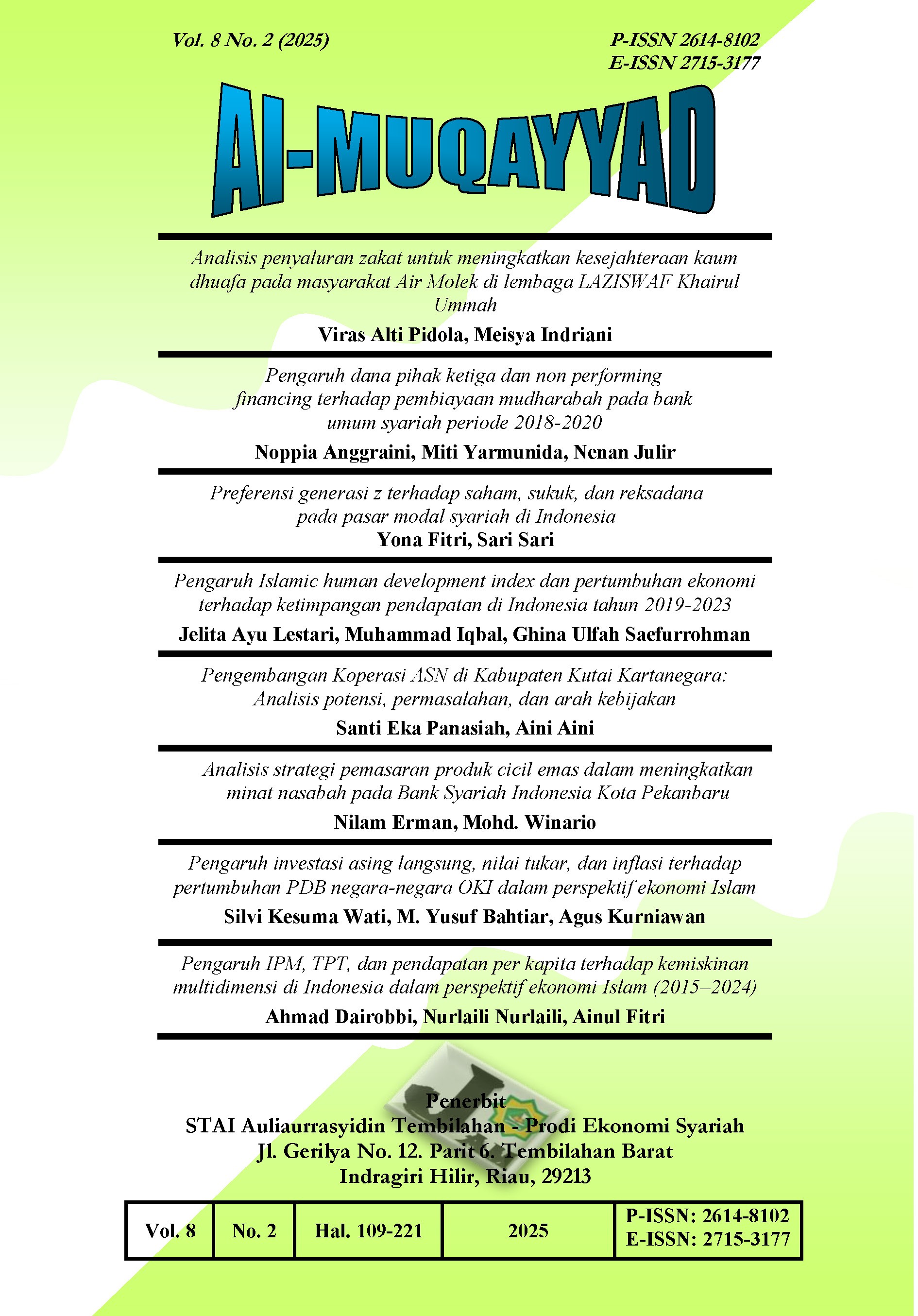
Pengaruh Islamic human development index dan pertumbuhan ekonomi terhadap ketimpangan pendapatan di Indonesia tahun 2019-2023
DOI:
https://doi.org/10.46963/jam.v8i2.3232Keywords:
I-HDI, Economic Growth, Income InequalityAbstract
This study aims to analyze the effect of the Islamic Human Development Index (I-HDI) and economic growth on income inequality in Indonesia during the 2019-2023 period. The research employs a quantitative approach using secondary data from 34 provinces in Indonesia, obtained from the Central Statistics Agency (BPS) and other official sources. The analysis method applied is panel data regression, with the best model selected through the Chow and Hausman tests, which confirmed the Fixed Effect Model (FEM) as the most appropriate estimation model. The results show that partially, I-HDI has no effect on income inequality, while economic growth has a negative and significant effect. Simultaneously, I-HDI and economic growth have a significant effect on income inequality, with a contribution of 57.1%, while the remaining 42.9% is explained by other factors outside the model. These findings emphasize that inclusive economic growth plays an important role in reducing inequality, while improving human development quality based on maqaşid al-shari'ah requires more equitable distribution to optimally reduce income disparity.
Downloads
References
Amir, A. (2021). Ekonomi Pembangunan Islam. WIDA Publishing.
Anggraini, N., Santosa, P. B., & Citaningati, P. R. (2024). Pengaruh Islamic Human Development Index , Pengangguran , Ketimpangan Pendapatan , dan Upah Minimum Kabupaten Terhadap Kemiskinan ( Studi di Provinsi Daerah Istimewa Yogyakarta Periode Tahun 2009-2022). 10(03), 3143–3153.
Arfah, A., & Arif, M. (2021). Pembangunan Ekonomi, Keadilan Sosial dan Ekonomi Berkelanjutan dalam Perspektif Islam. SEIKO: Journal of Management & Business, 4(1), 566–581.
Badan Pusat Statistik. (2023). Gini Ratio Indonesia Tahun 2019-2023. Https://Www.Bps.Go.Id/Id/Statistics-Table/2/OTgjMg==/Gini-Rasio--Maret-2023.Html.
Devi, Y., & Saefurrohman, G. U. (2024). Analisis pengaruh PDRB, investasi & PAD terhadap ketimpangan distribusi pendapatan dalam perspektif ekonomi Islam (Studi pada provinsi Lampung tahun 2018-2023). Jurnal Media Akademik (JMA), 2(11).
Efendi, B., Nasution, D. P., Rusiadi, R., & Pratiwi, D. (2024). Teori Indeks Pembangunan Manusia dan Pertumbuhan Ekonomi. Penerbit Tahta Media.
Hifzanaddin, G. M. (2020). Pengaruh Islamic human development index terhadap tingkat kemiskinan dan rasio gini di daerah istimewa Yogyakarta tahun 2009–2018. Universitas Islam Indonesia.
Iqbal, M., Kusuma, H., & Sunaryati, S. (2022). Vulnerability of Islamic banking in ASEAN. Islamic Economic Studies, 29(2), 159–168.
Janah, M. (2022). Analisis pengaruh tingkat pdrb perkapita, indeks pembangunan manusia, dan penanaman modal asing terhadap ketimpangan pendapatan di indonesia periode tahun 2019-2021. Profit: Jurnal Manajemen, Bisnis Dan Akuntansi, 1(4), 23–43.
Kunenengan, R. M. A., Engka, D. S. M., & Rorong, I. P. F. (2023). Pengaruh pertumbuhan ekonomi dan kemiskinan terhadap ketimpangan pendapatan lima Kabupaten / Kota Di Bolaang Mongondow Provinsi Sulawesi Utara. 23(3), 133–144.
Lala, A. J., Naukoko, A. T., & Siwu, H. F. D. (2023). Analisis Pengaruh Pertumbuhan Ekonomi Dan Indeks Pembangunan Manusia Terhadap Tingkat Ketimpangan Pendapatan (Studi Pada Kota–Kota Di Provinsi Sulawesi Utara). Jurnal Berkala Ilmiah Efisiensi, 23(1), 61–72.
Putra, D. S. (2021). Teori Ekonomi Mikro. PT. Muara Karya.
Queentha Monica Maorencia, M. (2022). Pengaruh Pertumbuhan Ekonomi, Investasi Dan Indeks Pembangunan Manusia Terhadap Ketimpangan Pendapatan Di Indonesia. Jurnal Manajemen dan Pendidikan Dasar, 3, 571–580.
Rafsanjani, H. (2022). Islamic human devolepment index in Indonesia. UMSurabaya Publishing.
Rizqullah, A. B. (2021). Determinan Ketimpangan Pendapatan Di Kawasan Timur Indonesia.
Saputra, M. I., & Zulham, T. (2023). Analisis faktor faktor yang mempengaruhi ketimpangan distribusi pendapatan di kota Banda Aceh. Jurnal Ilmiah Mahasiswa Ekonomi Pembangunan, 8(3), 178–188.
Utami, T. A., Nurul, R., Wahyuni, T., & Timur, J. (2022). Pengaruh Pendidikan dan Pertumbuhan Ekonomi Terhadap Ketimpangan Pendapatan di Indonesia dengan Akses Energi Sebagai Variabel Moderasi : Moderated Regression Analysis. 2018, 1031–1040.
Viollani, K. A., & Suprayitno, E. (2022). Pengaruh islamic human development index dan pertumbuhan ekonomi terhadap kemiskinan dengan pengangguran sebagai variabel intervening. 4(11), 5233–5244.
Downloads
Published
Issue
Section
License
Copyright (c) 2025 Jelita Ayu Lestari, Muhammad Iqbal, Ghina Ulfah Saefurrohman

This work is licensed under a Creative Commons Attribution-ShareAlike 4.0 International License.
Authors who publish with this journal agree to the following terms:
1. Copyright on any article is retained by the author(s).
2. The author grants the journal, right of first publication with the work simultaneously licensed under a Creative Commons Attribution shareAlike 4.0 International License that allows others to share the work with an acknowledgment of the work’s authorship and initial publication in this journal.
3. Authors are able to enter into separate, additional contractual arrangements for the non-exclusive distribution of the journal’s published version of the work (e.g., post it to an institutional repository or publish it in a book), with an acknowledgment of its initial publication in this journal.
4. Authors are permitted and encouraged to post their work online (e.g., in institutional repositories or on their website) prior to and during the submission process, as it can lead to productive exchanges, as well as earlier and greater citation of published work.
5. The article and any associated published material is distributed under the Creative Commons Attribution-ShareAlike 4.0 International License




2.png)