
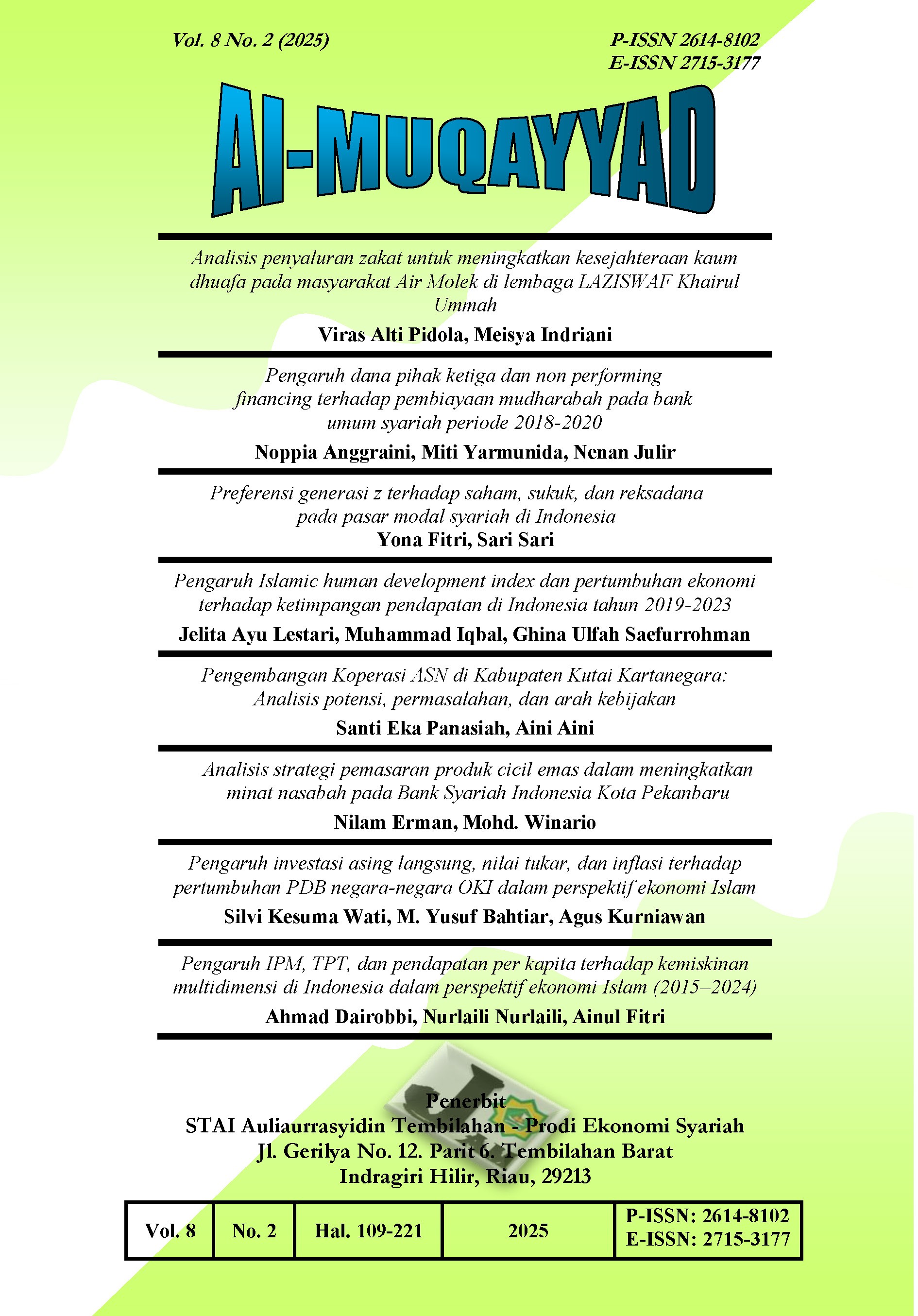
Pengaruh investasi asing langsung, nilai tukar, dan inflasi terhadap pertumbuhan PDB negara-negara OKI dalam perspektif ekonomi Islam
DOI:
https://doi.org/10.46963/jam.v8i2.3246Keywords:
Gross Domestic Product, Foreign Direct Investment, Exchange Rate, InflationAbstract
One of the main indicators for measuring a country's economic performance is GDP. This study aims to analyze the effect of foreign direct investment, exchange rates and inflation on GDP in OIC countries. This research method uses an Associative quantitative approach with a Panel Data Regression model. The population in this study is 57 OIC countries. The sample in this study was selected using Purposive Sampling Technique, using Secondary Data. Data were analyzed using Eviews10. The results of the study show that foreign direct investment and exchange rates have an insignificant effect on GDP while inflation has a significant effect on GDP in OIC, and simultaneously the three variables do not have a significant effect on OIC GDP.
Downloads
References
Aviantih, D. A. (2023). Analisis Faktor Faktor Yang Mempengaruhi Investasi Asing Langsung Di 5 Negara Asean Data Panel 2010-2021. Jurnal Ilmiah Wahana Pendidikan, (15), 98–105. https://doi.org/10.5281/zenodo.8201763
Basuki, A. T. R. I., & Yuliadi, I. (2014). Electronic data processing.
Bramtheo, F. T., Anggraeni, E., & Utamie, Z. R. (2025). Pengaruh Nilai Tukar dan Tingkat Inflasi terhadap Produk Domestik Bruto Negara Anggota Organisasi Kerjasama Islam (OKI) Pespektif Ekonomi Islam Tahun 2008 – 2023. Jurnal Ekonomi Dan Bisnis Islam (JEBI), 5(1), 15–50. https://doi.org/10.56013/jebi.v5i1.3856
Dewi Sekarsari, Faza Amaliah Az Zahra, Frista Rahma Ayuningtyas, A. F. (2024). Analisis Dinamika Inflasi dan Implikasinya terhadap Stabilitas Ekonomi di Indonesia. Journal Of Macroeconomics and Social Development, 1(3). https://doi.org/10.47134/jmsd.v1i3.194
Dinda Anggraini, D. M. (2025). Pengertian statistik dan manfaat statistik dalam kehidupan sehari-hari. JIIC: Jurnal Intelek Insan Cendikia, 8767–8774. https://jicnusantara.com/index.php/jiic
Dornbusch, R. (1976). Expectations and exchange rate dynamics. Journal of Political Economy, 84(6). https://doi.org/10.1086/260506
Dwi, Y., & Pasaribu, J. P. K. (2023). Pengaruh Inflasi terhadap Pertumbuhan Ekonomi di Indonesia Periode 2013-2021. Jurnal Ilmiah Manajemen Dan Kewirausahaan (JUMANAGE), 2(1), 131–137. https://doi.org/10.33998/jumanage.2023.2.1.673
Erni Febrina Harahap, Natasya Wulan Devinda, R. J. F. (2023). Analisis ekspor, impor, nilai tukar dan inflasi terhadap produk domestik bruto Indonesia. Jurnal Bisnis Net, 6(2), 875–885. https://doi.org/10.46576/bn.v6i2.3664
Fauzan Roland Nabongkalon. (2023). Pengaruh Foreign Direct Investment, Jumlah Penduduk, Inflasi, Dan Pengangguran, Terhadap Pertumbuhan Ekonomi Di Negara-Negara Asean Tahun 2012 – 2021. Universitas Islam Indonesia.
Ghozali, Imam., D. R. (2013). Analisis Multivariat dan Ekonometrika, Teori, Konsep, dan Aplikasi dengan Eviews 8. Semarang: Badan Penerbit Universitas Diponegoro.
Hanisah, N., & Syarvina, W. (2023). Analisis Pengaruh Nilai Tukar (Kurs) dan Inflasi terhadap Pertumbuhan Ekonomi di Indonesia. 2, 150–162.
Harahap, W. A., Imsar, & Rahmani, N. A. B. (2023). The Influence of Inflation and Exchange Rates on the Balance of Trade in Member Countries of the Organization of Islamic Cooperation (OKI) (Case Study: Indonesia, Brunei Darussalam and Saudi Arabia). International Journal of Economics Development Research, 4(2), 608–621. https://doi.org/10.37385/ijedr.v4i3.3213
Krugman, P., & Obstfeld, M. (2018). International Economics: Theory and Policy. Boston: Pearson Education.
M Bahrudin, A Kurniawan, and S. (2022). Peran Zakat dalam Pertumbuhan Ekonomi di Provinsi Lampung (Studi pada Baznas Kota Bandar Lampung). Jurnal Ilmiah Ekonomi Islam, 8(2), 1513–1521. http://dx.doi.org/10.29040/jiei.v8i2.5740
Mankiw, N. G. (2014). Principles of Economics (7th ed.). Boston: Cengage Learning.
Mukaromah., E. W. (2023). Pengaruh tingkat inflasi, nilai tukar, ekspor minyak bumi, dan agriculture sector terhadap produk domestik bruto di sepuluh negara anggota OKI tahun 2011–2020. Skripsi, Universitas Islam Negeri Salatiga.
Napitupulu, R. B., Simanjuntak, T. P., Hutabarat, L., Damanik, H., Harianja, H., & Sirait, R. T. M., Tobing, L., & Ria, C. E. (2021). Penelitian Bisnis, Teknik dan Analisa dengan SPSS - STATA - Eviews. 1 ed. Madenatera.
Profesor Werner Antweiler. (1996). Paritas daya beli. In Layanan Kurs Pertukaran Pasifik. ekolah Bisnis Sauder • Universitas British Columbia.
Rahmandani, N., & Dewi, E. P. (2023). Pengaruh Energi Terbarukan, Emisi Karbon, Dan Foreign Direct Investment Terhadap Pertumbuhan Ekonomi Negara Anggota OKI. Jurnal Ilmiah Ekonomi Islam, 9(01), 405–417. http://dx.doi.org/10.29040/jiei.v9i1.6962
Rizky Amalia. (2020). Pengaruh nilai tukar terhadap pertumbuhan ekonomi di negara-negara ASEAN.
Sari, E. P., F. A. (2014). Modal manusia dan produktivitas. Jejak: Jurnal Ekonomi Dan KebijakaN, 7(1), 22–28. https://doi.org/10.15294/jejak.v7i1.3840
Silaban, P. S., & Rejeki, R. (2020). Pengaruh inflasi, ekspor dan impor terhadap PDB di. Niagawan. 9(1), 56–64. https://doi.org/10.24114/niaga.v9i1.17656
Sinta Andiana Putri, Widiarti, D. E. N. (2025). Kajian model regresi data panel pada data indeks pembangunan manusia provinsi DKI Jakarta tahun 2019-2023. MATHunesa Jurnal Ilmiah Matematika, 13(01), 117–124. https://doi.org/10.26740/mathunesa.v13n1.p117-124
Sugiyono. (2017). Statistika untuk penelitian. Bandung: alfabeta.
Sukirno, S. (2005). Ekonomi Pembangunan, Proses, Masalah dan Dasar Kebijaksanaan. LPFEUIJakarta.
Undari Sulung, M. M. (2024). Memahami penelitian data sumber: primer, sekunder, dan tersier. Jurnal Edu ResearchIndonesian Institute for Corporate Learning and Studies (IICLS), 5(September), 110–116. https://doi.org/10.47827/jer.v5i3.238
Downloads
Published
Issue
Section
License
Copyright (c) 2025 Silvi Kesuma Wati, M. Yusuf Bahtiar, Agus Kurniawan

This work is licensed under a Creative Commons Attribution-ShareAlike 4.0 International License.
Authors who publish with this journal agree to the following terms:
1. Copyright on any article is retained by the author(s).
2. The author grants the journal, right of first publication with the work simultaneously licensed under a Creative Commons Attribution shareAlike 4.0 International License that allows others to share the work with an acknowledgment of the work’s authorship and initial publication in this journal.
3. Authors are able to enter into separate, additional contractual arrangements for the non-exclusive distribution of the journal’s published version of the work (e.g., post it to an institutional repository or publish it in a book), with an acknowledgment of its initial publication in this journal.
4. Authors are permitted and encouraged to post their work online (e.g., in institutional repositories or on their website) prior to and during the submission process, as it can lead to productive exchanges, as well as earlier and greater citation of published work.
5. The article and any associated published material is distributed under the Creative Commons Attribution-ShareAlike 4.0 International License




2.png)