
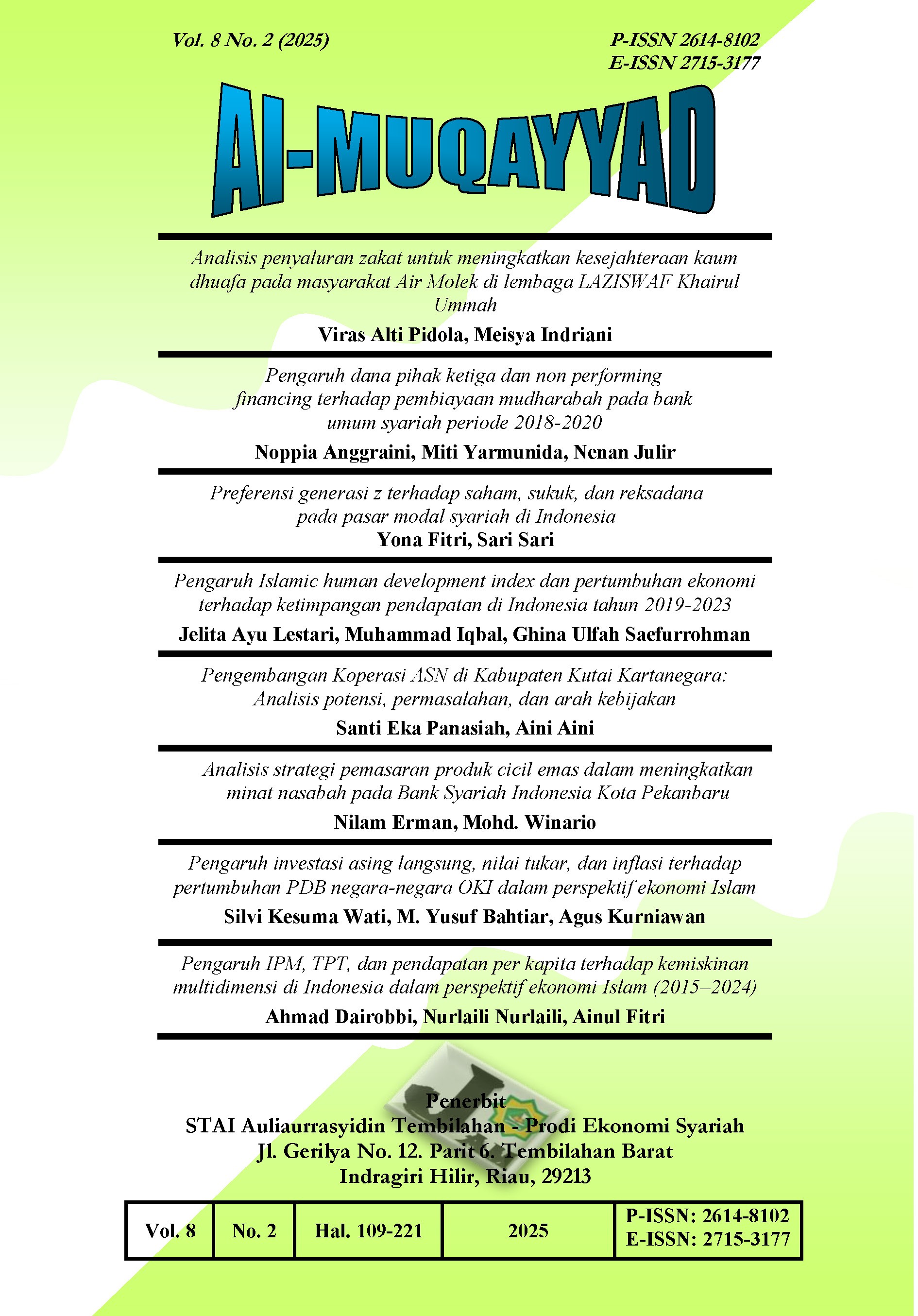
Analisis penyaluran zakat untuk meningkatkan kesejahteraan kaum dhuafa pada masyarakat Air Molek di lembaga LAZISWAF Khairul Ummah
DOI:
https://doi.org/10.46963/jam.v8i2.2745Keywords:
Zakat Distribution, LAZISWAF Khairul Ummah, Community WelfareAbstract
Zakat is a key instrument with a strategic role in wealth distribution and poverty alleviation. The effectiveness of zakat distribution in achieving these goals still requires in-depth analysis within the context of economic and social welfare. This study aims to analyze the distribution mechanism, identify changes in welfare levels, and evaluate zakat distribution towards improving welfare. The study used a qualitative descriptive approach supported by quantitative data. Data were obtained through interviews, field observations, and documentation. Analysis was carried out through data reduction, data presentation, and drawing conclusions with welfare indicators covering economic (income and employment), social (education and health), and spiritual (active worship and independence). The results show that LAZISWAF Khairul Ummah implements two forms of zakat distribution: consumptive zakat to meet basic needs and productive zakat in the form of business capital assistance. Zakat distribution has been proven to have a positive impact on improving the welfare of the poor, indicated by increased income, access to education, and social participation. However, long-term effectiveness still needs to be improved through mentoring programs and ongoing monitoring.
Downloads
References
Al-Qaradawi, Y. (2011). Fiqh az-zakah: A comparative study of zakah, regulations and philosophy in the light of Qur’an and Sunnah. Scientific Publishing Centre, King Abdulaziz University.
Ascarya, & Rahmawati, S. (2020). The impact of productive zakat on economic empowerment of mustahik in Indonesia. Journal of Islamic Monetary Economics and Finance, 6(2), 351–370.
Badan Amil Zakat Nasional (BAZNAS). (2023). Zakat impact report 2023. Jakarta: BAZNAS.
Beik, I. S., & Arsyianti, L. D. (2019). Zakat and development: The role of zakat in building human capital and reducing poverty in Indonesia. Jakarta: IPB Press.
Gujarati, D. N., & Porter, D. C. (2009). Basic econometrics (5th ed.). New York, NY: McGraw-Hill.
Huda, N., & Rini, N. (2022). The role of productive zakat in improving welfare of mustahik. Journal of Islamic Economics, 5(2), 134–148.
Kementerian Agama Republik Indonesia. (2022). Laporan statistik zakat nasional tahun 2022. Direktorat Pemberdayaan Zakat dan Wakaf.
Ma’ruf, A. (2021). Analisis faktor-faktor yang mempengaruhi kesadaran zakat masyarakat Indonesia. Jurnal Ekonomi Syariah Indonesia, 9(1), 45–58.
Sugiyono. (2021). Metode penelitian kuantitatif, kualitatif, dan R&D. Bandung: Alfabeta.
Wibowo, A., & Hasanah, U. (2022). Productive zakat and empowerment of mustahik: A case study of community-based zakat management. Al-Iqtishad: Journal of Islamic Economics, 14(3), 525–540.
Yusuf, M., & Rahman, F. (2020). The effectiveness of zakat distribution in alleviating poverty in Indonesia. Journal of Islamic Accounting and Finance Research, 2(1), 89–104.
Downloads
Published
Issue
Section
License
Copyright (c) 2025 Viras Alti Pidola, Meisya Indriani

This work is licensed under a Creative Commons Attribution-ShareAlike 4.0 International License.
Authors who publish with this journal agree to the following terms:
1. Copyright on any article is retained by the author(s).
2. The author grants the journal, right of first publication with the work simultaneously licensed under a Creative Commons Attribution shareAlike 4.0 International License that allows others to share the work with an acknowledgment of the work’s authorship and initial publication in this journal.
3. Authors are able to enter into separate, additional contractual arrangements for the non-exclusive distribution of the journal’s published version of the work (e.g., post it to an institutional repository or publish it in a book), with an acknowledgment of its initial publication in this journal.
4. Authors are permitted and encouraged to post their work online (e.g., in institutional repositories or on their website) prior to and during the submission process, as it can lead to productive exchanges, as well as earlier and greater citation of published work.
5. The article and any associated published material is distributed under the Creative Commons Attribution-ShareAlike 4.0 International License




2.png)