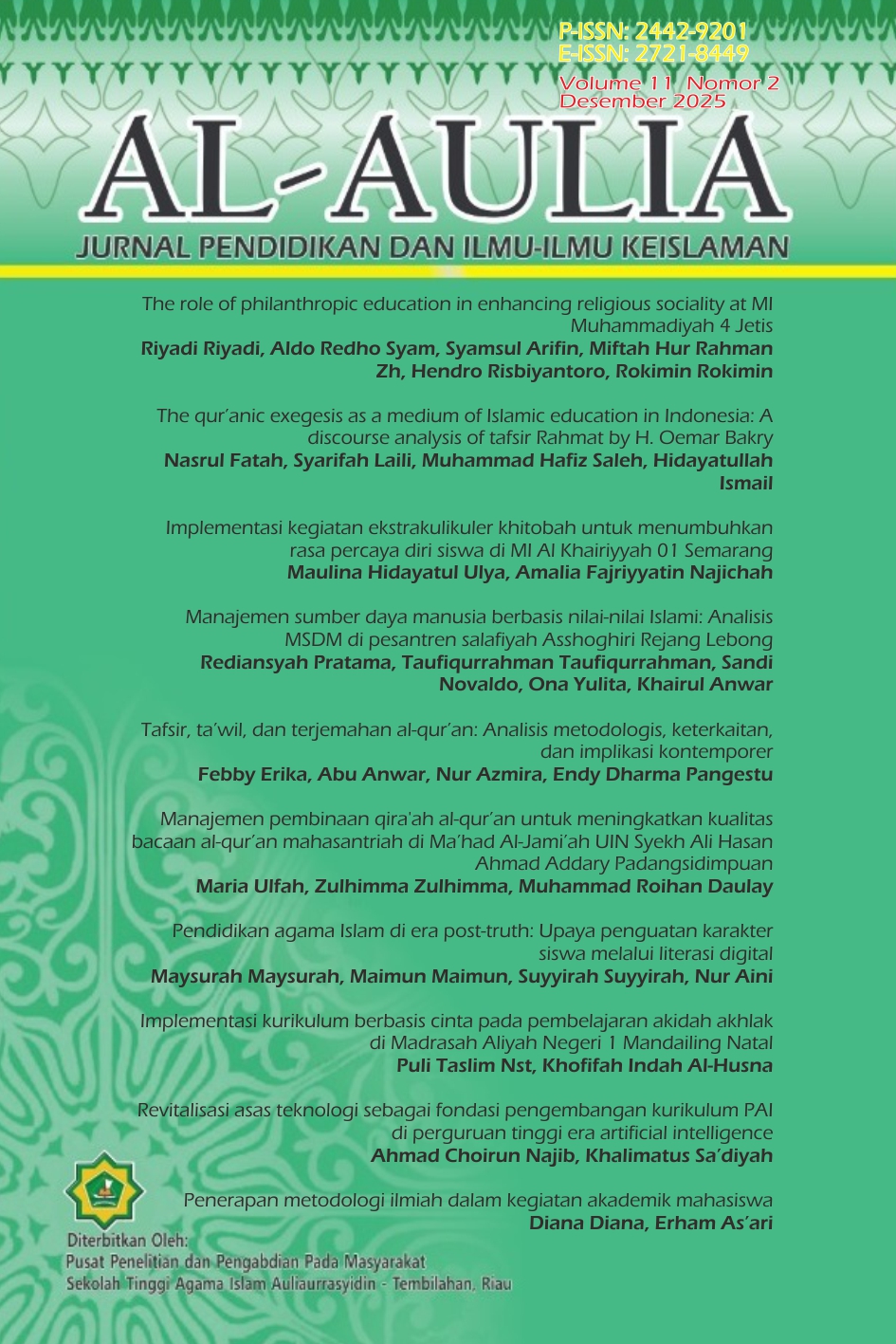
Implementasi kegiatan ekstrakulikuler khitobah untuk menumbuhkan rasa percaya diri siswa di MI Al Khairiyyah 01 Semarang
DOI:
https://doi.org/10.46963/aulia.v11i2.3340Keywords:
Extracurricular, Khitobah, Confidence, StudentsAbstract
This study aims to examine the role of extracurricular khitobah at MI Al Khairiyyah 01 Semarang in building self-confidence and nurturing young preachers as a strategy for instilling Islamic values from an early age and developing public communication skills in elementary school children. The research uses a qualitative approach to capture meanings, experiences, and social dynamics that cannot be measured quantitatively. Data collection techniques were carried out through participatory observation and interviews. The research location was at MI Al Khairiyyah 01 Semarang, which is the center for the implementation of the khitobah extracurricular program. The results show that this activity not only attracts students' interest but also becomes an important pillar in shaping a young generation that is confident, articulate, and morally upright. The mimicry memorization method was strategically applied as a first step in mastering basic speech techniques by imitating and memorizing according to the teacher's instructions. Although its implementation faced several challenges, the application of this method was responded to through contextual and adaptive solutions. The integration of khitobah with the school curriculum made it a vehicle for shaping Islamic character, public literacy, and 21st-century competencies.
References
Afif, Y. U., Rahayu, A., & Ningrum, S. (2024). Peran Strategis pendidikan agama islam dalam membentuk generasi berakhlak dan berwawasan keislaman di era digital: Peran Pendidikan Agama Islam (PAI) dalam pembentukan akhlak. MA’ALIM: Jurnal Pendidikan Islam, 5(2), 308–324. https://doi.org/10.21154/maalim.v5i2.9916
Amilatun, N. (2022). Implementasi kegiatan hitobah dalam menumbuhkan rasa percaya diri anak di panti asuhan dewi masyithoh cabang pemalang tahun 2022. Sekolah Tinggi Ilmu Tarbiyah (STIT) Pemalang.
Arifudin, O. (2022). Optimalisasi Kegiatan Ekstrakurikuler dalam Membina Karakter Peserta Didik. JIIP - Jurnal Ilmiah Ilmu Pendidikan, 5(3), 829–837. https://doi.org/10.54371/jiip.v5i3.492
Berliani, D., Amrullah, A. M. K., & Kholil, A. (2024). Metode Mimicry Memorization dalam Pembelajaran Keterampilan Berbicara. Journal of Education Research, 5(4), 6787–6796. https://doi.org/10.37985/jer.v5i4.1992
Fitriyah, Syaifulloh, A., & Nabil, M. (2021). Internalisasi Nilai-Nilai Religius Kepada Siswa. 4(2), 36–49.
Hamsina, S., Bahri, A., Supriadi, & Nuriani. (2023). Menumbuhkan Keterampilan Berkomunikasi Abad 21 Dengan Menggunakan Model Talking Chip Kantong Ajaib Doraemon Di MTs Negeri Barru Developing 21st Century Communication Skills Using Doraemon ’ s Magic Pocket Talking Chip Model at MTs Negeri Barru. Prosiding Seminar Nasional Biologi FMIPA UNM, 164–180.
Hasyim, M., & Najibah, A. (2022). Pembentukan Karakter Religius Siswa berbasis Pembiasaan dalam Kegiatan Ekstrakurikuler di Madrasah. Journal of Education and Religious Studies, 2(02), 53–61. https://doi.org/10.57060/jers.v2i02.62
Mahdi, M., Rijal, S., & Silahuddin, S. (2023). Ikhtiar Integrasi Mata Pelajaran Agama di Madrasah. Sustainable Jurnal Kajian Mutu Pendidikan, 6(1), 179–189. https://doi.org/10.32923/kjmp.v6i1.3606
Masduqi, A. (2021). Pengelolaan Program Unggulan Pendidikan Agama Islam Di Sekolah Menengah Kejuruan Berbasis Pesantren. At-Ta’Dib: Jurnal Ilmiah Prodi Pendidikan Agama Islam, 13(1), 01. https://doi.org/10.47498/tadib.v13i01.501
Ruhaniah, N., Khoerotunisa, K., & Saefudin, A. (2024). Penguatan Kecakapan Komunikasi Publik Santri Melalui Program Khitobah. Al-Musannif, 7(1), 15–26. https://doi.org/10.56324/al-musannif.v7i1.134
Safrudin, R., Zulfamanna, Kustati, M., & Sepriyanti, N. (2023). Penelitian Kualitatif. Journal Of Social Science Research, 3(2), 1–15.
Suharmawan, W. (2023). evaluasi program khitobah dua bahasa (Indonesia Arab) menggunakan model CIPP di Ma’had Al-Azhar. Bimbingan, Konseling Dan Multikultural, 1(1), 74–78.
Taufiq, I. (2024). Pembentukan rasa percaya diri dan keberanian melalui kegiatan ekstrakurikuler khitobah pada siswa MA Al-Ihsan Kalikejambon. 3(3), 2261–2269.
Usman. (2024). Kegiatan Ekstrakulikuler Khitobah Dalam Meningkatkan Keterampilan Dakwah Santri Di Pondok Pesantren Miftahul Qulub Polagan Kecamatan Galis Kabupaten Pamekasan. Institut Agama Islam Negeri Madura.
Wulan, N., Palupi, I., Ummah, S. R., & Larasati, P. (2025). Konsep dan Praktik Metode Kualitatif untuk Penelitian Sosial. RISOMA : Jurnal Riset Sosial Humaniora Dan Pendidikan, 3, 188–198.
Wulandari, F. (2024). Peran program khitobah ekstrakurikuler keagamaan dalam mengembangkan keterampilan komunikasi siswa di MAN 1 Cianjur. Dirasa Islamiyya: Journal of Islamic Studies, 3(2), 160–178. https://doi.org/10.61630/dijis.v3i2.53
Zakiah, L. (2022). Pengaruh pembelajaran khitobah di Pondok Pesantren terhadap kemampuan bicara santri di depan umum: Studi kasus santri kelas Al-Istiqomah Pondok Pesantren Asy-Syatibiyyah Ciloa Kabupaten Sumedang. UIN Sunan Gunung Djati Bandung.
Zulkifli, Z., & Jumadi, J. (2022). Strategi Pembelajaran untuk meningkatkan keterampilan berbicara bahasa Arab Mahasiswa Ma’had Bilal Bin Rabah Sorong. Jurnal Pendidikan Agama Islam, 1(2), 77–92. https://doi.org/10.36232/jurnalpaida.v1i2.1468
Downloads
Published
Issue
Section
License
Copyright (c) 2025 Maulina Hidayatul Ulya, Amalia Fajriyyatin Najichah

This work is licensed under a Creative Commons Attribution-ShareAlike 4.0 International License.
Authors who publish with this journal agree to the following terms:
1. Copyright on any article is retained by the author(s).
2. The author grants the journal, right of first publication with the work simultaneously licensed under a Creative Commons Attribution License that allows others to share the work with an acknowledgment of the work’s authorship and initial publication in this journal.
3. Authors are able to enter into separate, additional contractual arrangements for the non-exclusive distribution of the journal’s published version of the work (e.g., post it to an institutional repository or publish it in a book), with an acknowledgment of its initial publication in this journal.
4. Authors are permitted and encouraged to post their work online (e.g., in institutional repositories or on their website) prior to and during the submission process, as it can lead to productive exchanges, as well as earlier and greater citation of published work.
5. The article and any associated published material is distributed under the Creative Commons Attribution-ShareAlike 4.0 International License