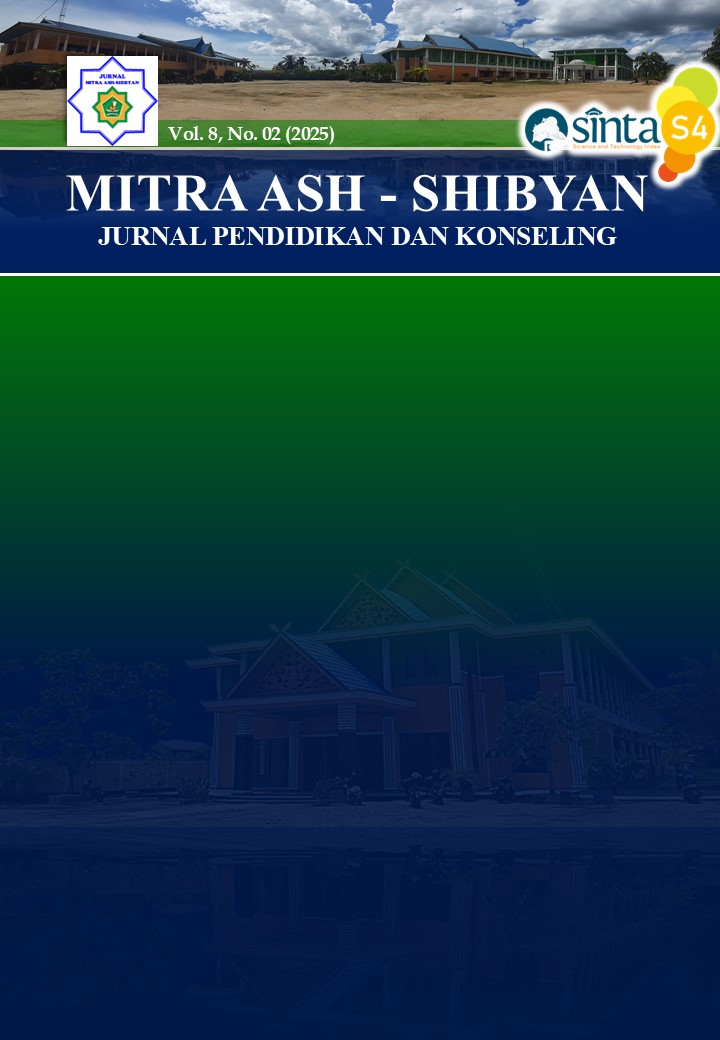
The Influence of Islamic Counseling on Drug Addiction Patients’ Quality of Life at the Qur’anic Healing Indonesia Rehabilitation Center
DOI:
https://doi.org/10.46963/mash.v8i02.2899Keywords:
Islamic counseling, Drug addiction, Quality of life, Rehabilitation, Spiritual therapyAbstract
The widespread issue of drug abuse poses significant challenges to individuals' quality of life, particularly among those undergoing rehabilitation. This study investigates the effect of Islamic Counseling Guidance on the quality of life of drug addicts at the Qur’anic Healing Indonesia Rehabilitation Center. The study involved 90 male participants aged 20–35 years who had been in rehabilitation for more than three months. Total sampling was employed to include individuals classified as severe, moderate, and mild addicts. Data were collected using two reliable instruments: a Quality-of-Life Scale and an Islamic Counseling Scale (Cronbach’s Alpha > 0.90). The data were analyzed using simple linear regression. The findings indicated no significant influence of Islamic Counseling Guidance on quality of life (p = 0.934), suggesting that the Islamic counseling approach implemented in this setting was not effective in enhancing the patients’ quality of life. These results highlight the need to reevaluate and possibly integrate more holistic or tailored approaches in counseling interventions for drug rehabilitation.
Downloads
References
Andrade, C. J. do N., & Alves, C. de A. D. (2019). Relationship between bullying and type 1 diabetes mellitus in children and adolescents: A systematic review. Jornal de Pediatria, 95(5), 509–518. https://doi.org/10.1016/j.jpedp.2018.10.006
Creswell, J. W., & Creswell, J. D. (2018). Research design: Qualitative, quantitative, and mixed methods approaches (5th ed.). SAGE Publications.
Dewi, A., Rahmawati, S., & Lestari, D. (2020). Pengaruh layanan konseling terhadap peningkatan penyesuaian diri peserta didik. Jurnal Konseling dan Pendidikan, 8(2), 145–153.
Hair, J. F., Black, W. C., Babin, B. J., & Anderson, R. E. (2019). Multivariate data analysis (8th ed.). Cengage.
Harmoni, T. (2004). Dasar-dasar konseling: Teori dan praktik. Rineka Cipta.
Herlina, R., & Mulyadi, D. (2022). Islamic counseling approach for improving well-being among drug rehabilitation participants. Journal of Islamic Guidance and Counseling, 6(2), 45–59. https://doi.org/10.24014/jigc.v6i2.2931
Koenig, H. G. (2012). Religion, spirituality, and health: The research and clinical implications. ISRN Psychiatry, 2012, 1–33. https://doi.org/10.5402/2012/278730
Kurniawan, A. (2020). Efektivitas konseling kelompok dalam meningkatkan keterampilan sosial siswa. Jurnal Psikologi Terapan, 12(1), 33–42.
Laudet, A. B. (2011). The case for considering quality of life in addiction research and clinical practice. Addiction Science & Clinical Practice, 6(1), 44–55.
Majid, M. (2020). Narkoba dan generasi muda: Kajian sosial keagamaan di Indonesia. Alfabeta.
Marlatt, G. A., & Donovan, D. M. (2005). Relapse prevention: Maintenance strategies in the treatment of addictive behaviors (2nd ed.). Guilford Press.
Miller, W. R., & Thoresen, C. E. (2003). Spirituality, religion, and health: An emerging research field. American Psychologist, 58(1), 24–35. https://doi.org/10.1037/0003-066X.58.1.24
National Narcotics Agency. (2017). Regulation of the National Narcotics Agency Number 24 of 2017 on rehabilitation service standards for drug addicts and victims of drug abuse. https://www.bnn.go.id
Prasetyo, B., & Adiyanti, M. (2018). Peran konseling kognitif-perilaku dalam mengurangi kecemasan remaja. Jurnal Psikologi Indonesia, 5(1), 25–36.
Rizqiani, A., & Maulana, H. (2021). Islamic counseling and self-adjustment among drug addicts. Jurnal Bimbingan dan Konseling Islam, 5(2), 112–124. https://doi.org/10.24042/jbki.v5i2.9321
Ryff, C. D., & Singer, B. (2008). Know thyself and become what you are: A eudaimonic approach to psychological well-being. Journal of Happiness Studies, 9(1), 13–39. https://doi.org/10.1007/s10902-006-9019-0
Seligman, M. E. P. (2018). The hope circuit: A psychologist’s journey from helplessness to optimism. PublicAffairs.
Sutoyo, A. (2009). Bimbingan dan konseling: Teori dan praktik dalam berbagai setting pendidikan. Pustaka Pelajar.
Telaumbanua, T. (2018). Perkembangan kasus narkotika di Indonesia: Tantangan dan penanggulangannya. Jurnal Kriminologi Indonesia, 14(2), 77–89. https://doi.org/10.7454/jki.v14i2.1104
Valentina, G. I. (2015). Kualitas hidup mantan pecandu narkoba yang menjalani terapi metadon. Jurnal Psikologi Udayana, 2(1), 113–128. https://doi.org/10.24843/JPU.2015.v02.i01.p09
World Health Organization. (2012). WHOQOL: Measuring quality of life. https://www.who.int
Yusuf, M., & Fitriani, L. (2020). Pengaruh konseling Islami terhadap peningkatan kesejahteraan spiritual klien rehabilitasi narkoba. Jurnal Dakwah dan Konseling Islam, 7(2), 120–133.
Downloads
Published
Issue
Section
License
Copyright (c) 2025 Lailatul Izzah, Willytiyo Kurniawan, Raspan Hamdi, Dini Nafisah A

This work is licensed under a Creative Commons Attribution-ShareAlike 4.0 International License.
Authors who publish with this journal agree to the following terms:
1. Copyright on any article is retained by the author(s).
2. The author grants the journal, right of first publication with the work simultaneously licensed under a Creative Commons Attribution shareAlike 4.0 International License that allows others to share the work with an acknowledgment of the work’s authorship and initial publication in this journal.
3. Authors are able to enter into separate, additional contractual arrangements for the non-exclusive distribution of the journal’s published version of the work (e.g., post it to an institutional repository or publish it in a book), with an acknowledgment of its initial publication in this journal.
4. Authors are permitted and encouraged to post their work online (e.g., in institutional repositories or on their website) prior to and during the submission process, as it can lead to productive exchanges, as well as earlier and greater citation of published work.
5. The article and any associated published material is distributed under the Creative Commons Attribution-ShareAlike 4.0 International License



2.png)