
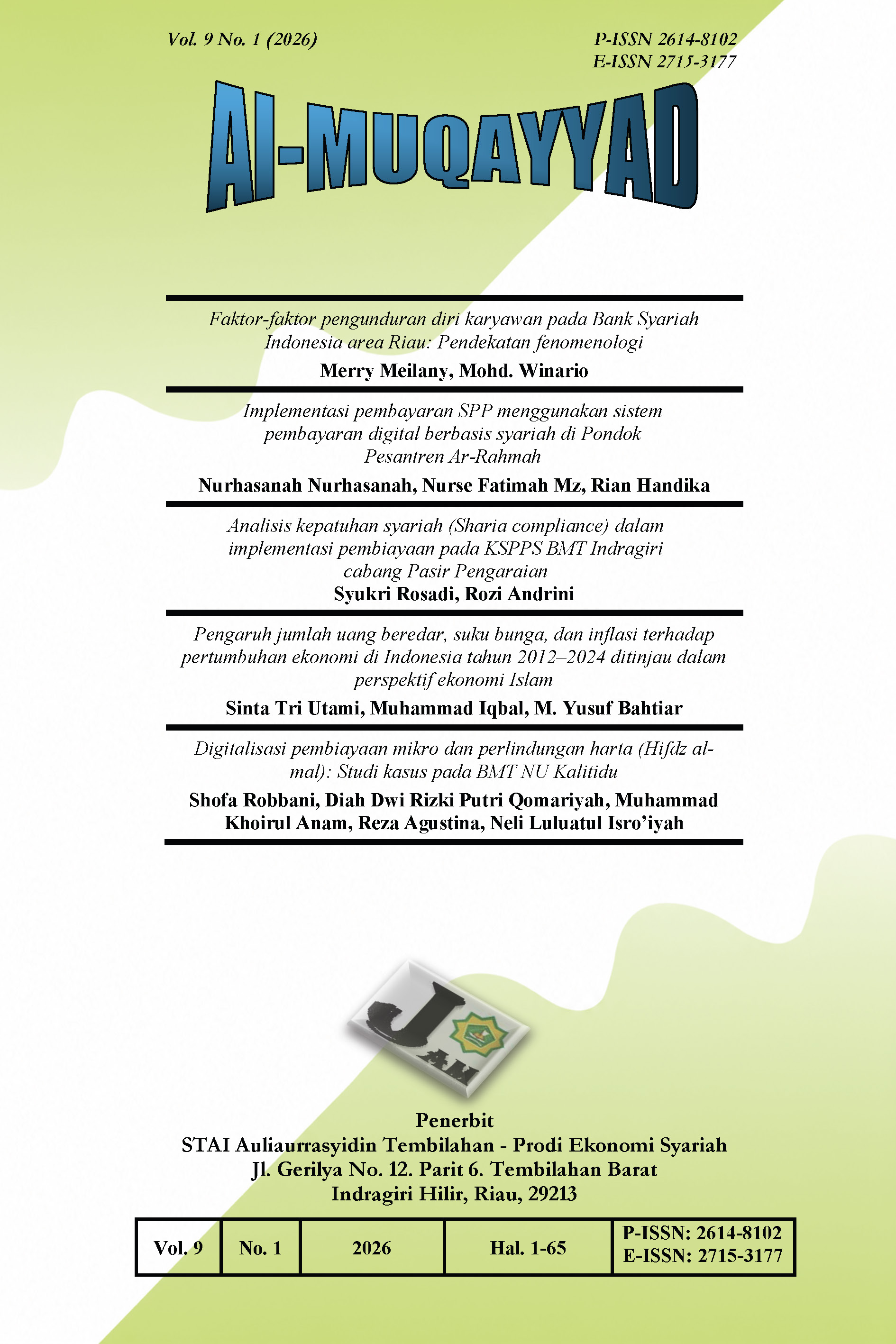
Analisis kepatuhan syariah (Sharia compliance) dalam implementasi pembiayaan pada KSPPS BMT Indragiri cabang Pasir Pengaraian
DOI:
https://doi.org/10.46963/jam.v9i1.3693Keywords:
Kepatuhan Syariah; Pembiayaan Syariah; Baitul Mal wat TamwilAbstract
This study aims to analyze the level of sharia compliance in the implementation of financing and to identify the factors influencing the application of sharia principles at the Islamic Savings and Financing Cooperative BMT Indragiri Branch Pasir Pengaraian. This research employs a qualitative approach using a field research method. Data were collected through interviews, observations, and documentation involving 25 informants consisting of the cooperative chairman, BMT management, financing members, and surrounding community members. The data analysis technique used the interactive model of Miles and Huberman, which includes data reduction, data display, and conclusion drawing. The results indicate that financing implementation has applied sharia contracts such as murabaha, mudharabah, and musyarakah, supported by clear and transparent contract documentation. However, members’ understanding of sharia contract concepts remains limited. Influencing factors include human resource competence, sharia supervision systems, sharia financial literacy, and institutional support. Therefore, strengthening literacy and supervision is necessary to ensure optimal and sustainable sharia compliance implementation.
Downloads
References
Anas, A., & Rahim, Abd. (2026). Implementasi prinsip hukum islam dan mekanisme pengawasan terhadap kepatuhan syariah pada lembaga keuangan syariah. Alsys, 6(2), 706–717. https://doi.org/10.58578/alsys.v6i2.9004
Anwar, M. K., Ridlwan, A. A., & Laili, W. N. R. (2023). The role of baitul maal wat tamwil in empowering msmes in Indonesia: A Study of Indonesian Islamic microfinance institutions. International Journal of Professional Business Review, 8(4). https://doi.org/10.26668/businessreview/2023.v8i4.913
Atmajaya, E. U., Noviani, D. P., Putri, S. A., Glediska, S. N., Maharani, A. G., Islam, U., Raden, N., Palembang, F., Pgri, S., Lampung, B., Raden, U., Lampung, I., & History, A. (2024). Kepatuhan syariah (Syariah Compliance) pada lembaga keuangan mikro syariah. Journal Of Economis and Business, 2(1), 133–143. http://jurnal.dokicti.org/index.php/Econis/index
Fajri, D., Marlion, F. A., Arham, Q. L., Wulansari, W., & Shabri, H. (2025). Comparative study of murabahah contract recording practices: Implementation at qurrata ayun sharia cooperative versus PSAK 402 standards. Imara: Jurnal Riset Ekonomi Islam, 9(2), 91–98. https://doi.org/10.31958/imara.v9i2.16533
Hanifuddin, I., Kasanah, N., & Bianda, R. (2025). Sharia financial inclusion based on local cultural values to support the sustainability of small traders’ businesses. Hikmatuna : Journal for Integrative Islamic Studies, 11(2), 178–196. https://doi.org/10.28918/hikmatuna.v11i2.12750
Hendri Mauliansyah. (2024). Good corporate governance in Islamic financial institutions: OJK compliance challenges. Global Research in Economics and Advanced Theory (Great), 1(2), 62–70. https://doi.org/10.65788/greatjournal.v1i2.49
Latifah, E., & Fika, Z. (2022). Peran dewan pengawas syariah dengan pendekatan sharia compliance pada lembaga keuangan mikro syariah (Studi kasus pada USPPS BMT Sunan Drajat). Journal of Finance and Business Digital, 1(1), 25–38. https://doi.org/10.55927/jfbd.v1i1.1197
Maal, P. B., Tamwil, W., Pemberdayaan, D., Masyarakat, E., Insani, A., Zaim, M., Hermawati, S., Febri, W., Sudirman, R., & Syaipudin, M. (n.d.). The role of Baitul Maal Wat Tamwil (BMT) in community economic empowerment. Journal of Financial and Busines, 1. https://money-id.com/index.php/jfb/index
Maghfira Izzany. (2025). Strategi peningkatan literasi keuangan syariah di masyarakat: Peran pendidikan dan kampanye. Jurnal Nuansa : Publikasi Ilmu Manajemen dan Ekonomi Syariah, 3(2), 184–195. https://doi.org/10.61132/nuansa.v3i2.1739
Mourad Mouloua, & Antar Oukkal. (2025). The role of shari’a accounting standards in organizing and guiding Islamic financial institutions. International Journal of Innovative Technologies in Social Science, 1(45). https://doi.org/10.31435/ijitss.1(45).2025.3221
Nurjannah, S., & Setiaji, B. (2021). Law enforcement on sharia compliance: A case study on the murabahah consumptive financing agreement of bank a syariah. Jurnal IUS Kajian Hukum Dan Keadilan, 9(2), 299–309. https://doi.org/10.29303/ius.v9i2.895
Prawanti, A. A., Kumala, I., Fadillah, M. N., Damanik, R. Y. S., & Lubis, R. N. (2025). Desain, jenis, dan metode dalam penelitian kualitatif. Tarbiyah : Jurnal Ilmu Pendidikan dan Pengajaran, 4(1), 384–388. https://doi.org/10.64464/tarbiyah.v4i1.186
Qomaruddin, Q., & Sa’diyah, H. (2024). Kajian teoritis tentang teknik analisis data dalam penelitian kualitatif: perspektif Spradley, Miles dan Huberman. Journal of Management, Accounting, and Administration, 1(2), 77–84. https://doi.org/10.52620/jomaa.v1i2.93
Rizal, Nengsih, I., Sari, C. I., Hayati, R. F., & Mutia, S. (2025). Inconsistency of shariatization: Exploring the implementation of sharia principles in baitul maal wa tamwil. Al-Istinbath: Jurnal Hukum Islam, 10(1), 105–129. https://doi.org/10.29240/jhi.v10i1.11508
Rohman, P. S., Laila, N., & Shofawati, A. (2022). Baitul mal wat tamwil architectural map: Institutional and Regulatory Analysis. Perisai: Islamic Banking and Finance Journal, 6(1), 30-39. https://doi.org/10.21070/perisai.v6i1.1583
Thoib, M., Wargo, & Bibi, T. (2025). A literature review on the role of the sharia supervisory board in maintaining sharia compliance in Islamic banks. Zabags International Journal of Economy, 3(2), 280–288. https://doi.org/10.61233/zijec.v3i2.117
Tuzzahroh, F. ., & Laela, S. F. (2022). Sharia audit and shariah compliance of Islamic financial institutions: A bibliometric analysis. Jurnal Ekonomi Syariah Teori dan Terapan, 9(6), 815–833. https://doi.org/10.20473/vol9iss20226pp815-833
Downloads
Published
Issue
Section
License
Copyright (c) 2026 Syukri Rosadi, Rozi Andrini

This work is licensed under a Creative Commons Attribution-ShareAlike 4.0 International License.
Authors who publish with this journal agree to the following terms:
1. Copyright on any article is retained by the author(s).
2. The author grants the journal, right of first publication with the work simultaneously licensed under a Creative Commons Attribution shareAlike 4.0 International License that allows others to share the work with an acknowledgment of the work’s authorship and initial publication in this journal.
3. Authors are able to enter into separate, additional contractual arrangements for the non-exclusive distribution of the journal’s published version of the work (e.g., post it to an institutional repository or publish it in a book), with an acknowledgment of its initial publication in this journal.
4. Authors are permitted and encouraged to post their work online (e.g., in institutional repositories or on their website) prior to and during the submission process, as it can lead to productive exchanges, as well as earlier and greater citation of published work.
5. The article and any associated published material is distributed under the Creative Commons Attribution-ShareAlike 4.0 International License




2.png)