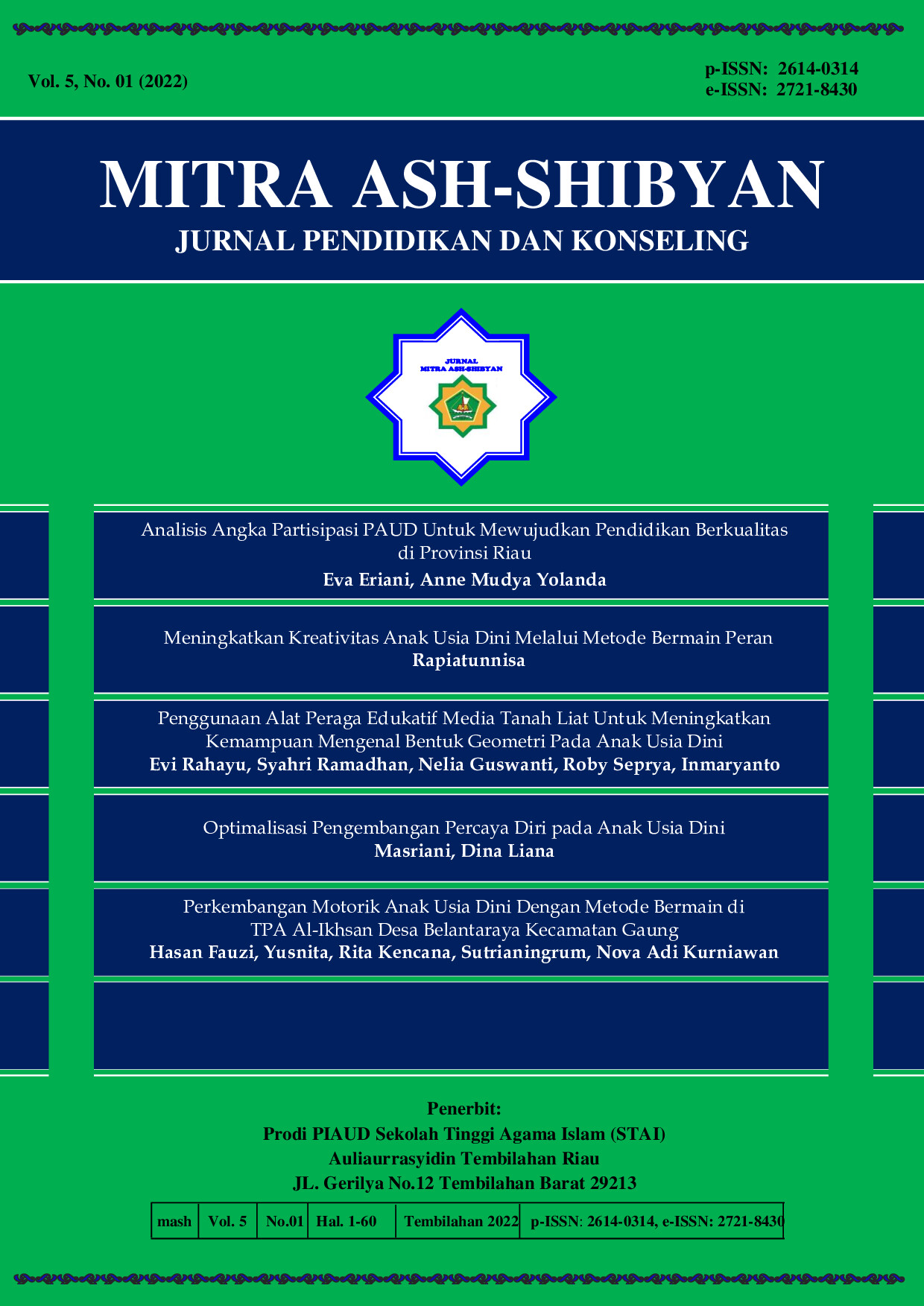
Analisis Angka Partisipasi PAUD Untuk Mewujudkan Pendidikan Berkualitas di Provinsi Riau
DOI:
https://doi.org/10.46963/mash.v5i01.470Keywords:
ECE Participation Rate, Quality's Education, Sustainable Development Goals (SDGs)Abstract
Quality education can be traced back to the level of early childhood education as assessed by the participation rate in Early Childhood Education (ECE). The ECE participation rate is determined by three indicators: the School Participation Rate (SPR), the Gross Enrollment Rate (GER), and the Pure Participation Rate (PPR). However, there are still gaps in the national ECE participation rate, children who have not earned ECE services, and some villages that do not have ECE institutions. Although the Ministry of Education and Culture has established guidelines for one village one ECE. The purpose of this research is to provide an overview of ECE participation rates in Riau Province and to explain what factors influence them. This study used descriptive analysis. Secondary data were obtained from the Central Bureau of Statistics, the Ministry of Education and Culture, and the Ministry of National Development Planning/National Development Planning Agency. The results show that the ECE participation rate, in general, has been fluctuating, especially in the last five years, and that the GER of children attending ECE in Riau province is still lower than the national rate, while the PPR in rural areas is higher than the NER in urban areas. According to PER by gender, girls who attend ECE on time contribute more than boys. Those are influenced by the fact that ECE institutions are not recorded in the education database, and there are social trends that lead parents to prefer homeschooling over ECE institutions, particularly with the impact of the COVID-19.
Downloads
Downloads
Published
Issue
Section
License
Authors who publish with this journal agree to the following terms:
1. Copyright on any article is retained by the author(s).
2. The author grants the journal, right of first publication with the work simultaneously licensed under a Creative Commons Attribution shareAlike 4.0 International License that allows others to share the work with an acknowledgment of the work’s authorship and initial publication in this journal.
3. Authors are able to enter into separate, additional contractual arrangements for the non-exclusive distribution of the journal’s published version of the work (e.g., post it to an institutional repository or publish it in a book), with an acknowledgment of its initial publication in this journal.
4. Authors are permitted and encouraged to post their work online (e.g., in institutional repositories or on their website) prior to and during the submission process, as it can lead to productive exchanges, as well as earlier and greater citation of published work.
5. The article and any associated published material is distributed under the Creative Commons Attribution-ShareAlike 4.0 International License




2.png)