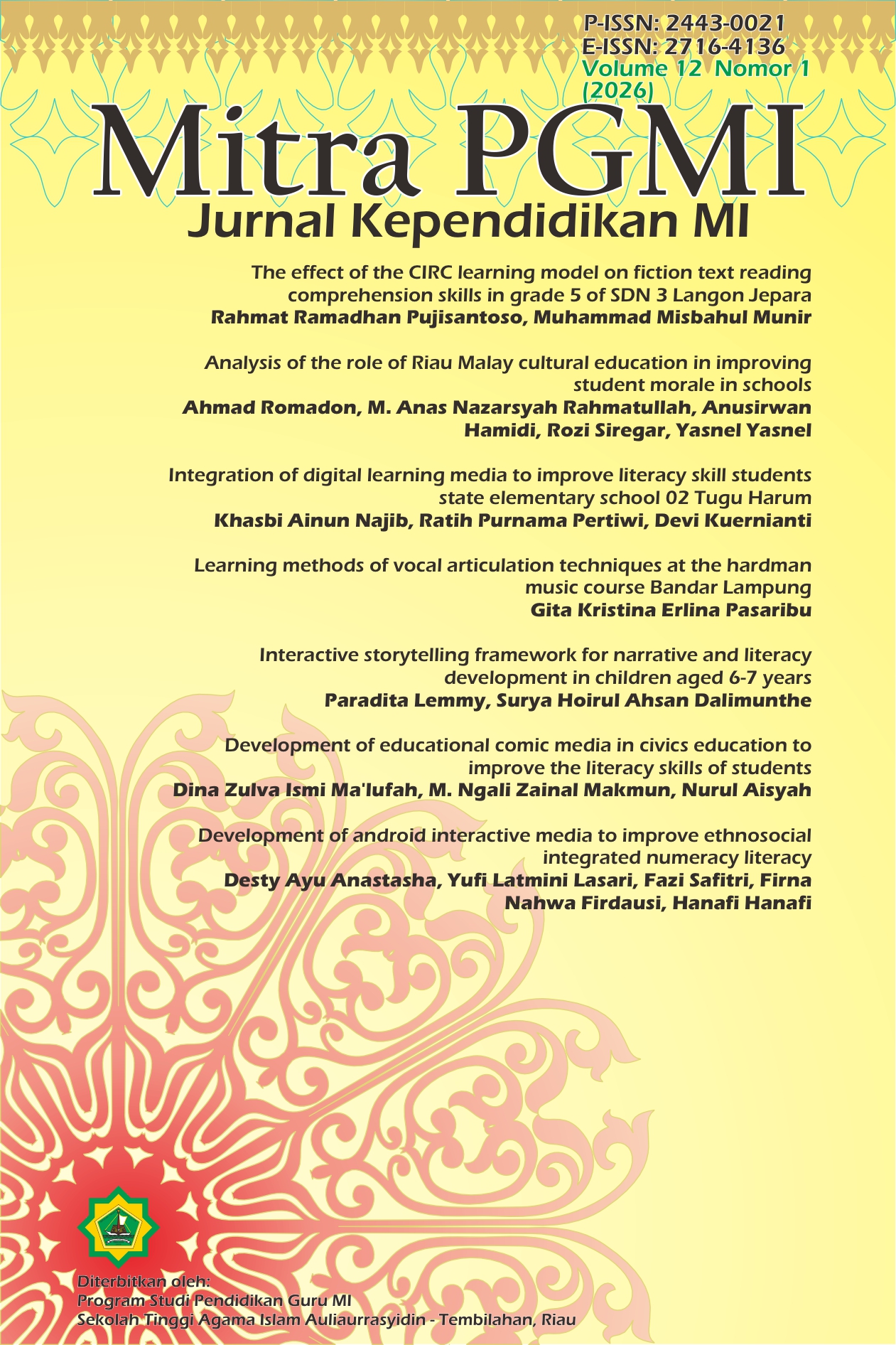
Development of educational comic media in civics education to improve the literacy skills of students
DOI:
https://doi.org/10.46963/mpgmi.v12i1.3500Keywords:
Educational Comic, Civic Education, Literacy Skills, Elementary School, Learning MediaAbstract
This study addresses the limited use of innovative learning media in Civic Education (PKn) which affects students’ activeness and literacy skills in elementary schools. The research aims to develop educational comic media in PKn learning and to examine its feasibility and students’ responses in improving literacy skills. This study employed a Research and Development (R&D) method using the 4-D model, consisting of define, design, develop, and disseminate stages. The subjects of the study were fourth-grade students of SDNU Metro. Data were collected through interviews with teachers and the school principal, material expert and media expert validation questionnaires, and student response questionnaires. The findings indicate that the developed educational comic media is feasible to use based on material and media expert evaluations. Students' responses show a very positive category, particularly in increasing learning interest, reading motivation, and understanding of Pancasila values. Therefore, educational comic media can serve as an effective alternative learning medium to support literacy improvement in Civic Education learning at the elementary school level.
Downloads
References
Ahmadi, F. R. (2021). The development of mathematics comics containing Pancasila values to develop the character of elementary school students: A case study of Indonesia. Journal of Innovation in Educational and Cultural Research, 2(1), 25–34.
Chanifudin, C. R. (2024). National Education: The Main Pillar in Building a Competitive Nation. Journal of Education Religion Humanities and Multidisciplinary, 2(2), 772–783.
Darwis, U. &. (2023). The Effect of Comic Media on Interest in Learning Civics. Pendas: Scientific Journal of Primary Education, 8(1), 55–58.
Devianty, R. (2024). Pengembangan Bahan Ajar Berbasis Komik untuk Meningkatkan Pemahaman Struktur Cerita Rakyat pada Siswa Sekolah Dasar. Didaktika: Jurnal Kependidikan, 13(3), 2985-2966.
Fitri, A. S. (2023). Development of Digital Comics to Improve Learning Outcomes on Pancasila Values for Fourth Grade Elementary School Students. Al-Madrasah: Journal of Madrasah Ibtidaiyah Education, 7 (1), 220.
Hamidah, N. P. (2021). Development of science comics as information media. IOP Conference Series: Materials Science and Engineering (pp. 1098(6), 62002.). IOP.
Indonesia, R. (1945). Preamble of the 1945 Constitution of the Republic of Indonesia, Fourth Paragraph. Jakarta: Republik Indonesia.
Lia, A. S. (2023). Analysis Of Literacy of Fourth Grade Students of SDN Gayamsari 02 Semarang City Through Comic Media Oriented to the Profile of Pancasila Learners. Didaktik: Scientific Journal of PGSD STKIP Subang, 9(04), 1457–1472.
Maharani, M. A. (2025). Development of Audio-Visual Learning Media Based on the Canva Application to Improve Learning Outcomes of Grade 6 Students in Science Subjects at MIS Darul Ulum TUBABA. AL-MANAR: Journal of Communication and Islamic Education, 14(1), 264–278.
MD, R. A. (2024). Comics-based learning in science subjects and its implications for teaching and learning: A literature review. JOURNAL OF EDUCATION, 14(1), 50–60.
Muhaimin, M. R. (2023). The role of comic learning media in elementary school students' reading skills. Flobamorata Journal of Primary Education, 4(1), 399–405.
Nafilah, R. P. (2025). The Foundation, Role, Direction of Education in Indonesia, Along with Responsibilities, Authorities and What Educators Must Do. Responsive: Journal of Islamic Education Management, 1(2), 185–192.
Ningsih, D. S. (2023). Development of Booklet Learning Media and Its Role on Learning Interest of Islamic Elementary School Students. JIP PGMI Scientific Journal, 9(1), 1–11.
Oktaviana, P. D. (2023). The Implementation of Pancasila Values in Civics Learning in the Digital Era. MIMBAR PGSD Undiksha, 11(3), 384–395.
Pekkolay. (2022). The Importance of Literacy. Scholars Journal of Arts, Humanities and Social Sciences, 10 (1), 6–8.
Riduwan. (2015). Dasar-Dasar Statistika. Bandung: Alfabeta.
Rismawati, I. M. (2024). Development of Comic- Based Learning Media to Improve Student Learning Outcomes in Grade IV MI NU Tri Bhakti At-Taqwa. Scientific Journal of Education, 4(1), 79–89.
Sinaga, W. T. (2024). The Effect of Audio-Visual Media on Learning Outcomes of Fifth Grade Elementary School Students. Basicedu Journal, 8 (3), 1804-1812.
Sugiyono. (2019). Metode Penelitian Kuantitatif, Kualitatif, dan R&D. Bandung: Alfabeta.
Sugiyono. (2018). Educational Research Methods: Quantitative, Qualitative, and R&D Approaches. Bandung: Alfabeta.
Suherman, A. &. (2023). Application of Digital Comic Media to Improve Student Understanding of Pancasila and Citizenship Education Subjects. Proceedings of the 5th International Conference on Law, Social Sciences and Education, ICLSSE 2023. Bali: EAI.
Suryaningrum, M. D. (2022). Improving the Quality of Civic Education Learning through the Problem-Based Learning Model with Audio-Visual Media for Fourth Grade Elementary School Students. Paedagogie, 17 (1), 37–46.
Suryaningrum. (2022). Application of Learning Media as an Effort to Improve the Quality of Citizenship Education in Elementary Schools. Scientific Journal of Education, 6(1), 45–53.
Tirtoni, F. &. (2024). Interactive Media Development for Pancasila Education in Elementary Schools. Academia Open, 9(2), 10–21070.
Wati, D. R. (2024). Building national character through civic education learning in elementary schools: challenges and strategies. Journal of Elementary School Teacher Education, 1(3), 13.
Downloads
Published
Issue
Section
License
Copyright (c) 2026 Dina Zulva Ismi Ma'lufah, M. Ngali Zainal Makmun, Nurul Aisyah

This work is licensed under a Creative Commons Attribution-ShareAlike 4.0 International License.
Authors who publish with this journal agree to the following terms:
1. Copyright on any article is retained by the author(s).
2. The author grants the journal, right of first publication with the work simultaneously licensed under a Creative Commons Attribution shareAlike 4.0 International License that allows others to share the work with an acknowledgment of the work’s authorship and initial publication in this journal.
3. Authors are able to enter into separate, additional contractual arrangements for the non-exclusive distribution of the journal’s published version of the work (e.g., post it to an institutional repository or publish it in a book), with an acknowledgment of its initial publication in this journal.
4. Authors are permitted and encouraged to post their work online (e.g., in institutional repositories or on their website) prior to and during the submission process, as it can lead to productive exchanges, as well as earlier and greater citation of published work.
5. The article and any associated published material is distributed under the Creative Commons Attribution-ShareAlike 4.0 International License





2.png)