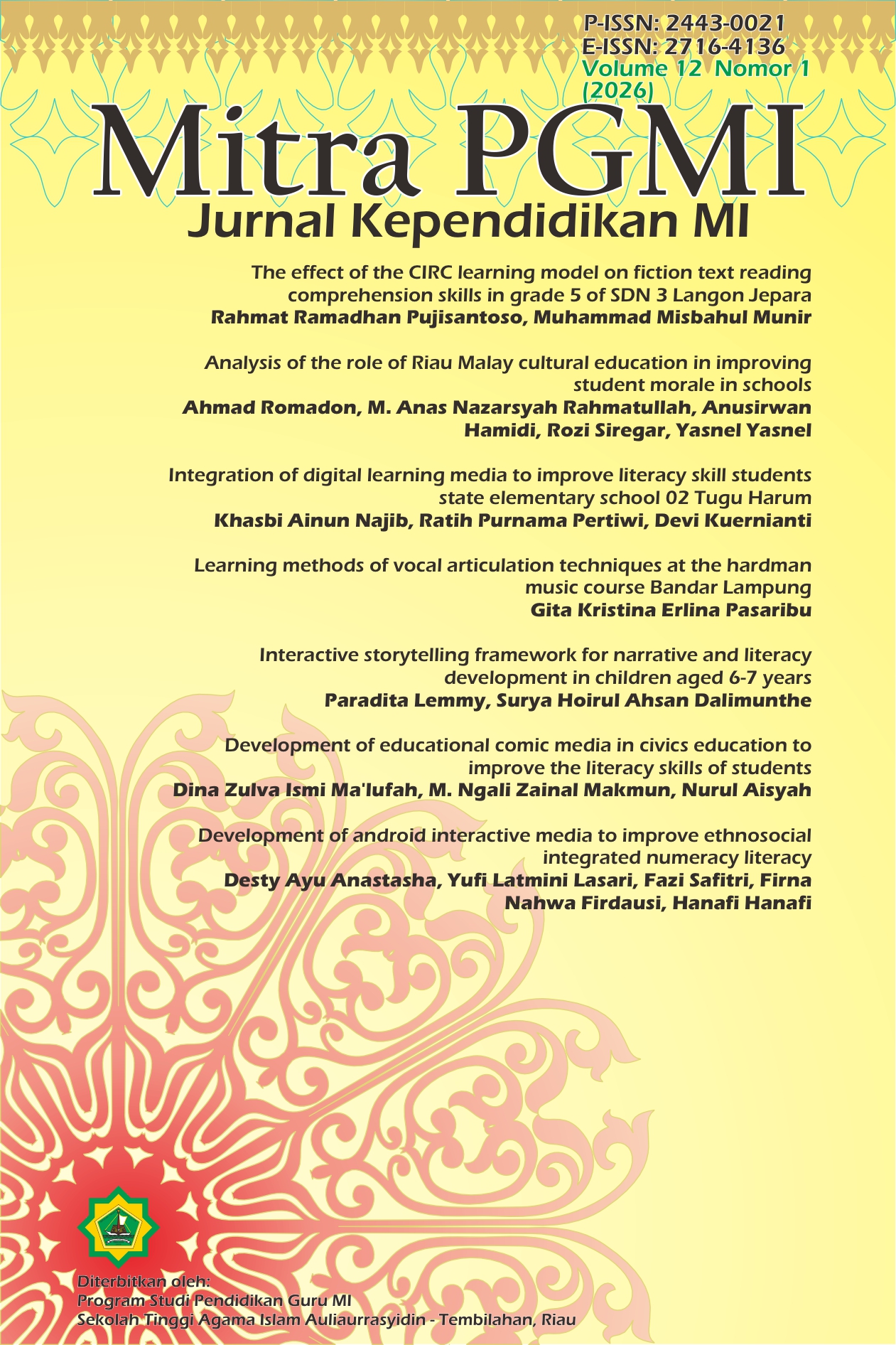
Interactive storytelling framework for narrative and literacy development in children aged 6-7 years
DOI:
https://doi.org/10.46963/mpgmi.v12i1.3495Keywords:
Interactive Storytelling, Early Literacy, Elementary EducationAbstract
Early literacy instruction in Indonesia remains dominated by conventional approaches emphasizing isolated technical skills, with minimal attention to holistic narrative competence development. This study aimed to (1) develop an Interactive Storytelling Framework grounded in emergent literacy theory, narrative theory, and sociocultural learning principles, and (2) examine its effectiveness in enhancing literacy and narrative abilities of children aged 6-7 years. A Design-Based Research approach with sequential explanatory mixed methods was employed over eight months. Participants included 267 first-grade students from three public elementary schools in Medan Denai District, North Sumatra, assigned to experimental (n=133) and control (n=134) groups using a quasi-experimental design. Results revealed statistically significant between-group differences favoring the experimental group. For literacy skills, ANCOVA showed F (1,264) =112.09, p<0.001, ηp²=0.298, Cohen's d=1.07. The experimental group achieved mean gains of 20.87 points versus 11.45 points in controls (82% greater improvement). For narrative abilities, F (1,264) =286.14, p<0.001, ηp²=0.520, Cohen's d=1.48, with experimental gains of 6.92 versus 2.84 points (144% greater improvement). Student engagement was significantly higher in the experimental group (M=14.03 vs. 11.39, d=1.51) and correlated strongly with literacy gains (r=0.628) and narrative gains (r=0.712). Thematic analysis identified five mechanisms: meaningful contextual learning, active participation, narrative metacognition development, adaptive differentiation, and real-life transfer.
Downloads
References
Abdussakir, A. (2017). Strategi internalisasi nilai budaya dalam pembelajaran matematika. Procediamat
Anderson, T. &. (2012). Design-based research: A decade of progress in education research. Educational Researcher, 41(1), 16-25
Azis, A., Haikal., & Iswanto, S. (2018). Internalisasi nilai-nilai Budaya Toleransi dalam pembelajaran sejarah (Studi kasus SMA Negeri 1 Banda Aceh). Jurnal Riset dan Konseptual, 287-299
Braun, V. &. (2006). Using thematic analysis in psychology. Qualitative Research in Psychology, 3(2), 77-101
Brown, C. S. (2014). Language and literacy development in the early years: Foundational skills that support emergent readers. Language and Literacy Spectrum, 24, 35-49.
Bruner, J. (1991). The narrative construction of reality. Critical inquiry, 18(1), 1-21.
Bus, A. G. (1995). Joint book reading makes for success in learning to read: A meta-analysis on intergenerational transmission of literacy. Review of educational research, 65(1), 1-21.
Choi, N. C. (2025). Tinker Tales: Interactive Storytelling Framework for Early Childhood Narrative Development and AI Literacy. arXiv preprint arXiv, 2504.13969.
Clay, M. M. (2001). Change over time in children's literacy development. United State: Heinemann.
Gil, M. &. (2021). A close look into the storytelling process: The procedural nature of interactive digital narratives as learning opportunity. Entertainment Computing, 41, 100466.
Ibrahim, A. (2014). Pengelolaan Pembangunan Berkelanjutan. Yogyakarta: PT Leautika.
Indonesia., K. P. (2021). Gerakan Literasi Nasional: Panduan pelaksanaan gerakan literasi sekolah di sekolah dasar. Jakarta: Kemendikbud.
Kalaitzi, C. &. (2023). Developing narrative performance of 5–6-year-old children through combined use of narrative elements in their speech. International Journal of Early Years Education, 31(3), 688-707.
Kendeou, P. B.‐G. (2008). Children's inference generation across different media. Journal of research in reading, 31(3), 259-272.
Lickona, T. (2012). Educating for Character. How Our Schools Can Teach Respect and Responsibility. Bantam Books.
Mamuladze, N. T. (2024). Preschool education and the academic performance of first-graders. INTED2024 Proceedings (pp. (pp. 2412-2418).). IATED.
McKenney, S. &. (2012). Conducting educational design research. New York: Routledge.
Melzi, G. S. (2023). Stories beyond books: Teacher storytelling supports children’s literacy skills. Early Education and Development, 34(2), 485-505.
Merriam, S. B. (2020). Learning in adulthood: A comprehensive guide. John Wiley & Sons.
Miller, S. &. (2008). The power of story: Using storytelling to improve literacy learning. Journal of Cross-Disciplinary Perspectives in Education, 1(1), 36-43.
Muhaimin, A. (2023). Urgensi Pendidikan Karakter di Indonesia. Jogjakarta: Ar-rus Media.
Nicolopoulou, A. C. (2015). (2015). Using a narrative-and play-based activity to promote low-income preschoolers’ oral language, emergent literacy, and social competence. Early childhood research quarterly, 31, 147-162.
O’Byrne, W. I. (2018). Digital storytelling in early childhood: Student illustrations shaping social interactions. Frontiers in psychology, 9, 1800.
O’Neill, D. K. (2004). (2004). Preschool children’s narratives and performance on the Peabody Individualized Achievement Test–Revised: Evidence of a relation between early narrative and later mathematical ability. First Language, 24(2), 149-183.
Permana, A. R. (2025). Peningkatan keterampilan menulis teks narasi anak usia 6-15 tahun melalui pemanfaatan bank cerita. An-Nizam, 4(1), 86-95.
Piaget, J. (1970). Science of education and the psychology of the child. Viking Press.
Rufaida, H. (2017). Menumbuhkan sikap multikultural melalui internalisasi nilai-nilai multikultural dalam pembelajaran IPS. Sosio Didaktika.
Saracho, O. N. (2017). Literacy and language: new developments in research, theory, and practice. Early Child Development and Care, 187(3-4), 299-304.
Schoon, I. P. (2010). Childhood language skills and adult literacy: A 29-year follow-up study. Pediatrics, 125(3), e459-e466.
Sitko, B. M. (1998). Knowing how to write: Metacognition and writing instruction. In J. D. D. J. Hacker, Metacognition in educational theory and practice (pp. pp. 93-115). Lawrence Erlbaum Associates.
UNESCO. (2017). Reading the past, writing the future: Fifty years of promoting literacy. UNESCO Publishing.
Usman, B. (2002). Media Pendidikan. Jakarta: Ciputat Press.
Vygotsky, L. S. (1978). Mind in society: The development of higher psychological processes. United State: Harvard University Press.
Ye, L. J. (2024). Colin: A Multimodal Human-AI Co-Creation Storytelling System to Support children’s Multi-Level Narrative Skills. Proceedings of the Extended Abstracts of the CHI Conference on Human Factors in Computing Systems, 1-11.
Zini, A. (2024). Promoting narrative competence and media literacy in early childhood education through digital storytelling. A research instrument for analysing digital stories. Revista Eletrônica de Educação, 18(1), e6940211-e6940211.
Downloads
Published
Issue
Section
License
Copyright (c) 2026 Paradita Lemmy, Surya Hoirul Ahsan Dalimunthe

This work is licensed under a Creative Commons Attribution-ShareAlike 4.0 International License.
Authors who publish with this journal agree to the following terms:
1. Copyright on any article is retained by the author(s).
2. The author grants the journal, right of first publication with the work simultaneously licensed under a Creative Commons Attribution shareAlike 4.0 International License that allows others to share the work with an acknowledgment of the work’s authorship and initial publication in this journal.
3. Authors are able to enter into separate, additional contractual arrangements for the non-exclusive distribution of the journal’s published version of the work (e.g., post it to an institutional repository or publish it in a book), with an acknowledgment of its initial publication in this journal.
4. Authors are permitted and encouraged to post their work online (e.g., in institutional repositories or on their website) prior to and during the submission process, as it can lead to productive exchanges, as well as earlier and greater citation of published work.
5. The article and any associated published material is distributed under the Creative Commons Attribution-ShareAlike 4.0 International License





2.png)