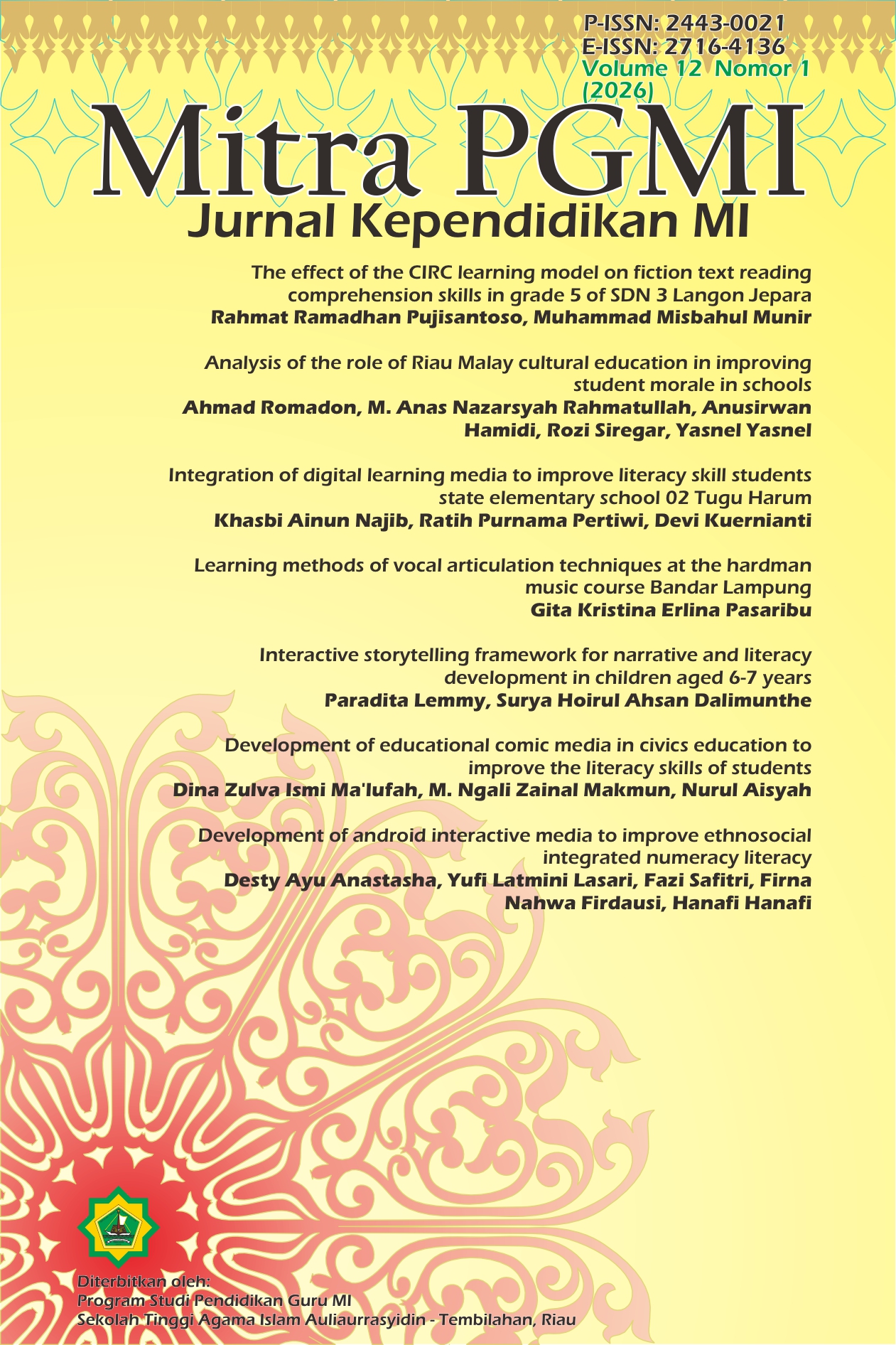
Learning methods of vocal articulation techniques at the hardman music course Bandar Lampung
DOI:
https://doi.org/10.46963/mpgmi.v12i1.3343Keywords:
Vocal Technique, Articulation, Non-Formal Music Education, Vocal PedagogyAbstract
This study aims to analyze the learning process of vocal articulation techniques implemented at the Hardman Music Course in Bandar Lampung and to identify the teaching methods used by instructors in vocal instruction. Vocal learning in this non-formal music institution focuses on improving students’ pronunciation clarity, vocal strength, and expressive performance. The study employed a descriptive qualitative approach, with data collected through observations, interviews, and documentation involving vocal teachers and students. The findings indicate that articulation instruction is conducted through three main stages: vowel articulation, consonant articulation, and diphthong articulation. In practice, instructors apply a combination of demonstration, direct practice, drills, and continuous feedback to support students’ mastery of articulation techniques. The results show that students demonstrate noticeable improvements in pronunciation accuracy, vocal control, and articulation consistency after undergoing structured and practice-oriented training. This study concludes that the integration of systematic articulation stages with experiential learning methods effectively enhances students’ vocal performance in non-formal music education settings.
Downloads
References
Aqib, Z. &. (2021). Kumpulan Metode Pembelajaran. PT Sarana Tutorial Nurani Sejahtera
Arbarini, M. P. (2025). Transforming Communities through Non-Formal Education: A Study of Indonesia and Thailand. International Joint Conference on Arts and Human.
Bigler, A. R. (2021). Voice Pedagogy for the 21st Century: The Summation of Two Summits. Journal of Singing, 78(1), 11-28.
Chapman, J. L. (2021). Singing and teaching singing: A holistic approach to classical voice (Vol. 1). Plural Publishing.
Clark, T. J. (2024). Vocal pedagogy in 21st century music education (PhD Thesis). LibertyUniversity.
Febriani, E. S. (2023). Analisis data dalam penelitian tindakan kelas. Jurnal Kreativitas Mahasiswa, 1(2), 140-153.
Gada, H. (2022). Educational Transformation in formal and non-formal learning. International Journal of Multidisciplinary Educational Research, 11(7), 22-25.
Hartwig, A. K. (2014). Research Methodologies in Music Education. cambridge scholars.
Hidayatullah, R. (2024). Vokal Dasar. Jawa Tengah: Lakeisha.
Hutapea, C. J. (2025). Pengukuran dan Evaluasi dalam Pembelajaran Musik: Kajian Teoritis dan Praktis dalam Lembaga Musik Non Formal. Musikolastika: Jurnal Pertunjukan Dan Pendidikan Musik, 7(1), 55-70.
Imomalievich, S. (2022). Metode pembentukan keterampilan vokal. Jurnal Penelitian Interdisipliner Internasional Galaxy, 10 (11), 808-811.
Ionescu, F. (2020). Non-formal education approaches in school organization methodological aspects and case study. Journal of education, society & multiculturalism, 1(2), 1-14.
Jamilah, S. e. (2022). Pengantar Ilmu Statistik. Medan: Yayasan Kita Menulis.
Kovalsky, D. (2021). Vocal Pedagogy and Using Healthy Technique to Sing. Akron, Ohio: Williams Honors College
Krause, A. E. (2018). Effective educational strategies to promote life-long musical investment: Perceptions of educators. Frontiers in psychology, 9, 1977.
Maragani, M. H. (2020). Strategy of Non Formal Music Education in Disruptive Era. ICCIRS 2019: Proceedings of the First International Conference on Christian and Inter Religious Studies. Christian and Inter Religious Studies.
Maragani, M. H. (2023). Pengajaran Teknik Vokal Head Voice dan Penerapannya dalam Paduan Suara Anak Gema Sangkakala Children Choir. Clef: Jurnal Musik Dan Pendidikan Musik, 4(2), 147-154
McPherson, G. E. (2022). Feedback in music performance teaching. Frontiers in Psychology, 13, 891025.
Miles, M. B. (2014). Qualitative data analysis: A methods sourcebook (Edition 3). Sage.
Nordgren, C. E. (2019). Phonetics of vowels. In Oxford Research Encyclopedia of Linguistics. United State: Oxford University.
Okatara, B. (2011). 6 jam jago teknik vokal. Jakarta: Gudang Ilmu.
Pitts, S. (2012). Chances and choices: Exploring the impact of music education. USA: OUP.
Syaadah, R. A. (2023). Pendidikan Formal, Pendidikan Non Formal dan Pendidikan Informal. Pema (Jurnal Pendidikan dan Pengabdian Kepada Masyarakat), 2(2), 125–131.
Tobing, H. D. (2024). Penerapan Teknik Vokal Artikulasi pada Lagu Indahnya Saat Teduh oleh Pemimpin Pujian di Gereja Methodist Indonesia Sukarame Baru Resort Sukasari Labuhan Batu Utara Tahun Pembelajaran 2023/2024. Jurnal Kajian Ilmu seni, Media dan Desain, 1(5), 277-288.
Tsaniyah, W. (2024). Implementasi Metode Bernyanyi Pada Pembelajaran Pendidikan Agama Islam di SDN 107412 Simadamada Deli Serdang. Al-I'tibar: Jurnal Pendidikan Islam, 11(2), 181-192.
Waruwu, M. (2024). Pendekatan penelitian kualitatif: Konsep, prosedur, kelebihan dan peran di bidang pendidikan. Afeksi: Jurnal Penelitian Dan Evaluasi Pendidikan, 5(2), 198-211.
Downloads
Published
Issue
Section
License
Copyright (c) 2026 Gita Kristina Erlina Pasaribu

This work is licensed under a Creative Commons Attribution-ShareAlike 4.0 International License.
Authors who publish with this journal agree to the following terms:
1. Copyright on any article is retained by the author(s).
2. The author grants the journal, right of first publication with the work simultaneously licensed under a Creative Commons Attribution shareAlike 4.0 International License that allows others to share the work with an acknowledgment of the work’s authorship and initial publication in this journal.
3. Authors are able to enter into separate, additional contractual arrangements for the non-exclusive distribution of the journal’s published version of the work (e.g., post it to an institutional repository or publish it in a book), with an acknowledgment of its initial publication in this journal.
4. Authors are permitted and encouraged to post their work online (e.g., in institutional repositories or on their website) prior to and during the submission process, as it can lead to productive exchanges, as well as earlier and greater citation of published work.
5. The article and any associated published material is distributed under the Creative Commons Attribution-ShareAlike 4.0 International License





2.png)