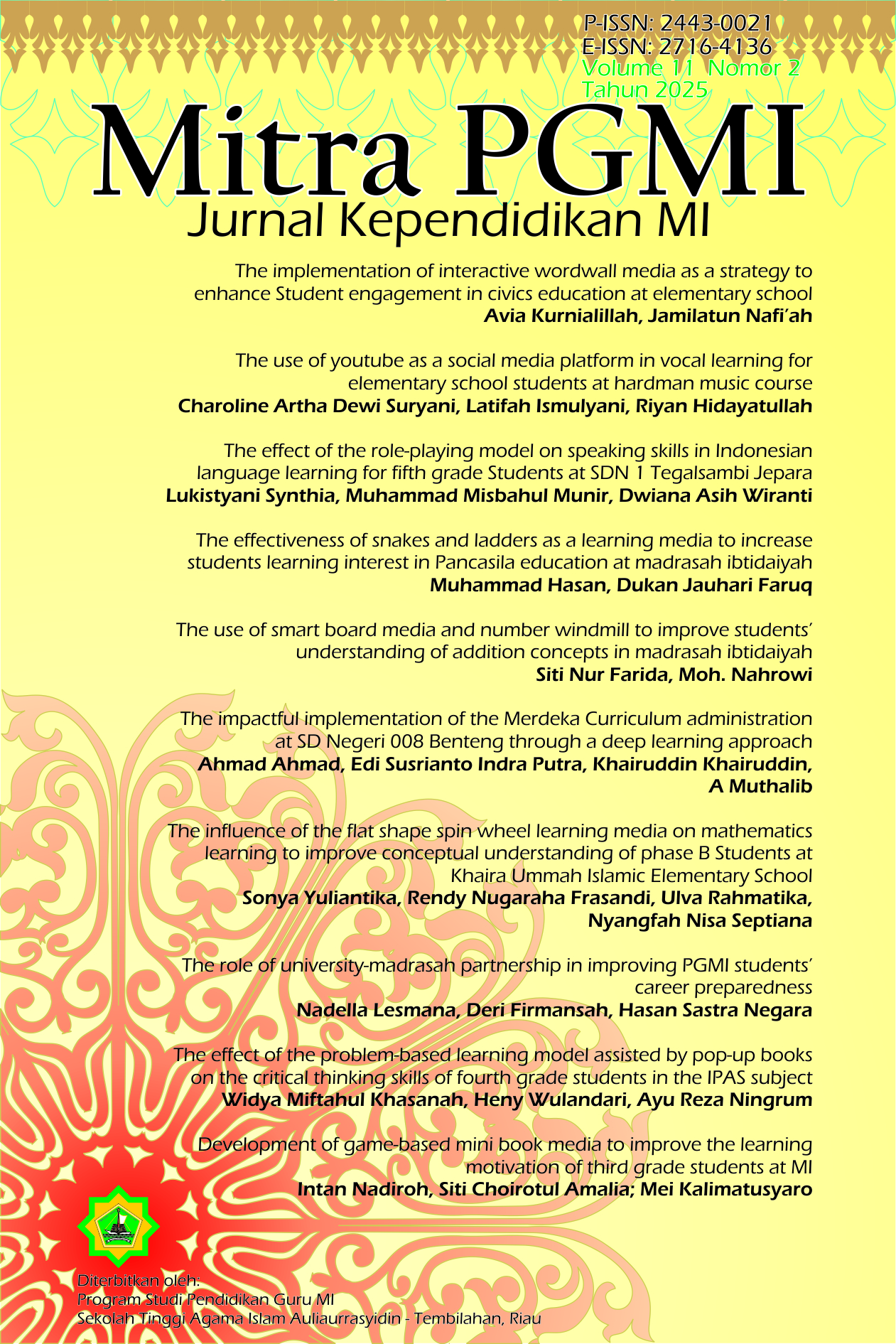
The use of smart board media and number windmill to improve students’ understanding of addition concepts in madrasah ibtidaiyah
DOI:
https://doi.org/10.46963/mpgmi.v11i2.2930Keywords:
Smart Board, Windmill, Addition, Madrasah IbtidaiyahAbstract
students through the use of innovative learning media in the form of a smart board and number windmill. The main issue identified at MI Bustanul Ulum 06 Gumukmas is the low arithmetic ability of students, particularly in grasping basic addition concepts. This research employs a qualitative approach using the Research and Development (R&D) method, referring to the ADDIE development model, which includes five stages: analysis, design, development, implementation, and evaluation. The media is designed to incorporate visual, auditory, and kinesthetic elements to stimulate the learning interest of students aged 7–10 years. Based on trial results, the media was found to be highly feasible, with an eligibility score of 94%. The use of this media effectively increased students' enthusiasm and active participation in learning and facilitated a better understanding of addition through a fun and concrete approach. Therefore, the use of the smart board and number windmill is effective in supporting the learning process of mathematics at the Madrasah Ibtidaiyah level.
Downloads
References
Amalina, Z, N., & Maharbid, D. A. (2025). Pengaruh penggunaan media pembelajaran kincir angka berbantuan gelas dan sedotan terhadap kemampuan operasi hitung perkalian matematika siswa kelas ii di SDN Mustikajaya IV. Sindoro Cendekia Pendidikan 13(3).
BP A. R., Munandar, S. A., Fitriani, A., Karlina, Y., & Yumriani, Y. (2022). Pengertian pendidikan, ilmu pendidikan dan unsur-unsur pendidikan. Journal Unismuh 2(1), 1–8. https://journal.unismuh.ac.id/index.php/alurwatul/article/view/7757
Cornelia, T, S, Fahira, Z., & Rahmadini, V. (2024). Upaya meningkatkan kognitif siswa dengan penggunaan media kincir angka di Sd Negeri 173655 Lumban Rang. Jurnal Curere, 8(2). http://dx.doi.org/10.36764/jc.v8i2.1448
Geme, Y. T. Y., Dhiu, K. D., & Ita, E. (2024). Pengembangan alat permainan edukatif kincir angka untuk aspek kognitif pada anak usia 5-6 tahun di tkk olaew. Jurnal Citra Pendidikan Anak (JCPA) 3(4). 1187–1200. https://doi.org/10.38048/jcpa.v3i4.2840
Harpini, H., Amalia, R., Asilestari, P., Zulfah, Z., & Yusnita, A. (2024). Upaya meningkatkan kognitif anak dengan media kincir angka di tk maya permata penyasawan pada usia 4-5 tahun. Jurnal Dedikasi Pendidikan, 8(12).
Siregar, N. B., Karim, P. A., & Siregar, L. N. K. (2024). Pengaruh media pembelajaran kincir pintar terhadap kemampuan berhitung perkalian siswa kelas ii min12 Kota Medan Tembung. MERDEKA: Jurnal Ilmiah Multidisiplin, 2(2), 516-522. https://doi.org/10.62017/merdeka.v2i2.3136
Siswondo, R., & Agustina, L. (2021). Penerapan strategi pembelajaran ekspositori untuk mencapai tujuan pembelajaran matematika. Himpunan: Jurnal Ilmiah Mahasiswa Pendidikan Matematika 1(1). 33–40. https://jim.unindra.ac.id/index.php/himpunan/article/view/3155
Supardi, A., Gumilar, A., & Abdurohman, R. (2022). Pembelajaran nahwu dengan metode deduktif dan induktif. Al-Urwatul Wutsqo: Jurnal Ilmu Keislaman dan Pendidikan, 3(1), 23-32. https://doi.org/10.62285/alurwatulwutsqo.v3i1.43
Downloads
Published
Issue
Section
License
Copyright (c) 2025 Siti Nur Farida, Moh. Nahrowi

This work is licensed under a Creative Commons Attribution-ShareAlike 4.0 International License.
Authors who publish with this journal agree to the following terms:
1. Copyright on any article is retained by the author(s).
2. The author grants the journal, right of first publication with the work simultaneously licensed under a Creative Commons Attribution shareAlike 4.0 International License that allows others to share the work with an acknowledgment of the work’s authorship and initial publication in this journal.
3. Authors are able to enter into separate, additional contractual arrangements for the non-exclusive distribution of the journal’s published version of the work (e.g., post it to an institutional repository or publish it in a book), with an acknowledgment of its initial publication in this journal.
4. Authors are permitted and encouraged to post their work online (e.g., in institutional repositories or on their website) prior to and during the submission process, as it can lead to productive exchanges, as well as earlier and greater citation of published work.
5. The article and any associated published material is distributed under the Creative Commons Attribution-ShareAlike 4.0 International License




2.png)