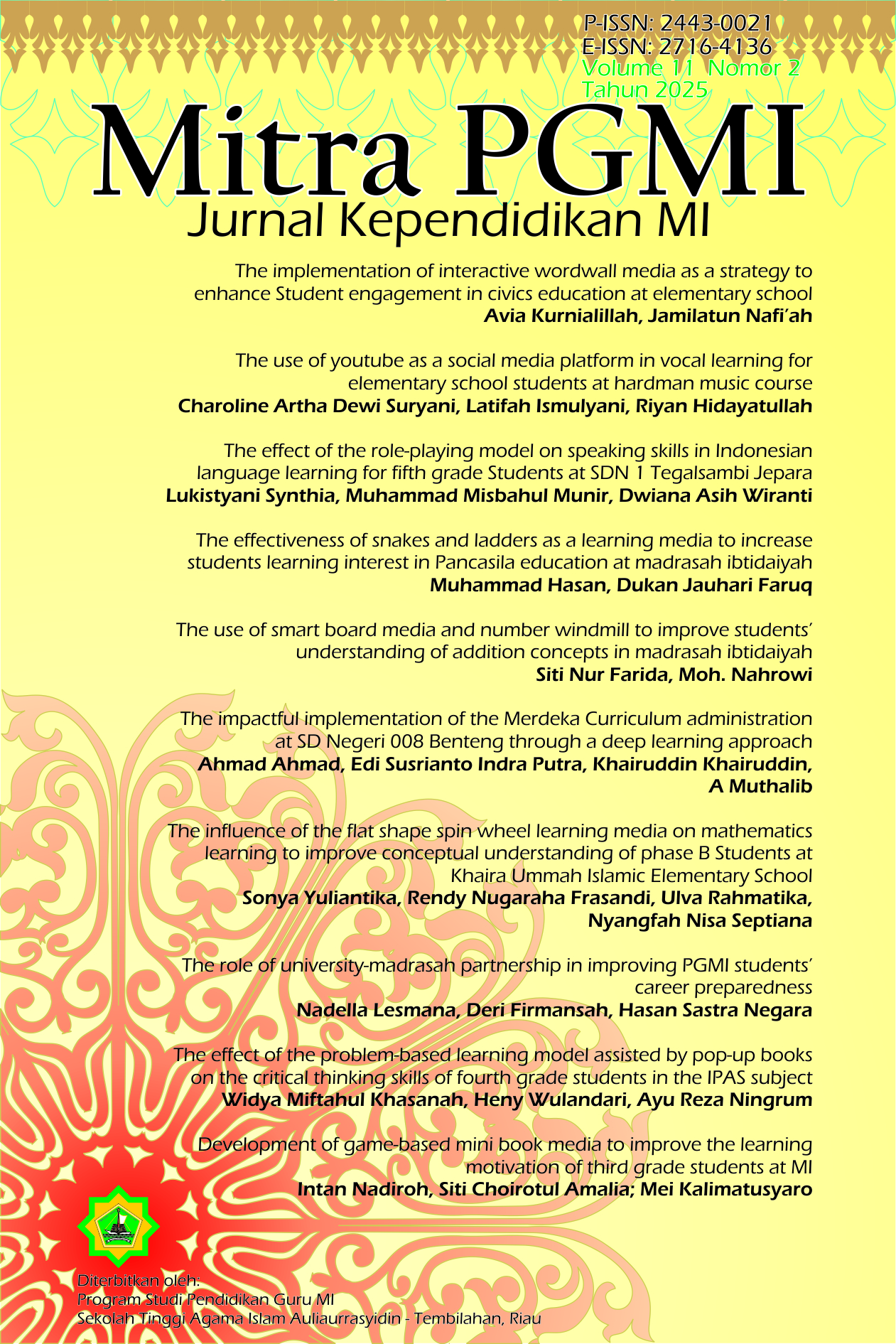
The role of university-madrasah partnership in improving PGMI students’ career preparedness
DOI:
https://doi.org/10.46963/mpgmi.v11i2.2815Keywords:
Career Readiness, Instructional Strategies, PGMI StudentsAbstract
The career readiness of Madrasah Ibtidaiyah Teacher Education (PGMI) students is a crucial factor in shaping competent educators in the field of education. This study aims to explore the implementation of instructional strategies to enhance the career readiness of PGMI students. A qualitative research method with a case study approach was employed, involving two classes of sixth-semester PGMI students at a university. Data were collected through in-depth interviews, observations, and academic document analysis. The findings indicate that practice-based learning strategies, such as microteaching, field experience practice (PPL), and project-based learning, significantly impact students' pedagogical competencies. Additionally, the integration of technology in the learning process helps students develop digital skills relevant to modern educational demands. Challenges in implementing these strategies include limited practical facilities, students' readiness to apply theoretical knowledge to practice, and the lack of a structured career development program. This study concludes that the implementation of more practical and experience-based learning strategies can enhance PGMI students' career readiness. Therefore, it is recommended that educational institutions strengthen collaborations with madrasahs and other educational institutions and develop more intensive training programs for students.
Downloads
References
Al-Waqfi, Mohammed A., Hayfaa Tlaiss, and Kilani Ghoudi. 2023. “Career Adaptability as a Predictor of Job Search Intentions and Career Readiness of Young Adults in the United Arab Emirates.” Journal of Career Development 50(5):1076–96. https://doi.org/10.1177/08948453231157759.
Ambrosetti, Angelina, and John Dekkers. 2010. “The Interconnectedness of the Roles of Mentors and Mentees in Pre-Service Teacher Education Mentoring Relationships.” Australian Journal of Teacher Education 35(6). https://doi.org/10.14221/ajte.2010v35n6.3.
Aruan, Yuliani, Edi Syahputra, and Edy Surya. 2021. “Analysis of the Implementation of the Indonesian National Qualifications Framework Oriented Curriculum in the Mathematics Education Program of Universitas Negeri Medan.” Budapest International Research and Critics in Linguistics and Education (BirLE) Journal 4(1):42–49. https://doi.org/10.33258/birle.v4i1.1554.
Aslan, Aslan, and Kok Shiong Pong. 2023. “Understanding the Trend of Digital Da’wah Among Muslim Housewives in Indonesia.” Fikroh: Jurnal Pemikiran Dan Pendidikan Islam 16(1):11–22. https://doi.org/10.37812/fikroh.v16i1.681.
Assingkily, Muhammad Shaleh. 2020. “Upaya Mewujudkan Program Kampus Merdeka Pada Kurikulum PGMI STIT Al Ittihadiyah Labuhanbatu Utara.” At-Thullab : Jurnal Pendidikan Guru Madrasah Ibtidaiyah 4(2):62. https://doi.org/10.30736/atl.v4i2.263.
Balderas, Antonio, Manuel Palomo-Duarte, Juan Manuel Dodero, María Soledad Ibarra-Sáiz, and Gregorio Rodríguez-Gómez. 2018. “Scalable Authentic Assessment of Collaborative Work Assignments in Wikis.” International Journal of Educational Technology in Higher Education 15(1):40. https://doi.org/10.1186/s41239-018-0122-1.
Barrett, Lisa Feldman, Batja Mesquita, and Maria Gendron. 2011. “Context in Emotion Perception.” Current Directions in Psychological Science 20(5):286–90. https://doi.org/10.1177/0963721411422522.
Billett, Stephen. 2015. “Integrating Practice-Based Experiences with Higher Education.” Pp. 1–26 in Integrating Practice-based Experiences into Higher Education. Vol. 13, Professional and Practice-based Learning. Dordrecht: Springer Netherlands.
Blume, Rachel. 2022. “Learning Instructional Methods and Practices: An Early Career Health Sciences Librarian Perspective.” Medical Reference Services Quarterly 41(1):117–25. https://doi.org/10.1080/02763869.2022.2021049.
Braun, Virginia, and Victoria Clarke. 2006. “Using Thematic Analysis in Psychology.” Qualitative Research in Psychology 3(2):77–101. https://doi.org/10.1191/1478088706qp063oa.
Darling-Hammond, Linda. 2017. “Teacher Education around the World: What Can We Learn from International Practice?” European Journal of Teacher Education 40(3):291–309. https://doi.org/10.1080/02619768.2017.1315399.
Dengerink, Jurriën, Mieke Lunenberg, and Quinta Kools. 2015. “What and How Teacher Educators Prefer to Learn.” Journal of Education for Teaching 41(1):78–96. https://doi.org/10.1080/02607476.2014.992635.
F, Huda. 2022. “Assessing the Quality of Operation Notes in a Teaching Hospital.” Gastroenterology & Hepatology International Journal 4(1):1–5. https://doi.org/10.23880/ghij-16000150.
GEM Report UNESCO. 2023. Global Education Monitoring Report 2023: Technology in Education: A Tool on Whose Terms? 1st ed. GEM Report UNESCO.
Guest, Greg, Arwen Bunce, and Laura Johnson. 2006. “How Many Interviews Are Enough?: An Experiment with Data Saturation and Variability.” Field Methods 18(1):59–82. https://doi.org/10.1177/1525822x05279903.
Hobson, Andrew J., Patricia Ashby, Angi Malderez, and Peter D. Tomlinson. 2009. “Mentoring Beginning Teachers: What We Know and What We Don’t.” Teaching and Teacher Education 25(1):207–16. https://doi.org/10.1016/j.tate.2008.09.001.
Hoekstra, Annemarieke, and Jocelyn R. Crocker. 2015. “ePortfolios: Enhancing Professional Learning of Vocational Educators.” Vocations and Learning 8(3):353–72. https://doi.org/10.1007/s12186-015-9133-4.
Howard, Sarah K., Jo Tondeur, Fazilat Siddiq, and Ronny Scherer. 2021. “Ready, Set, Go! Profiling Teachers’ Readiness for Online Teaching in Secondary Education.” Technology, Pedagogy and Education 30(1):141–58. https://doi.org/10.1080/1475939X.2020.1839543.
Inganah, Siti, Nopia Rizki, Choirudin Choirudin, Syed Muhammad Yousaf Farooq, and Novi Susanti. 2023a. “Integration of Islamic Values, Mathematics, and Career Readiness Competencies of Prospective Teachers in Islamic Universities.” Delta-Phi: Jurnal Pendidikan Matematika 1(1):11–14. https://doi.org/10.61650/dpjpm.v1i1.31.
Inganah, Siti, Nopia Rizki, Choirudin Choirudin, Syed Muhammad Yousaf Farooq, and Novi Susanti. 2023b. “Integration of Islamic Values, Mathematics, and Career Readiness Competencies of Prospective Teachers in Islamic Universities.” Delta-Phi: Jurnal Pendidikan Matematika 1(1):11–14. https://doi.org/10.61650/dpjpm.v1i1.31.
Ingersoll, Richard M., and Michael Strong. 2011. “The Impact of Induction and Mentoring Programs for Beginning Teachers: A Critical Review of the Research.” Review of Educational Research 81(2):201–33. https://doi.org/10.3102/0034654311403323.
Korthagen, F. A. J. 2001. Linking Practice and Theory: The Pedagogy of Realistic Teacher Education. Mahwah, N.J: L. Erlbaum Associates.
Lumbilsa, Abbas, Asrori, and Rusman. 2023. “Improving Creativity and Learning Outcomes Through Team-Assisted Individualization Learning Islamic Education Lessons.” EDUKASI : Jurnal Pendidikan Islam (e-Journal) 11(2):199–213. https://doi.org/10.54956/edukasi.v11i2.371.
Muhammad Dhori, Jonata, and Ahmad Saufi Al Hadisi. 2021. “Curriculum Refers To Kkni At The Pgmi Study Program At Uin Raden Fatah Palembang.” International Journal of Social Science 1(4):301–8. https://doi.org/10.53625/ijss.v1i4.706.
Podsakoff, Philip M., Scott B. MacKenzie, Jeong-Yeon Lee, and Nathan P. Podsakoff. 2003. “Common Method Biases in Behavioral Research: A Critical Review of the Literature and Recommended Remedies.” Journal of Applied Psychology 88(5):879–903. https://doi.org/10.1037/0021-9010.88.5.879.
Prihastia, Agnes, Umi Hani, Maskun Safi’i, Silmi Mausul, and Daimah Daimah. 2022. “Digitalization Of Islamic Education Planning In Madrasah.” Managere: Indonesian Journal of Educational Management 4(1):83–96. https://doi.org/10.52627/managere.v4i1.97.
Rahman, Md. Mahfuzur, Tarek Md. Anamul Haque, Nafish Sams Sourav, Sadia Rahman, Subrina Yesmin, Rony Mia, Abdullah Al Noman, and Khadija Begum. 2021. “Synthesis and Investigation of Dyeing Properties of 8-Hydroxyquinoline-Based Azo Dyes.” Journal of the Iranian Chemical Society 18(4):817–26. https://doi.org/10.1007/s13738-020-02070-2.
Sefudin, Akhmad, and Muhammad Darwin. 2020. “Perbandingan Teori Disrupsi Pada Marketing Di Era Industri 4.0 Menurut Hermawan Kartajaya Dan Rhenald Kasali.” Komitmen: Jurnal Ilmiah Manajemen 1(2):25–39. doi:10.15575/jim.v1i2.10315.
Sutcher, Leib, Linda Darling-Hammond, and Desiree Carver-Thomas. 2019. “Understanding Teacher Shortages: An Analysis of Teacher Supply and Demand in the United States.” Education Policy Analysis Archives 27:35. doi:10.14507/epaa.27.3696.
University of Southern California, Ann Majchrzak, Universidad Ramon Llull, Christian Wagner, City University of Hong Kong, Dave Yates, and United States Air Force. 2013. “The Impact of Shaping on Knowledge Reuse for Organizational Improvement with Wikis.” MIS Quarterly 37(2):455–69. https://doi.org/10.25300/MISQ/2013/37.2.07.
Voogt, Joke, and Natalie Pareja Roblin. 2012. “A Comparative Analysis of International Frameworks for 21st Century Competences: Implications for National Curriculum Policies.” Journal of Curriculum Studies 44(3):299–321. https://doi.org/10.1080/00220272.2012.668938.
Wijaya, Tommy Tanu, Yiming Cao, Martin Bernard, Imam Fitri Rahmadi, Zsolt Lavicza, and Herman Dwi Surjono. 2022. “Factors Influencing Microgame Adoption among Secondary School Mathematics Teachers Supported by Structural Equation Modelling-Based Research.” Frontiers in Psychology 13:952549. https://doi.org/10.3389/fpsyg.2022.952549.
Zulkifli, Zulkifli, Erwinsyah Satria, Agus Supriyadi, and Tomi Apra Santosa. 2022. “Meta-Analysis: The Effectiveness of the Integrated STEM Technology Pedagogical Content Knowledge Learning Model on the 21st Century Skills of High School Students in the Science Department.” Psychology, Evaluation, and Technology in Educational Research 5(1):32–42. https://doi.org/10.33292/petier.v5i1.144.
Downloads
Published
Issue
Section
License
Copyright (c) 2025 Nadella Lesmana, Deri Firmansah, Hasan Sastra Negara

This work is licensed under a Creative Commons Attribution-ShareAlike 4.0 International License.
Authors who publish with this journal agree to the following terms:
1. Copyright on any article is retained by the author(s).
2. The author grants the journal, right of first publication with the work simultaneously licensed under a Creative Commons Attribution shareAlike 4.0 International License that allows others to share the work with an acknowledgment of the work’s authorship and initial publication in this journal.
3. Authors are able to enter into separate, additional contractual arrangements for the non-exclusive distribution of the journal’s published version of the work (e.g., post it to an institutional repository or publish it in a book), with an acknowledgment of its initial publication in this journal.
4. Authors are permitted and encouraged to post their work online (e.g., in institutional repositories or on their website) prior to and during the submission process, as it can lead to productive exchanges, as well as earlier and greater citation of published work.
5. The article and any associated published material is distributed under the Creative Commons Attribution-ShareAlike 4.0 International License



2.png)