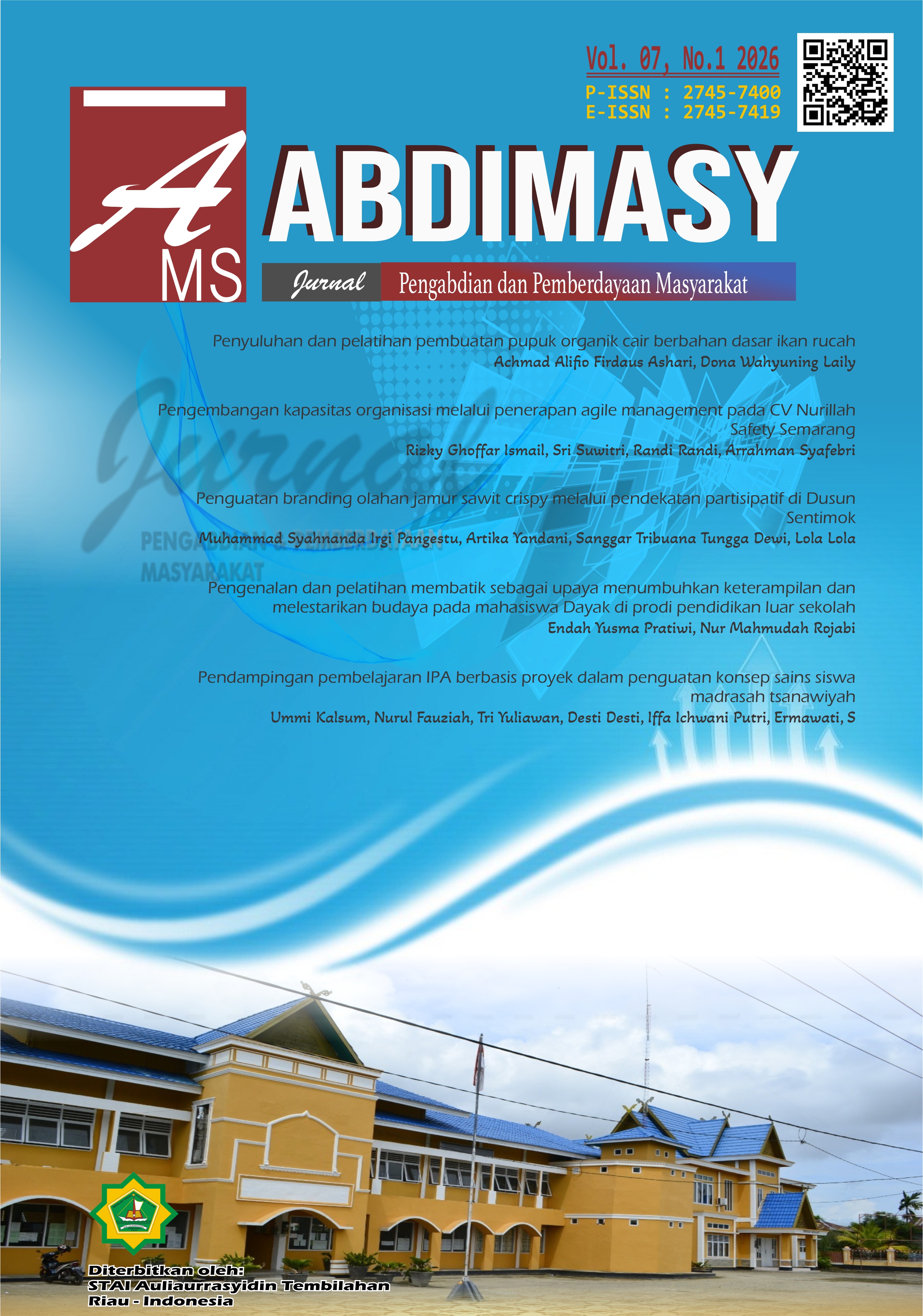
Pengembangan kapasitas organisasi melalui penerapan agile management pada CV Nurillah Safety Semarang
DOI:
https://doi.org/10.46963/ams.v7i1.3673Keywords:
Agile Management, Scrum, Kanban, Organizational DevelopmentAbstract
Rapid changes in the business environment require organizations to maintain high adaptability; however, many small and medium-sized enterprises still rely on bureaucratic work patterns that hinder decision-making speed. This Community Service (PkM) activity aimed to enhance the organizational capacity of CV. Nurillah Safety Semarang through the implementation of Agile Management. The program emphasized conceptual understanding, training in Agile tools (Scrum, Kanban, and Sprint Planning), and implementation support. Conducted on December 9, 2025, the activity applied methods including needs assessment, workshops, practical exercises, and evaluation. The results indicated a 50% increase in participants’ understanding of Agile concepts based on pre–post test measurements. Furthermore, improvements were observed in internal team communication, along with the initial adoption of Kanban boards for daily work visualization. These findings demonstrate that Agile Management is effective in strengthening adaptability and improving operational responsiveness in small organizations.
Downloads
References
Anderson, D. J. (2010). Kanban: Successful evolutionary change for your technology business. Blue Hole Press.
Asyifah Fauzah Delfira, P. Y., Baihaqi, M., & Baihaqi, M. (2025). Analisis permasalahan perkembangan UMKM terhadap perekonomian di Indonesia. Jurnal Ekonomi, Bisnis dan Manajemen, 4(1), 167–180. https://doi.org/10.58192/ebismen.v4i1.3184
Azra, F. E. A. (2022). Analisis strategi dan keunggulan bersaing sebagai kunci sukses UMKM ritel: Studi kasus perusahaan ABC. INOBIS: Jurnal Inovasi Bisnis dan Manajemen Indonesia, 5(3), 341–354. https://doi.org/10.31842/jurnalinobis.v5i3.234
Azrieel, W., & Valentino, N. (2024). Mengoptimalkan komunikasi dalam tim pengembangan perangkat lunak melalui pendekatan agile dengan scrum: Literature review. JATI (Jurnal Mahasiswa Teknik Informatika), 8(4), 4373-4378. https://doi.org/10.36040/jati.v8i4.9949
Denning, S. (2018). The age of agile: How smart companies work. AMACOM.
Diebold, J., Diebold, P., & Vetter, A. (2018). Agile meets assessments: Case study on how to do agile process improvement in a very small enterprise. In M. Kuhrmann, K. Schneider, D. Pfahl, S. Amasaki, M. Ciolkowski, R. Hebig, P. Tell, J. Klünder, & S. Küpper (Eds.), Product-focused software process improvement (Vol. 11271, pp. 31–47). Springer. https://doi.org/10.1007/978-3-030-03673-7_3
Fernandez, A., Silva, L., & Morais, R. (2024). Agile iteration planning and organizational adaptability in small enterprises. Journal of Management Innovation, 12(1), 44–59.
Highsmith, J. (2020). Agile project management: Creating innovative products. Addison-Wesley.
Kementerian Koperasi dan Usaha Kecil dan Menengah Republik Indonesia. (2023). Data perkembangan UMKM Indonesia tahun 2023. Kementerian Koperasi dan UKM Republik Indonesia.
Permatasari, R. J. (2024). The Agile Concept in Enhancing a More Responsive Organization. Dirya: Journal of Economic Management, 1(2), 67-75. https://doi.org/10.70283/dirya.v1i2.58
Rahman, A., Indrajit, E., Unggul, A., & Dazki, E. (2024). Agile project management impacts software development team productivity. Sinkron: Jurnal dan Penelitian Teknik Informatika, 8(3), 1847–1858. https://doi.org/10.33395/sinkron.v8i3.13853
Rigby, D. K., Sutherland, J., & Takeuchi, H. (2016). Embracing agile. Harvard business review, 94(5), 40-50. https://hbr.org/2016/05/embracing-agile
Sari, S., & Rachmawati, O. C. R. (2025). The implementation of agile kanban in the development of an IoT-Based Sugarcane Growth Monitoring System. G-Tech: Jurnal Teknologi Terapan, 9(4), 1858–1867. https://doi.org/10.70609/g-tech.v9i4.7845
Schwaber, K., & Sutherland, J. (2020). The Scrum guide: The definitive guide to Scrum: The rules of the game. Scrum.org.
Serrador, P., & Pinto, J. K. (2015). Does agile work? A quantitative analysis of agile project success. International Journal of Project Management, 33(5), 1040–1051. https://doi.org/10.1016/j.ijproman.2015.01.006
Setiana, I., & Yunizar, Y. (2025). The Effect of scrum implementation and agile organization on project productivity mediated by team experience. Jurnal Ilmiah Manajemen Kesatuan, 13(5), 3725-3734. https://doi.org/10.37641/jimkes.v13i5.3798
Sri Wahyuni, F. W., Afifah, N., & Pratama, R. A. (2023). Application of inventory and service transactions on web-based CV Medan Teknik using the agile Kanban method. Jurnal Ilmu Komputer dan Informatika (JIKI), 4(2), 107–116. https://doi.org/10.54082/jiki.201
Tambunan, T. T. H. (2019). UMKM di Indonesia: Perkembangan, kendala, dan tantangan. Prenadamedia Group.
Teece, D. J., Peteraf, M., & Leih, S. (2016). Dynamic capabilities and organizational agility: Risk, uncertainty, and strategy in the innovation economy. California Management Review, 58(4), 13–35. https://doi.org/10.1525/cmr.2016.58.4.13
Walsh, G. S., & Cunningham, J. A. (2016). Business failure and entrepreneurship: Emergence, evolution and future research. Foundations and Trends® in Entrepreneurship, 12(3), 163–285. https://doi.org/10.1561/0300000063
Womack, J. P., & Jones, D. T. (2021). Lean thinking. Simon & Schuster.
Downloads
Published
Issue
Section
License
Copyright (c) 2026 Rizky Ghoffar Ismail, Sri Suwitri, Randi Randi, Arrahman Syafebri

This work is licensed under a Creative Commons Attribution-ShareAlike 4.0 International License.
Authors who publish with this journal agree to the following terms:
1. Copyright on any article is retained by the author(s).
2. The author grants the journal, right of first publication with the work simultaneously licensed under a Creative Commons Attribution shareAlike 4.0 International License that allows others to share the work with an acknowledgment of the work’s authorship and initial publication in this journal.
3. Authors are able to enter into separate, additional contractual arrangements for the non-exclusive distribution of the journal’s published version of the work (e.g., post it to an institutional repository or publish it in a book), with an acknowledgment of its initial publication in this journal.
4. Authors are permitted and encouraged to post their work online (e.g., in institutional repositories or on their website) prior to and during the submission process, as it can lead to productive exchanges, as well as earlier and greater citation of published work.
5. The article and any associated published material is distributed under the Creative Commons Attribution-ShareAlike 4.0 International License


2.png)