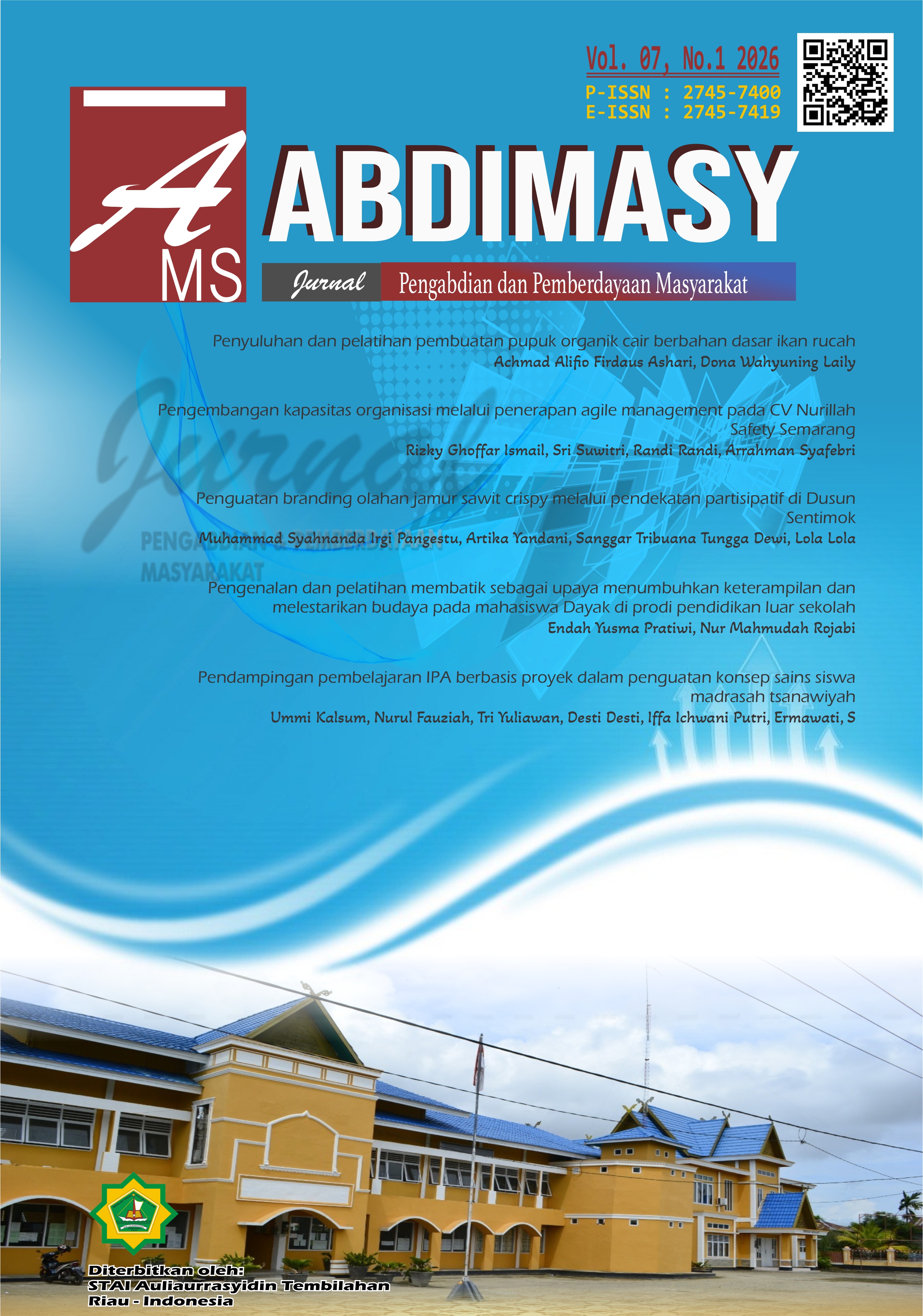
Pengenalan dan pelatihan membatik sebagai upaya menumbuhkan keterampilan dan melestarikan budaya pada mahasiswa Dayak di prodi pendidikan luar sekolah
DOI:
https://doi.org/10.46963/ams.v7i1.3900Keywords:
Training, Batik, Batik Kalteng, Benang Bintik, DayakAbstract
Batik is one of Indonesia’s cultural heritages that needs to be preserved through the active involvement of younger generations. To date, Dayak students in the Prodi Pendidikan Luar Sekolah have rarely worn batik featuring traditional motifs from Central Kalimantan, indicating the need for a Community Service Program addressing this issue. This program aimed to develop batik-making skills and enhance awareness of cultural preservation among Dayak students in the Prodi Pendidikan Luar Sekolah. The implementation method consisted of material presentation, introduction to tools and materials, demonstration of batik-making techniques, hands-on practice, and activity evaluation. The results showed that participants experienced increased knowledge regarding batik motifs, philosophical meanings, basic batik-making techniques, and the importance of cultural preservation. In addition, participants acquired practical batik-making skills, including motif design, wax application (canting), coloring, and finishing processes. Therefore, the introduction and batik training activities can serve as an effective approach to developing skills while strengthening cultural awareness among students in the Prodi Pendidikan Luar Sekolah.
Downloads
References
Trixie, A. A. (2020). Filosofi motif batik sebagai identitas bangsa Indonesia. Folio, 1 (1), 1-9. https://doi.org/10.37715/folio.v1i1.1380
Andriya, R., & Susilawati, N. (2019). Pelatihan membatik wanita Desa Ampuan Lumpo. Culture & Society: Journal Of Anthropological Research, 1(1), 1–7. https://doi.org/10.24036/culture/vol1-iss1/1
Ghufronudin, G., Zuber, A., & Demartoto, A. (2018). Representasi pendidikan karakter berbasis kearifan lokal melalui pembelajaran membatik. Jurnal Analisa Sosiologi, 6(2), 17–21. https://doi.org/10.20961/jas.v6i2.18020
Imaniar, T., Hilmi, M. I., & Fajarwati, L. (2023). Dampak pelatihan membatik dalam membentuk jiwa wirausaha masyarakat pesisir. Jurnal Cendekiawan Ilmiah PLS, 8. https://doi.org/10.37058/jpls.v8i1
Lastaria, Muhammad Tri Ramdhani, & Arna Purtina. (2022). Simbol budaya masyarakat Dayak Ngaju di Museum Balanga Palangka Raya
Oktavian, M. L., & -, widodo. (2020). Pemberdayaan masyarakat melalui pelatihan membatik dalam menunjang pendapatan keluarga. J+PLUS UNESA, 9(2), 51–60. https://ejournal.unesa.ac.id/index.php/jurnal-pendidikan-luar-sekolah/article/view/42379
Rahmawati, L., Rafsanjani, M. A., Dilla, W. P., & Pebrianti, T. (2025). Benang bintik: Sebuah eksplorasi nilai filosofis dan konsep matematis dengan pendekatan etnomatematika. Jurnal Ilmiah Kanderang Tingang, 16(1), 10–20. https://doi.org/10.37304/jikt.v16i1.373
Rahmawati, N. P. N. (n.d.). Benang bintik, motif batik khas Dayak Kalimantan Tengah.
Rasyad, Ach. (2016). Participative evaluation and the quality of community empowerment training of Program Keluarga Harapan (PKH) companions. International Journal of Education and Literacy Studies, 4(2). https://doi.org/10.7575/aiac.ijels.v.4n.2p.39
Usop, L. S., & Usop, T. B. (2021). Peran kearifan lokal masyarakat dayak dalam mengembangkan batik benang bintik di Kalimantan Tengah. Mudra Jurnal Seni Budaya, 36(3), 405–413. https://doi.org/10.31091/mudra.v36i3.1502
Downloads
Published
Issue
Section
License
Copyright (c) 2026 Endah Yusma Pratiwi, Nur Mahmudah Rojabi

This work is licensed under a Creative Commons Attribution-ShareAlike 4.0 International License.
Authors who publish with this journal agree to the following terms:
1. Copyright on any article is retained by the author(s).
2. The author grants the journal, right of first publication with the work simultaneously licensed under a Creative Commons Attribution shareAlike 4.0 International License that allows others to share the work with an acknowledgment of the work’s authorship and initial publication in this journal.
3. Authors are able to enter into separate, additional contractual arrangements for the non-exclusive distribution of the journal’s published version of the work (e.g., post it to an institutional repository or publish it in a book), with an acknowledgment of its initial publication in this journal.
4. Authors are permitted and encouraged to post their work online (e.g., in institutional repositories or on their website) prior to and during the submission process, as it can lead to productive exchanges, as well as earlier and greater citation of published work.
5. The article and any associated published material is distributed under the Creative Commons Attribution-ShareAlike 4.0 International License


2.png)