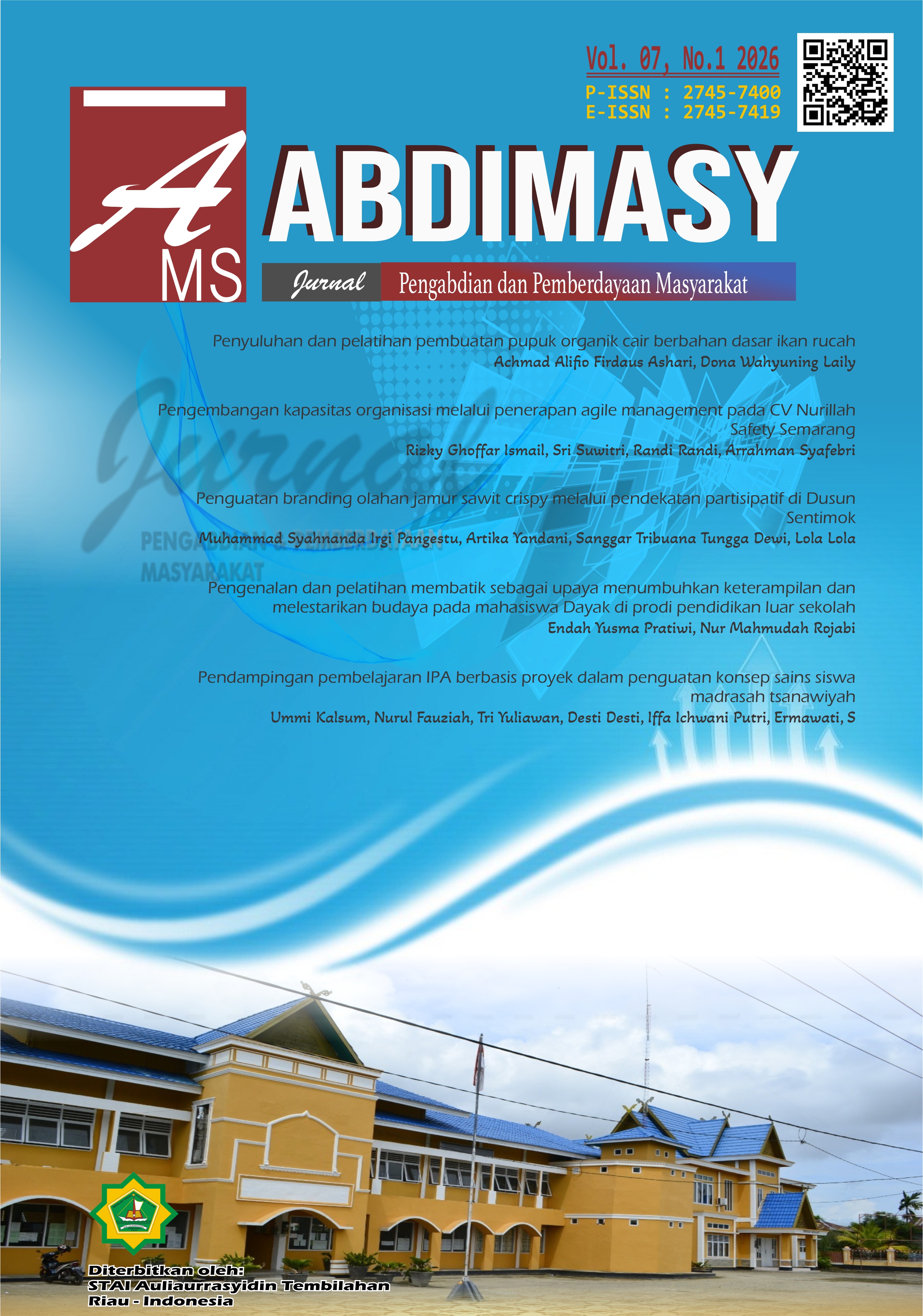
Pendampingan pembelajaran IPA berbasis proyek dalam penguatan konsep sains siswa madrasah tsanawiyah
DOI:
https://doi.org/10.46963/ams.v7i1.3769Keywords:
Science Learning, Projects, Conceptual UnderstandingAbstract
This community service activity aimed to assist teachers and students at a Madrasah Tsanawiyah in implementing project-based science learning to strengthen students' conceptual understanding of science. The partners' problems included teacher-centered instruction, limited application of innovative learning models, the unavailability of a science laboratory, and low student engagement in building meaningful comprehension of scientific concepts. The activity was conducted through five stages: needs analysis, teacher training, mentoring, learning implementation, and evaluation. The participants consisted of three teachers and 32 eighth-grade students. Data were collected using questionnaires, observations, tests, and documentation. The results showed an improvement in teachers' competence in designing and implementing project-based science learning, with an average pretest score of 64.6% increasing to 90% in the posttest. Students' conceptual mastery also improved, with an average pretest score of 53.8 rising to 82.5 in the posttest. Student responses to the learning process were highly positive, with a response rate of 88%. The outputs of this activity included project-based science learning kits and a scientific article on community service. In conclusion, this activity made a positive contribution to improving the quality of science learning at the Madrasah Tsanawiyah.
Downloads
References
Balemen, N., & Keskin, M. Ö. (2018). The effectiveness of project-based learning on science education: A meta-analysis search. International Online Journal of Education and Teaching, 5(4), 849–865. https://eric.ed.gov/?id=EJ1250564
Baum, F., MacDougall, C., & Smith, D. (2006). Participatory action research. Journal of Epidemiology and Community Health, 60(10), 854–857. https://doi.org/10.1136/jech.2004.028662
Bell, S. (2010). Project-based learning for the 21st century. The Clearing House, 83(2), 39–43. https://doi.org/10.1080/00098650903505415
Larmer, J., Lee, M., Clemente, D., Marzilli, A., White, E., Brandvold, E., ... & Field, S. (2021). Project based learning handbook for elementary school. PBLWorks.
Direktorat Jenderal Pendidikan Tinggi. (2021). Panduan pelaksanaan penelitian dan pengabdian kepada masyarakat. Kemendikbudristek.
Fadhilah, S. N., Fackhurohman, E., & Rahmawan, S. (2025). Improving Students' Understanding of Chemistry Concepts Through Project-Based Learning (PJBL): A Systematic Literature Review. Reforma: Jurnal Pendidikan dan Pembelajaran, 15(2), 162-172. https://doi.org/10.30736/reforma.v15i2.1281
Fitriani, A., Widodo, A., & Rochintaniawati, D. (2019). The profile of students’ scientific literacy through contextual learning. Journal of Physics: Conference Series, 1157(2), 022046. https://doi.org/10.1088/1742-6596/1157/2/022046
Holm, M. (2011). Project-based instruction: A review of the literature on effectiveness in prekindergarten through 12th grade classrooms. Rivier Academic Journal, 7(2), 1–13. https://www.rivier.edu/journal
Kementerian Pendidikan dan Kebudayaan. (2020). Panduan pembelajaran pada satuan pendidikan. Kemendikbud RI.
Kementerian Pendidikan, Kebudayaan, Riset, dan Teknologi. (2022). Kurikulum Merdeka. https://kurikulum.kemdikbud.go.id
Kokotsaki, D., Menzies, V., & Wiggins, A. (2016). Project-based learning: A review of the literature. Improving Schools, 19(3), 267–277. https://doi.org/10.1177/1365480216659733
Krajcik, J. S., & Blumenfeld, P. C. (2006). Project-based learning. In R. K. Sawyer (Ed.), The Cambridge handbook of the learning sciences (pp. 317–334). Cambridge University Press. https://doi.org/10.1017/CBO9780511816833.020
OECD. (2019). PISA 2018 Results: What Students Know and Can Do. OECD Publishing.
Rahmawati, Y., Ridwan, A., & Hadinugrahaningsih, T. (2020). Developing students’ critical thinking and creativity through STEM project-based learning in science education. Journal of Physics: Conference Series, 1521(4), 042083. https://doi.org/10.1088/1742-6596/1521/4/042083
Septianingsih, S., Aulia, E. V., & Mahdiannur, M. A. (2025). Efektivitas Project Based Learning dalam meningkatkan hasil belajar IPA: Systematic review. PENSA E-Jurnal Pendidikan Sains. https://doi.org/10.26740/pensa.v14i1.73156
Sun, D., & Ashari, Z. M. (2024). Project-based learning in early science education: A systematic review. International Journal of Academic Research in Progressive Education and Development, 13(2), 706–721.
Susanti, R., & Andriani, D. (2021). Pendampingan guru dalam implementasi pembelajaran IPA kontekstual. Jurnal Pengabdian kepada Masyarakat, 6(1), 45–53.
Widodo, A., Maria, R., & Fitriani, A. (2020). Contextual science learning to improve students’ scientific literacy. Journal of Science Learning, 3(3), 121–128. https://doi.org/10.17509/jsl.v3i3.23305
Downloads
Published
Issue
Section
License
Copyright (c) 2026 Ummi Kalsum, Nurul Fauziah, Tri Yuliawan, Desti Desti, Iffa Ichwani Putri, Ermawati S

This work is licensed under a Creative Commons Attribution-ShareAlike 4.0 International License.
Authors who publish with this journal agree to the following terms:
1. Copyright on any article is retained by the author(s).
2. The author grants the journal, right of first publication with the work simultaneously licensed under a Creative Commons Attribution shareAlike 4.0 International License that allows others to share the work with an acknowledgment of the work’s authorship and initial publication in this journal.
3. Authors are able to enter into separate, additional contractual arrangements for the non-exclusive distribution of the journal’s published version of the work (e.g., post it to an institutional repository or publish it in a book), with an acknowledgment of its initial publication in this journal.
4. Authors are permitted and encouraged to post their work online (e.g., in institutional repositories or on their website) prior to and during the submission process, as it can lead to productive exchanges, as well as earlier and greater citation of published work.
5. The article and any associated published material is distributed under the Creative Commons Attribution-ShareAlike 4.0 International License

2.png)