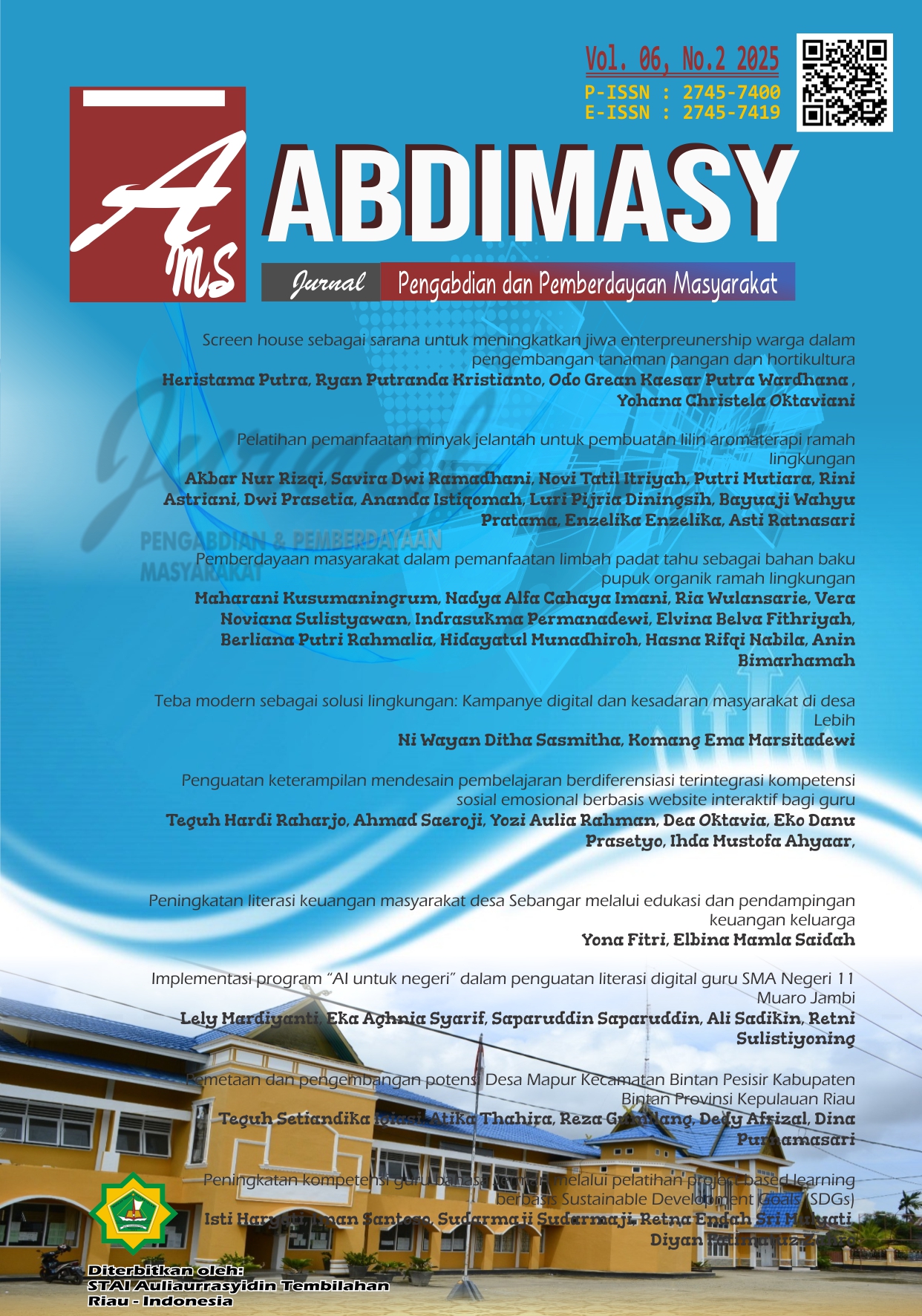
Peningkatan kompetensi guru bahasa Jerman melalui pelatihan project based learning berbasis Sustainable Development Goals (SDGs)
DOI:
https://doi.org/10.46963/ams.v6i2.3437Keywords:
Improving, Competence, German Language Teacher, PjBL, SDGsAbstract
Project-Based Learning (PjBL) is an effective teaching method for empowering learners of the German language. However, not all teachers fully understand how to integrate PjBL within German language learning and connect it to global issues. Therefore, the objectives of this community service activity are: (1) to provide up-to-date knowledge for German language teachers about the PjBL method in German language teaching, (2) to train teachers on how to integrate Sustainable Development Goals (SDGs) through the PjBL method in German language instruction. The activities conducted in this community service program consist of three stages: (1) Explanation of the urgency of SDGs-based PjBL in German language teaching, explanation of SDGs in German language learning, explanation of PjBL in German language teaching, and (2) Drafting SDGs-based PjBL lesson plans by German language teachers, (3) Online presentation of the SDGs-based PjBL lesson plan drafts by German language teachers. The outcomes achieved from this community service program are as follows: (1) There were 19 training participants offline and 14 participants online, (2) the participating teachers expanded their understanding of PjBL) and SDGs within the context of teaching the German language, and (3) teachers enhanced their abilities to design and incorporate SDGs-oriented PjBL approaches into German language instruction.
Downloads
References
Bekker, J. G., Craig, I. K., & Pistorius, P. C. (1999). Modeling and Simulation of Arc Furnace Process. ISIJ International, 39(1), 23–32.
Bell, S. (2010). Project-Based Learning for the 21st Century: Skills for the Future. The Clearing House: A Journal of Educational Stra tegies, Issues and Ideas, 83(2), 39–43. https://doi.org/10. 1080/00098650903505415.
Bolsunovskaya, L. M., Phillips, C., Korotchenko, T. V., Matveenko, I. A., Strelnikova, A. B., & Ulyanova, O. S. (2015). Project-based Method in Teaching Foreign Language for Specific Purposes. International Conference for International Education and Cross Cultural Communication. Problems and Solutions (IECC-2015), 215, 176–180. https://doi.org/10.1016/J.SBSPRO.2015.11.615.
Bondar, I. A., Kulbakova, R. I., Svintorzhitskaja, I. A., Pilat, L. P., & Zavrumov, Z. A. (2016). Project-based method as an effective means of interdisciplinary interaction while teaching a foreign language. International Journal of Environmental and Science Education, 11(8), 2123–2133. https://doi.org/10.12973/ijese. 2016.584a
Fragoulis, I. (2009). Project-Based Learning in the Teaching of English as A Foreign Language in Greek Primary Schools: From Theory 143 to Practice. English Language Teaching, 2(1), 113–119. https:// files.eric.ed.gov/fulltext/EJ1083088.pdf
Funke, J.O. (2022). Literature Review of Project-based Learning. Jour nal of Educational Research and Policies, 4(7). https://doi.org/ 10.53469/jerp.2022.04(07).23.
Gilis, N. I., & Winarta, I. K. A. (2019). Pengembangan Pembelajaran Project Based Learning Bermuatan Reflektif Pada Mata Kuliah Penulisan Karya Ilmiah. Journal of Education Technology, 3(4), 286–292. https://doi.org/10.23887/jet.v3i4.22365.
Hager, M. (2010). Using Projects to Teach Professional German. Glo bal Businnes Languages, 10(May).
Hiasa, F., & Supadi, S. (2020). Penerapan Model Pembelajaran Project Based Learning dalam Meningkatkan Hasil Belajar Matakuliah Sastra Bandingan Program Studi Pendidikan Bahasa Indonesia FKIP Universitas Bengkulu. Diksa : Pendidikan Bahasa Dan Sas tra Indonesia, 6(1), 1–11. https://doi.org/10.33369/DIKSA. V6I1.9476.
Kokotsaki, D., Menzies, V., & Wiggins, A. (2016). Project-based learn ing: A review of the literature. Improving Schools, 19(3), 267 277. https://doi.org/10.1177/1365480216659733.
Krumm, H.-J. (1991). Unterrichtsprojekte – praktisches Lernen im Deutschunterricht. Fremdsprache Deutsch - Zeitschrift Für Den Praxis Des Deutschunterrichts: Unterrichtsprojekte., 4(April).
Syakur, A., Musyarofah, L., Sulistiyaningsih, S., & Wike, W. (2020). The Effect of Project Based Learning (PjBL) Continuing Learning Innovation on Learning Outcomes of English in Higher 144 Education. Budapest International Research and Critics in Linguistics and Education (BirLE) Journal, 3(1), 625–630. https://doi.org/10.33258/BIRLE.V3I1.860.
Tamim, S.R., & Grant, M.M. 2013. Definitions and uses: Case study of teachers implementing project-based learning. Interdisciplinary Jour nal of Problem-Based Learning, 7(2).
Vaca Torres & Gómez Rodríguez. 2017. Increasing EFL Learners’ Oral Production at a Public School Through Project-Based Learning. PROFILE. Vol 19 (2): 57-71.
Velasco Moreno, M.I. (2023). On project based learning approach and future foreign language teachers. HUMAN REVIEW. Interna tional Humanities Review/Revista Internacional de Humani dades, 17(1), 1–8. https://doi.org/10.37467/REVHUMAN.V12. 4719.
Yin, E.L., & Huat, K.T. (2021). Project Based Learning in Teaching Man darin as Foreign Language: Theory to Practice. International Journal of Academic Research in Business and Social Sciences, 11(4), 542–551. https://doi.org/10.6007/ijarbss/v11-i4/9699. 49(1), 183–196. https://doi.org/10.14746/gl.2022.49.1.11
Downloads
Published
Issue
Section
License
Copyright (c) 2025 Isti Haryati, Iman Santoso, Sudarmaji Sudarmaji, Retna Endah Sri Mulyati, Diyan Fatimatuz Zahro

This work is licensed under a Creative Commons Attribution-ShareAlike 4.0 International License.
Authors who publish with this journal agree to the following terms:
1. Copyright on any article is retained by the author(s).
2. The author grants the journal, right of first publication with the work simultaneously licensed under a Creative Commons Attribution shareAlike 4.0 International License that allows others to share the work with an acknowledgment of the work’s authorship and initial publication in this journal.
3. Authors are able to enter into separate, additional contractual arrangements for the non-exclusive distribution of the journal’s published version of the work (e.g., post it to an institutional repository or publish it in a book), with an acknowledgment of its initial publication in this journal.
4. Authors are permitted and encouraged to post their work online (e.g., in institutional repositories or on their website) prior to and during the submission process, as it can lead to productive exchanges, as well as earlier and greater citation of published work.
5. The article and any associated published material is distributed under the Creative Commons Attribution-ShareAlike 4.0 International License


2.png)