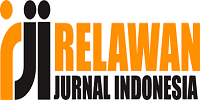
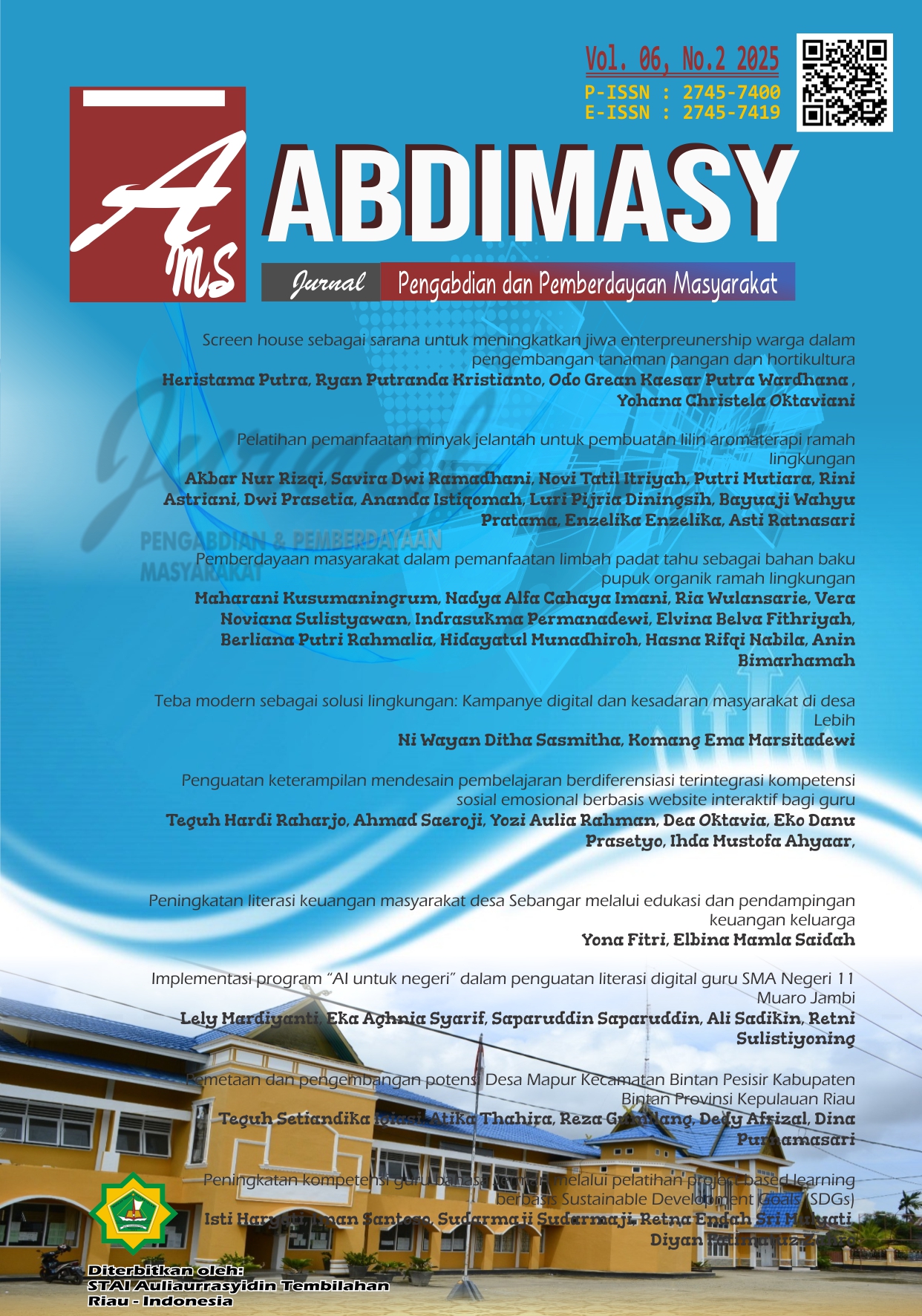
Teba modern sebagai solusi lingkungan: Kampanye digital dan kesadaran masyarakat di desa Lebih
DOI:
https://doi.org/10.46963/ams.v6i2.3192Keywords:
Community Service, Organic Waste, Modern Teba, Lebih Village, SocializationAbstract
This community engagement program aims to enhance the understanding and awareness of residents in Desa Lebih, Gianyar Regency, regarding organic waste management rooted in local wisdom through the implementation of Teba Modern. The program adopts a participatory communication approach that positions community members as active subjects in the educational process. This approach was operationalized through the involvement of residents as talents in the production of an educational video, as well as through a socialization forum and dialogue-based discussion that facilitated two-way communication. These strategies enabled environmental messages to be co-constructed with the community, drawing on their lived experiences and everyday practices, thereby increasing message receptivity. The effectiveness of the program was evaluated using pre-test and post-test instruments administered to 11 respondents. Findings indicate an increase in the average score from 6.4 (“Fair Understanding”) to 11.3 (“Good Understanding”), with all respondents demonstrating improved comprehension. These results suggest that a participatory approach is effective in strengthening organic waste literacy and fostering community readiness to adopt Teba Modern as a sustainable effort to reduce the burden on TPA (final waste disposal sites).
Downloads
References
Marsitadewi, K. E., Sudemen, I. W., & Antarini, L. (2021). Respon masyarakat terhadap program Tempat Olah Sampah Setempat (TOSS) di Desa Gunaksa, Kabupaten Klungkung. Journal of Contemporary Public Administration, 1(2), 65–70. https://doi.org/10.22225/jcpa.1.2.4322.65-70
Melkote, S. R., & Steeves, H. L. (2001). Communication for Development in the Third World: Theory and Practice for Empowerment. SAGE Publications.
Rappaport, J., & Seidman, E. (2000). Handbook of Community Psychology. Springer.
Servaes, Jan. (1996). Communication for Development and Social Change. SAGE Publications.
Simamora, I. Y., dkk. (2025). Penerapan Konsep Komunikasi Partisipatif pada Pembangunan di Indonesia. Jurnal Ilmu Komunikasi, Administrasi Publik dan Kebijakan Negara, 2(3), 180-191.
https://ejournal.appisi.or.id/index.php/Komunikasi/issue/view/31
Sudarta, W. (2024, Desember 19). Program Teba Modern (Boiz) di Wilayah Desa Gunaksa. Gunaksa.desa.id. Retrieved May 1, 2025, from https://gunaksa.desa.id/artikel/2024/12/19/program-teba-modern-boiz-di-wilayah-desa-gunaksa
Suwardana, G. (2018). Tantangan pengelolaan sampah di Bali: Antara pariwisata dan kesadaran lingkungan. Jurnal Ekologi Tropis, 9(2), 112–126.
Utari, C. I. A. C. (2021). Perubahan fungsi teba di pekarangan Desa Nyuh Kuning. Jurnal Arsitektur Lansekap, 7(2), 263–272.
Wibawa, I. M., Santika, N. P., & Adnyana, I. G. (2021). Pemanfaatan teba modern dalam pengelolaan sampah berbasis kearifan lokal di Bali. Jurnal Teknologi Hijau, 7(3), 78–91.
Downloads
Published
Issue
Section
License
Copyright (c) 2025 Ni Wayan Ditha Sasmitha, Komang Ema Marsitadewi

This work is licensed under a Creative Commons Attribution-ShareAlike 4.0 International License.
Authors who publish with this journal agree to the following terms:
1. Copyright on any article is retained by the author(s).
2. The author grants the journal, right of first publication with the work simultaneously licensed under a Creative Commons Attribution shareAlike 4.0 International License that allows others to share the work with an acknowledgment of the work’s authorship and initial publication in this journal.
3. Authors are able to enter into separate, additional contractual arrangements for the non-exclusive distribution of the journal’s published version of the work (e.g., post it to an institutional repository or publish it in a book), with an acknowledgment of its initial publication in this journal.
4. Authors are permitted and encouraged to post their work online (e.g., in institutional repositories or on their website) prior to and during the submission process, as it can lead to productive exchanges, as well as earlier and greater citation of published work.
5. The article and any associated published material is distributed under the Creative Commons Attribution-ShareAlike 4.0 International License
2.png)