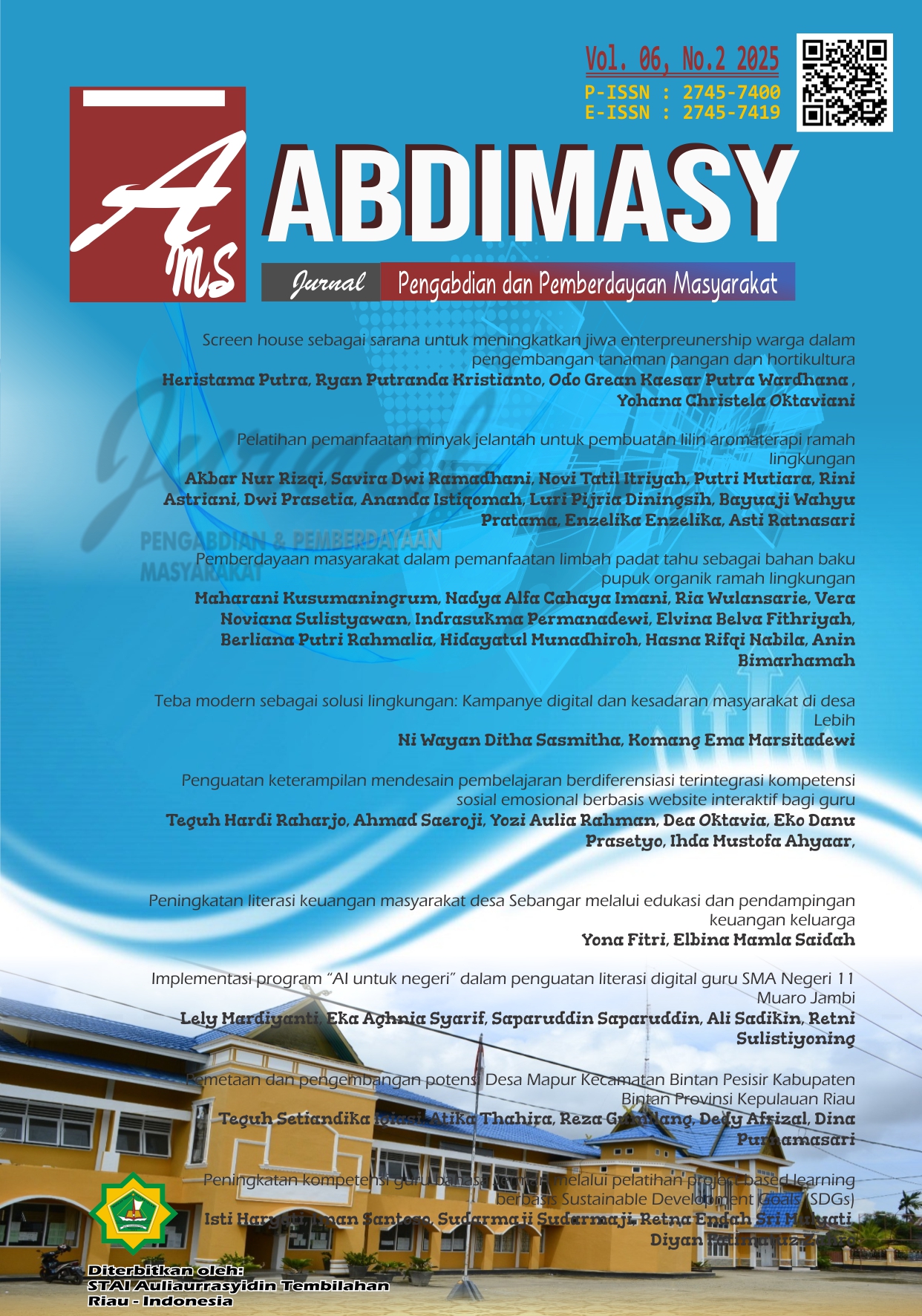
Penguatan keterampilan mendesain pembelajaran berdiferensiasi terintegrasi kompetensi sosial emosional berbasis website interaktif bagi guru
DOI:
https://doi.org/10.46963/ams.v6i2.3032Keywords:
Differentiated Learning, Social Emotional Competence, Interactive WebsiteAbstract
There are two main aspects of the problems faced by MGMP MPLB teachers in Semarang City that urgently need to be resolved, namely; (1) low conceptual and practical knowledge of teachers related to integrated differentiated learning design for Social Emotional Competence (KSE); and (2) minimal teacher literacy in utilizing digital tools in creating interactive learning websites and Artificial Intelligence as a tool in compiling interactive learning media. The solutions offered to solve these problems are (1) Socialization of the concept of integrated differentiated learning design for KSE; (2) Training in compiling integrated differentiated learning teaching modules for KSE; (3) Training in creating interactive learning websites using Google Sites; (4) Training in creating assignments and educational games along with evaluation instruments using eduaide.ai; (5) Training in creating learning podcasts using Google NotebookLM; (6) Training in creating learning videos using pictory.ai; (7) Training in creating learning comics using comicai.ai. The implementation methods used in this community service program are in the form of socialization, training, and mentoring and evaluation. The main achievements of this program are reflected in the substantial increase in teacher knowledge and skills. The evaluation results showed that there was a significant increase in the average teacher knowledge score from pre-test to post-test, indicating the effectiveness of the comprehensive training method.
Downloads
References
Afya, Z. V, Sahari, S., Widodo, A., Guru, P., Dasar, S., & Kediri, K. (2024). Pengembangan Modul Ajar Berdiferensiasi. 8(2), 280–289.
Andini, F., Waspada, I., Budiwati, N., & Susanto, S. (2023). Peran Guru Dengan Kompetensi Sosial Emosional Dalam Implementasi Pembelajaran Berdiferensiasi Untuk Membangun Student Well-Being Pada Sekolah Menengah. Jurnal Sosial Humaniora Sigli, 6(1), 175–182. https://doi.org/10.47647/jsh.v6i1.1490
Budi, S. S., Suhaili, N., & Irdamurni, I. (2021). 199-493-1-Pb. Journal of Educational and Learning Studies, 4(2), 232–236.
Coghlan, D., & Brydon-Miller, M. (2014). Participatory Rural Appraisal. The SAGE Encyclopedia of Action Research. https://doi.org/10.4135/9781446294406.n268
Dung, D. T. (2022). Social and emotional competence: the concept evolution and the shift in education. Vietnam Journal of Educational Sciences, 18(4), 72–80. https://doi.org/10.15625/2615-8957/22211007
Febrian, M. A., Irwan, M., & Nasution, P. (2024). Efektivitas Penggunaan Google Sites Sebagai Media Pembelajaran Kolaboratif : Perspektif Teoritis dan Praktis. Jurnal Pendidikan, 11(2), 152–159.
Flynn, K. S., Li, L., Huang, C.-W., Patel, R., Luttgen, K., Yang, S., & Chow, E. (2024). Leveraging technology to address social-emotional learning during the pandemic: Findings from an efficacy trial. Social and Emotional Learning: Research, Practice, and Policy, 4(August 2023), 100045. https://doi.org/10.1016/j.sel.2024.100045
Haeri, I. Z., & Afriansyah, A. (2024). Eksplorasi Beban Digital Guru : Survei Pemanfaatan Platform of Platform Merdeka Mengajar ( PMM ) by Teachers Pendahuluan Platform Merdeka Mengajar ( PMM ) merupakan media edukasi yang dikembangkan. 15(2).
Kamilah, S. F., Wahyuni, I., & Ratnasari, D. (2023). Pengembangan Media Pembelajaran Interaktif Berbasis Website Menggunakan Google Sites Pada Materi Ekosistem Kelas X SMA. Biodik, 9(3), 176–181. https://doi.org/10.22437/biodik.v9i3.25523
Lilin Marisa, Joko Raharjo, T., & Wardani, S. (2024). Pengembangan Modul Ajar IPAS Berbasis Pembelajaran Berdiferensiasi Terintegrasi Kompetensi Sosial Emosional. Elementary School Education Journal, 8(1), 61–72.
Mahrani, K. H., Falatena, A., & Wahyunengsih, W. (2022). The Effectiveness of Learning Media Digitalization on Increasing Independent for Indonesian Millenial Learners. International Journal Pedagogy of Social Studies, 7(2), 1–8. https://doi.org/10.17509/ijposs.v7i2.51807
Purba, M., Purnamasari, N., Soetantyo, S., Suwarma, I. R., & Susanti, E. I. (2021). Prinsip Pengembangan Pembelajaran Berdiferensiasi (Differentiated Instruction). In Pusat Kurikulum dan Pembelajaran Badan Standar, Kurikulum, dan Asesmen Pendidikan Kementerian Pendidikan, Kebudayaan, Riset, dan Teknologi.
Rafli, M. F., Sari, C. K., Syarah, M., Studi, P., Guru, P., Dasar, S., & Samudra, U. (2023). Pelatihan Penyusunan Modul Ajar Berdiferensiasi Berbasis Digital Dalam Upaya Implementasi Kurikulum Merdeka Dalam Komunitas Belajar Sekolah Dasar. 4(5), 650–657.
Rasheed, F., & Wahid, A. (2018). The Theory of Differentiated Instruction and Its Applicability: An E-Learning Perspective. VSRD International Journal of Technical and Non-Technical Research, 9(4), 193–202. https://www.researchgate.net/publication/324843878
Widagdo, A. K., Handajani, S., Astuti, N., Aini, A. N., Yuliana, S., & Bahar, A. (2023). Guided Demonstration Method to Improve Students’ Skills in Processing Banana. TEKNOBUGA: Jurnal Teknologi Busana Dan Boga, 11(2), 92–97. https://doi.org/10.15294/teknobuga.v11i2.43463
Zuhro, N. S., Rasmani, U. E. E., Wahyuningsih, S., Fitrianingtyas, A., Nurjanah, N. E., Jumiatmoko, J., & Winarji, B. (2023). Penerapan KSE dalam Pembelajaran Berdiferensiasi pada Sekolah Penggerak di Kota Surakarta. Jurnal Obsesi : Jurnal Pendidikan Anak Usia Dini, 7(4), 4937–4945. https://doi.org/10.31004/obsesi.v7i4.4991
Downloads
Published
Issue
Section
License
Copyright (c) 2025 Teguh Hardi Raharjo, Ahmad Saeroji, Yozi Aulia Rahman, Dea Oktavia, Eko Danu Prasetyo, Ihda Mustofa Ahyaar

This work is licensed under a Creative Commons Attribution-ShareAlike 4.0 International License.
Authors who publish with this journal agree to the following terms:
1. Copyright on any article is retained by the author(s).
2. The author grants the journal, right of first publication with the work simultaneously licensed under a Creative Commons Attribution shareAlike 4.0 International License that allows others to share the work with an acknowledgment of the work’s authorship and initial publication in this journal.
3. Authors are able to enter into separate, additional contractual arrangements for the non-exclusive distribution of the journal’s published version of the work (e.g., post it to an institutional repository or publish it in a book), with an acknowledgment of its initial publication in this journal.
4. Authors are permitted and encouraged to post their work online (e.g., in institutional repositories or on their website) prior to and during the submission process, as it can lead to productive exchanges, as well as earlier and greater citation of published work.
5. The article and any associated published material is distributed under the Creative Commons Attribution-ShareAlike 4.0 International License


2.png)