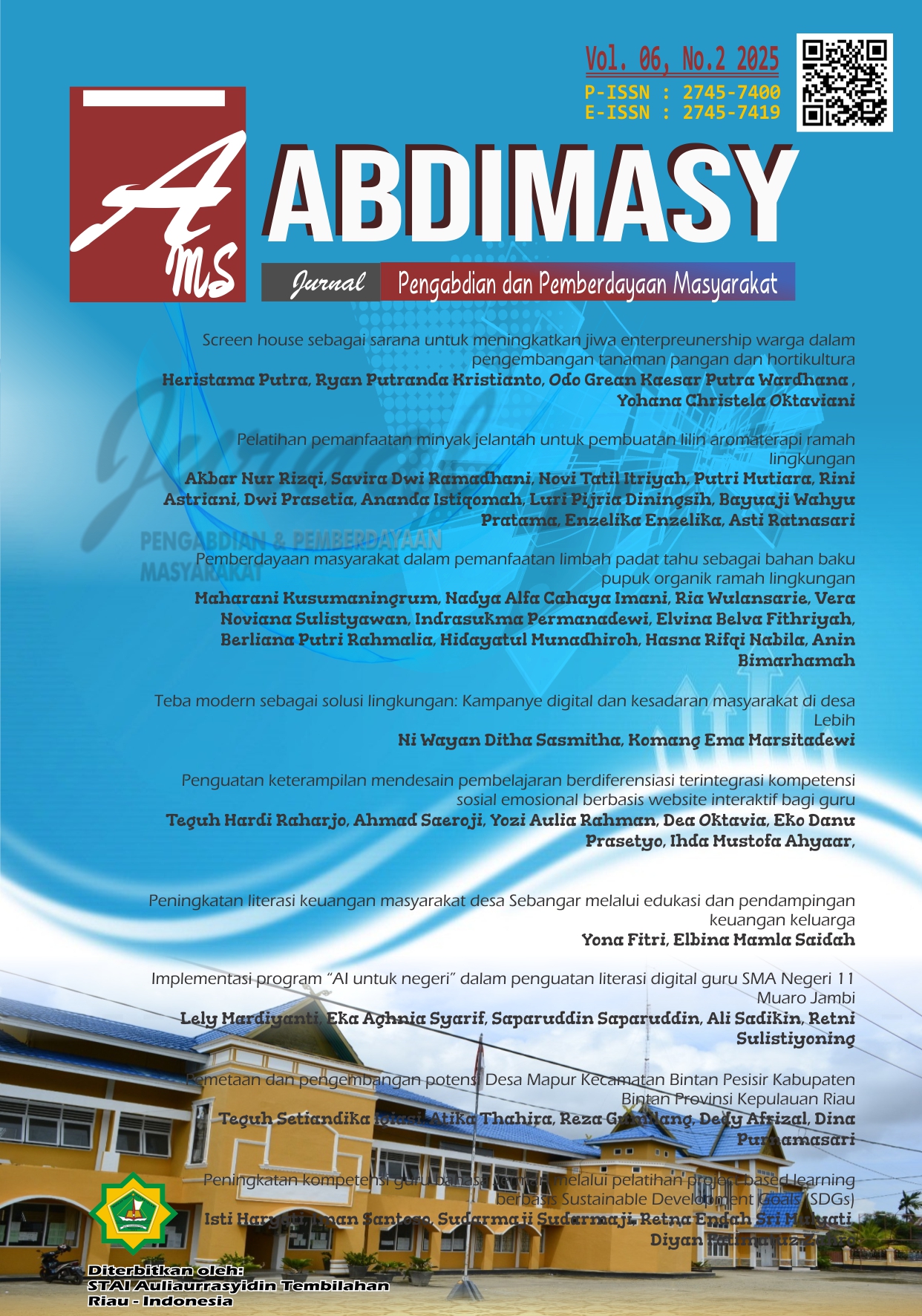
Pelatihan pemanfaatan minyak jelantah untuk pembuatan lilin aromaterapi ramah lingkungan
DOI:
https://doi.org/10.46963/ams.v6i2.2650Keywords:
Jelantah Oil, Aromatherapy Candles, Training, Community Empowerment, Waste ManagementAbstract
Jelantah oil is a kind of home and industrial waste often discarded without adequate processing, hence posing a risk of environmental pollution and jeopardising human health. This community service initiative seeks to train the Family Welfare Empowerment (PKK) group in Cangkring Hamlet, Sidomulyo Village, Bantul, on the use of recycled cooking oil as a raw material for producing aromatherapy candles. This activity employs demonstration-based instruction, including five primary stages: (1) identification, (2) organisation, (3) counselling, (4) demonstration, and (5) autonomous practice. This course equips participants with knowledge on the detrimental effects of spent cooking oil and procedures for purifying oil, blending it with stearin, including colours and essential oils, culminating in the moulding and packing of candles. The activity yielded 60 high-quality aromatherapy candles characterised by a prolonged fragrance and consistent combustion. Moreover, the participants shown considerable excitement for the training and recognised the economic and environmental advantages of the generated items. This program aims to enable the autonomous application of learnt skills and foster a community-based business potential for more sustainable waste oil management.
Downloads
References
Agarwal, P., Sebghatollahi, Z., Kamal, M., Dhyani, A., Shrivastava, A., Singh, K. K., Sinha, M., Mahato, N., Mishra, A. K., & Baek, K.-H. (2022). Citrus Essential Oils in Aromatherapy: Therapeutic Effects and Mechanisms. Antioxidants, 11(12), 2374. https://doi.org/10.3390/antiox11122374
Aini, D. N., Arisanti, D. W., Fitri, H. M., & Safitri, L. R. (2020). Pemanfaatan Minyak Jelantah Untuk Bahan Baku Produk Lilin Ramah Lingkungan Dan Menambah Penghasilan Rumah Tangga Di Kota Batu. Warta Pengabdian, 14(4), 253. https://doi.org/10.19184/wrtp.v14i4.18539
Banerjee, S., Rout, A., & Mishra, N. (2021). Aromatherapy and its benefits. In P. Bhadra & S. Parida (Eds.), Aromatherapy and its benefits (p. 119). Renu Publishers.
Chang, K.-M., & Shen, C.-W. (2011). Aromatherapy Benefits Autonomic Nervous System Regulation for Elementary School Faculty in Taiwan. Evidence-Based Complementary and Alternative Medicine, 2011(1). https://doi.org/10.1155/2011/946537
Dewi, I. P. (2013). Aromaterapi lavender sebagai media relaksasi. Farmasi Fakultas Kedokteran Universitas Udayana, 2(1), 21–53.
Dhany, A. L., Mitchell, T., & Foy, C. (2012). Aromatherapy and Massage Intrapartum Service Impact on Use of Analgesia and Anesthesia in Women in Labor: A Retrospective Case Note Analysis. The Journal of Alternative and Complementary Medicine, 18(10), 932–938. https://doi.org/10.1089/acm.2011.0254
Kusnadi, E. (2018). Studi potensi pencemaran lingkungan akibat limbah minyak jelantah di kota Banda Aceh. UIN Ar-Raniry Banda Aceh.
Sanli, H., Canakci, M., & Alptekin, E. (2011). Characterization of Waste Frying Oils Obtained from Different Facilities.
Setiati, N. W. (2019). Efektivitas pemberian aromaterapi lavender untuk menurunkan kecemasan ibu hamil trimester III dalam persiapan menghadapi persalinan di Bidan Praktek Mandiri Nurussyifa Kecamatan Buniseuri Ciamis. Jurnal Kesehatan Bakti Tunas Husada: Jurnal Ilmu-Ilmu Keperawatan, Analis Kesehatan Dan Farmasi, 19(1).
Udayani, N. N. W., Meriyani, H., & Adrianta, K. A. (2017). Efektivitas bunga kenanga (Cananga odorata Hook.f & Th) sebagai hepatoprotektor pada tikus putih (Rattus norvegicus) yang diinduksi carbon tetra chloride. Jurnal Ilmiah Medicamento, 3(2). https://doi.org/10.36733/medicamento.v3i2.902
Wahyuni, S., & Rojudin, R. (2021). Pemanfaatan minyak jelantah dalam pembuatan lilin aromaterapi. Proceedings UIN Sunan Gunung Djati Bandung, 1(54), 1–7.
Wardani, D. T. K., Saptutyningsih, E., & Fitri, S. A. (2021). Ekonomi Kreatif: Pemanfaatan Limbah Jelantah untuk Pembuatan Lilin Aromaterapi. Prosiding Seminar Nasional Program Pengabdian Masyarakat. https://doi.org/10.18196/ppm.32.224
Downloads
Published
Issue
Section
License
Copyright (c) 2025 Akbar Nur Rizqi, Savira Dwi Ramadhani, Novi Tatil Itriyah, Putri Mutiara, Rini Astriani, Dwi Prasetia, Ananda Istiqomah, Luri Pijria Diningsih, Bayuaji Wahyu Pratama, Enzelika Enzelika, Asti Ratnasari

This work is licensed under a Creative Commons Attribution-ShareAlike 4.0 International License.
Authors who publish with this journal agree to the following terms:
1. Copyright on any article is retained by the author(s).
2. The author grants the journal, right of first publication with the work simultaneously licensed under a Creative Commons Attribution shareAlike 4.0 International License that allows others to share the work with an acknowledgment of the work’s authorship and initial publication in this journal.
3. Authors are able to enter into separate, additional contractual arrangements for the non-exclusive distribution of the journal’s published version of the work (e.g., post it to an institutional repository or publish it in a book), with an acknowledgment of its initial publication in this journal.
4. Authors are permitted and encouraged to post their work online (e.g., in institutional repositories or on their website) prior to and during the submission process, as it can lead to productive exchanges, as well as earlier and greater citation of published work.
5. The article and any associated published material is distributed under the Creative Commons Attribution-ShareAlike 4.0 International License


2.png)