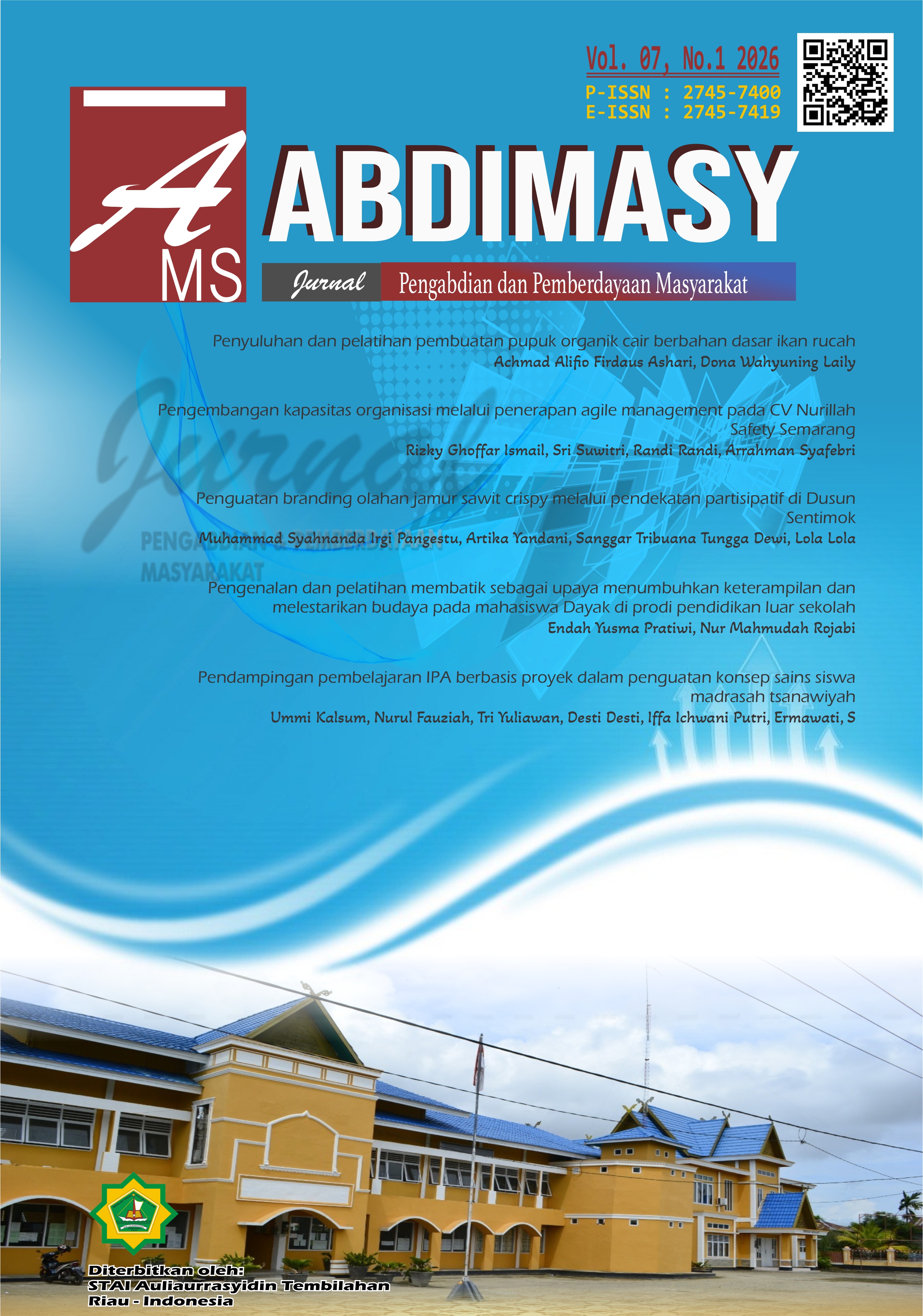
Penyuluhan dan pelatihan pembuatan pupuk organik cair berbahan dasar ikan rucah
DOI:
https://doi.org/10.46963/ams.v7i1.2075Keywords:
Community Service, Counseling, Liquid Organic FertilizerAbstract
Panimbang District is an area with a huge potential for marine nature. The increasing potential of the sea is balanced by the large number of rucah fish. The processing and utilization of rucah fish into liquid organic fertilizer independently is very good for business continuity and sustainability. The method of implementing the activity is carried out with offline activities including counseling and training. The activity was held on May 20, 2024 in Tanjungjaya Village with local community participants with counseling and training activities with BPP Panimbang. The results of the activity showed that many participants were enthusiastic about counseling and training activities on rucah fish processing innovations. Farmers hope that there will be many innovations provided by students and BPP related to the latest innovations that help the community in agricultural activities.
Downloads
References
Armadika, Y. K., Rukin, R., & Setiawan, A. (2025). Strategi pemasaran berkelanjutan berbasis zero waste pada UMKM olahan ikan di sentra ikan kenjeran kota Surabaya. JEB17: Jurnal Ekonomi dan Bisnis, 10(01), 11-22. https://doi.org/10.30996/jeb17.v10i01.13181
Fitria, Y., Ibrahim, B., & Desniar, D. (2008). Pembuatan pupuk organik cair dari limbah cair industri perikanan menggunakan asam Asetat dan EM4 (Effective microorganisme 4). Akuatik: Jurnal Sumberdaya Perairan, 2(1), 23-26. https://www.journal.ubb.ac.id/akuatik/article/view/390
Fitriani, L., Sumsanto, M., Dermawan, A., Dwiyanti, S., & Asri, Y. (2024). Sosialisasi pengelolaan limbah perikanan untuk meningkatkan kesadaran lingkungan di kalangan nelayan di Tanjung Luar, Lombok Timur. Indonesian Journal of Fisheries Community Empowerment (Jurnal Pengabdian Perikanan Indonesia), 4(1), 42-47. https://doi.org/10.29303/jppi.v4i1.6714
Hermawan, Y. E., Herdiana, N., & Susilawati, S. (2020). Karakteristik rusip ikan rucah dengan penambahan konsentrasi gula aren cair dan garam berbeda. Jurnal Teknologi & Industri Hasil Pertanian, 25(2), 120-128. https://doi.org/10.23960/jtihp.v25i2.120-128
Irdiana, E., Nurliza, N., & Kurniati, D. (2023). Keberhasilan penyuluhan melalui karakteristik penyuluh dan petani. Jurnal Agribisnis Indonesia (Journal of Indonesian Agribusiness), 11(2), 247-261. https://ideas.repec.org/a/ags/ipbjia/371667.html
Purnamasari, F., Rosadi, S. H., Bahar, A. S., & Ridwan, W. (2023). Pelatihan pemanfaatan limbah ikan menjadi Pupuk Organik Cair (POC) di Kampung Terapung Danau Tempe, Kabupaten Wajo. ABDIKAN: Jurnal Pengabdian Masyarakat Bidang Sains dan Teknologi, 2(4), 558-565. https://doi.org/10.55123/abdikan.v2i4.2746
Silawati, A., Putri, I. D. K., Chandra, A. B., Pratiwi, W. S. W., Alfisuma, M. Z., & Hafiludin, H. (2024). Pendampingan pembuatan pupuk organik cair dari limbah ikan hasil tangkapan sampingan udang di Desa Tanjung Pademawu. Jurnal Ilmiah Pangabdhi, 10(2), 124-129. https://doi.org/10.21107/pangabdhi.v10i2.23668
Siregar, F. A. (2023). Penggunaan pupuk organik dalam meningkatkan kualitas tanah dan produktivitas tanaman. https://doi.org/10.31219/osf.io/fyz8v
Tanti, N., Nurjannah, N., & Kalla, R. (2019). Pembuatan pupuk organik cair dengan cara Aerob. ILTEK: Jurnal Teknologi, 14(02), 68-73. https://doi.org/10.47398/iltek.v14i2.415
Wijaya M, M., & Syam, H. (2021). Eksplorasi limbah biomassa dan aplikasinya. UPT Badan Penerbit UNM.
Zahroh, F., Kusrinah, K., & Setyawati, S. M. (2018). Perbandingan variasi konsentrasi pupuk organik cair dari limbah ikan terhadap pertumbuhan tanaman cabai merah (Capsicum annum L.). Al-Hayat: Journal of Biology and Applied Biology, 1(1), 50-57. https://doi.org/10.21580/ah.v1i1.2687
Downloads
Published
Issue
Section
License
Copyright (c) 2026 Achmad Alifio Firdaus Ashari, Dona Wahyuning Laily

This work is licensed under a Creative Commons Attribution-ShareAlike 4.0 International License.
Authors who publish with this journal agree to the following terms:
1. Copyright on any article is retained by the author(s).
2. The author grants the journal, right of first publication with the work simultaneously licensed under a Creative Commons Attribution shareAlike 4.0 International License that allows others to share the work with an acknowledgment of the work’s authorship and initial publication in this journal.
3. Authors are able to enter into separate, additional contractual arrangements for the non-exclusive distribution of the journal’s published version of the work (e.g., post it to an institutional repository or publish it in a book), with an acknowledgment of its initial publication in this journal.
4. Authors are permitted and encouraged to post their work online (e.g., in institutional repositories or on their website) prior to and during the submission process, as it can lead to productive exchanges, as well as earlier and greater citation of published work.
5. The article and any associated published material is distributed under the Creative Commons Attribution-ShareAlike 4.0 International License


2.png)